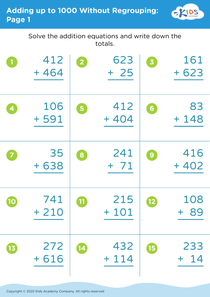
Mathematical reasoning Adding up to 1000 with Regrouping Worksheets for 9-Year-Olds
3 filtered results
-
From - To
Enhance your 9-year-old's mathematical reasoning skills with our engaging worksheets focused on adding up to 1000 through regrouping. These worksheets are designed to foster comprehension and improve problem-solving techniques in subtraction and addition, encouraging students to master complex calculations. By practicing with these carefully curated exercises, children will learn to regroup numbers effectively and build a solid foundation for future math concepts. Our resources not only make learning enjoyable but also reinforce essential mathematically reasoning skills. Dive into our collection and watch your child excel in math confidence and competence while having fun with numbers!
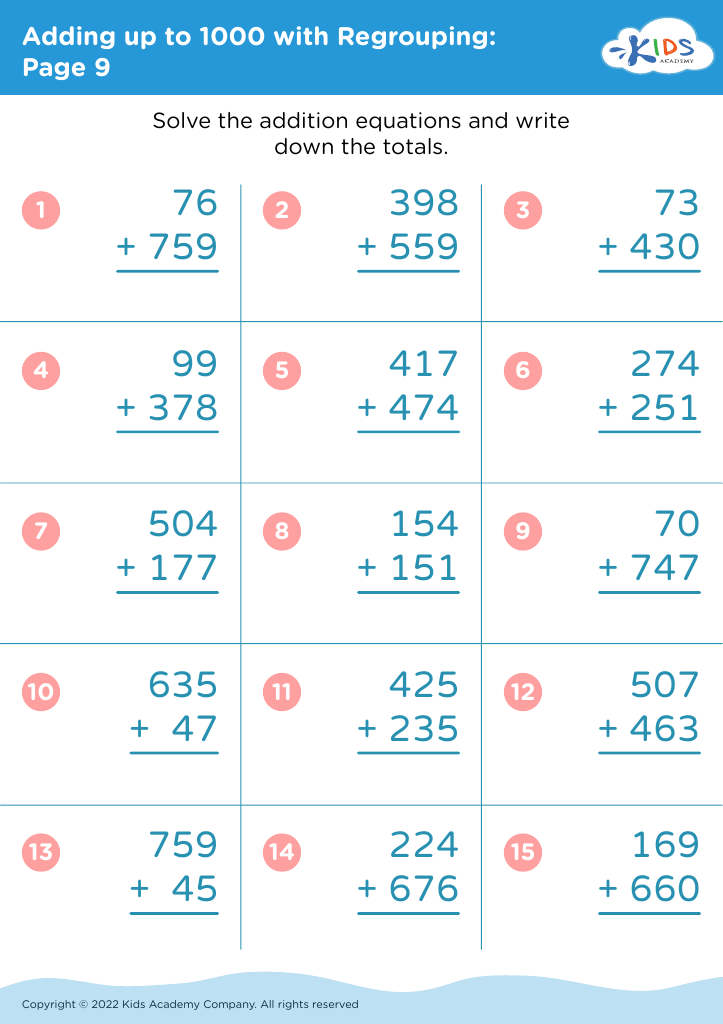
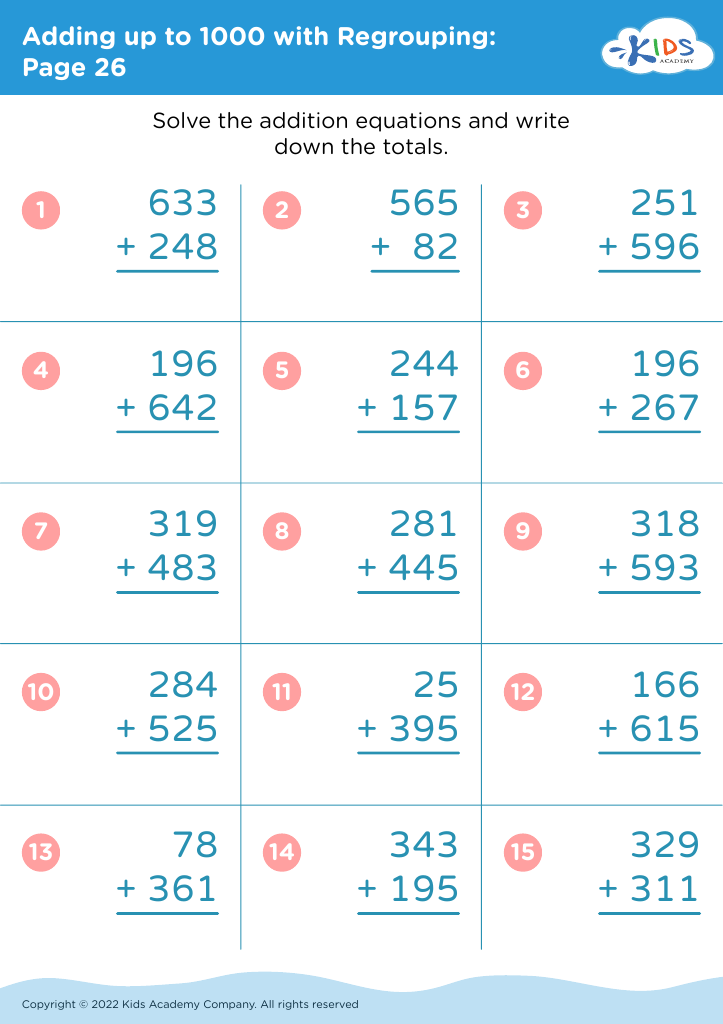
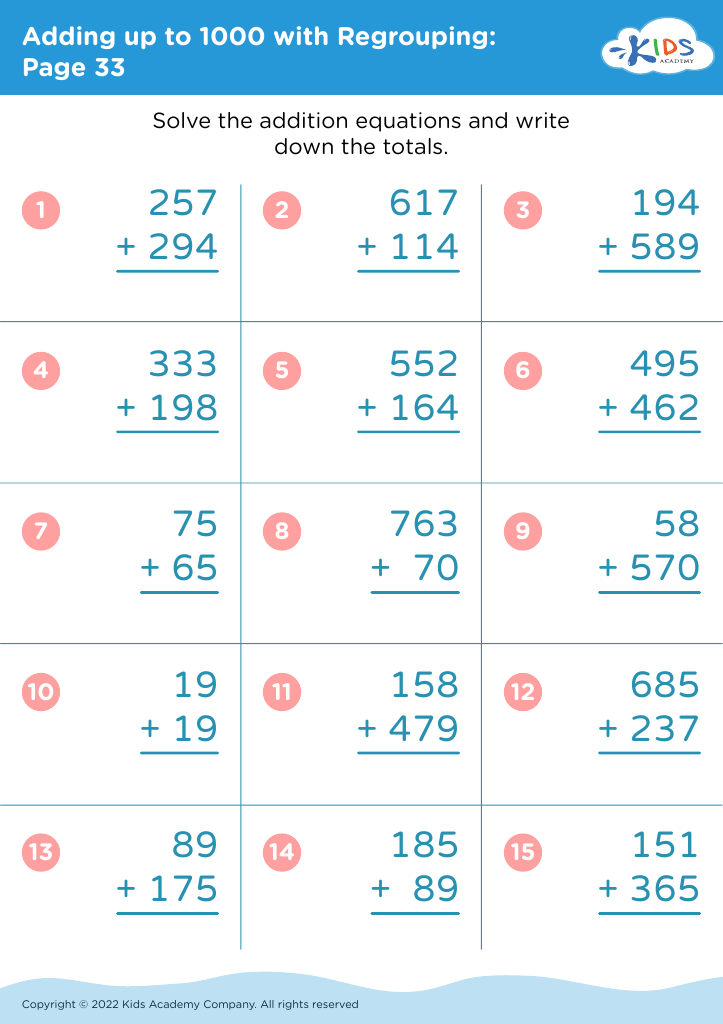


Mathematical reasoning, particularly mastering the concept of adding up to 1000 with regrouping, is foundational for 9-year-olds as it builds essential cognitive skills. At this age, students are transitioning from concrete to more abstract forms of thought, and learning to manipulate numbers through regrouping enhances their problem-solving abilities.
Understanding how to regroup fosters a strong grasp of place value, a critical concept for all future mathematical operations. It empowers children to approach complex problems systematically and increases their confidence when dealing with larger numbers. This skill not only supports success in mathematics but also promotes logical reasoning, allowing students to tackle interdisciplinary challenges in science and engineering.
Additionally, developing mathematical reasoning nurtures perseverance. As children work through regrouping challenges, they learn to approach problems creatively, collaborate with peers, and think critically—skills invaluable throughout their education and beyond. For parents and teachers, supporting this aspect of learning ensures that children are prepared for more advanced topics in math and other subjects while promoting a positive attitude towards math as an enjoyable and relevant part of everyday life. Encouraging mathematical reasoning today lays a strong foundation for tomorrow’s academic success.