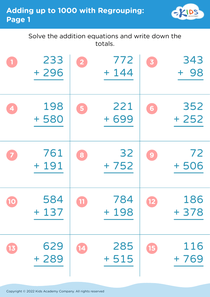
Develop counting skills Adding up to 1000 Without Regrouping Worksheets for 9-Year-Olds
3 filtered results
-
From - To
Help your 9-year-olds enhance their counting skills with our "Adding Up to 1000 Without Regrouping" worksheets. Designed to make learning enjoyable, these worksheets allow young learners to practice addition concepts without the need for regrouping, reinforcing their understanding of numbers and enhancing their mental math capabilities. Each worksheet provides engaging exercises that encourage kids to build confidence in their counting abilities while solving problems up to 1000. Perfect for classroom use or at-home practice, these resources will motivate students while equipping them with essential math skills. Empower your child's learning journey today with our educational worksheets!
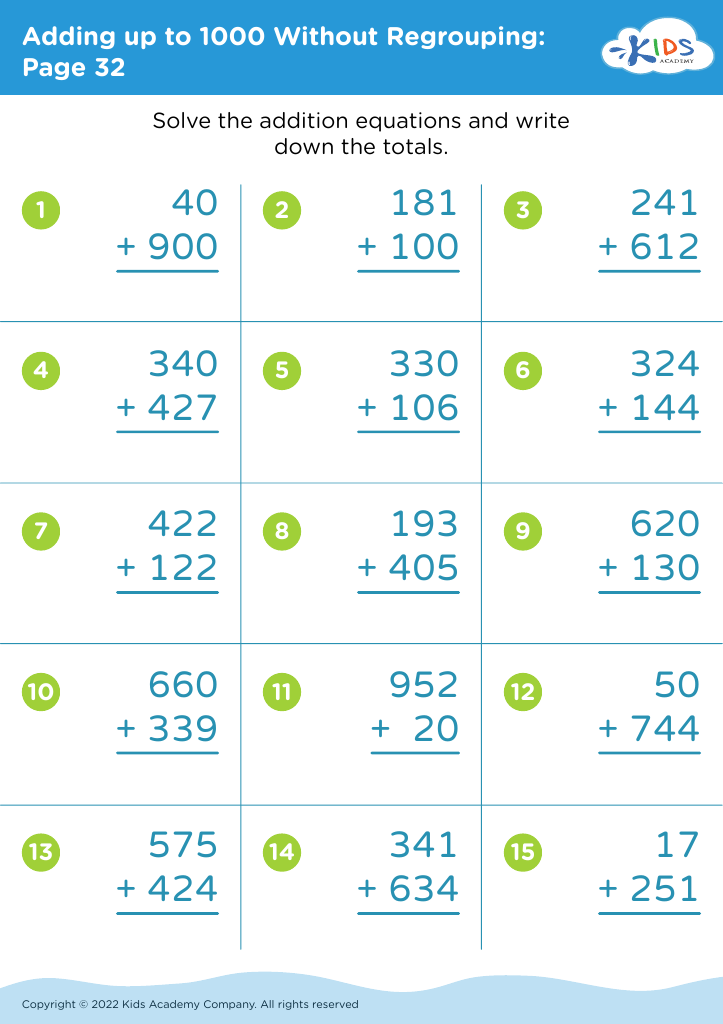
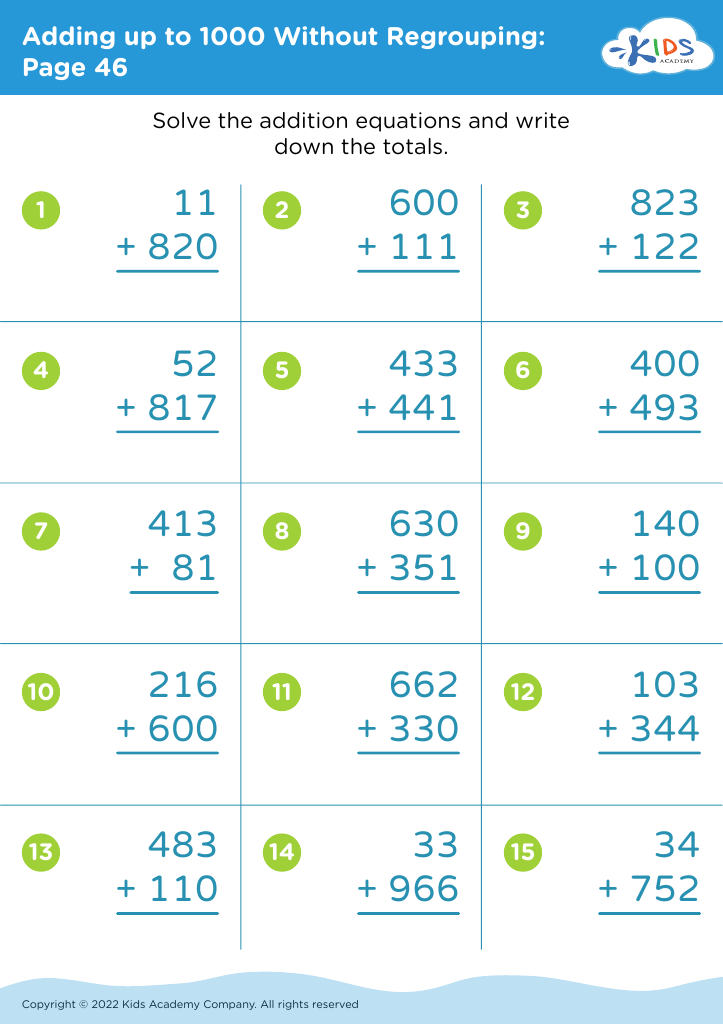
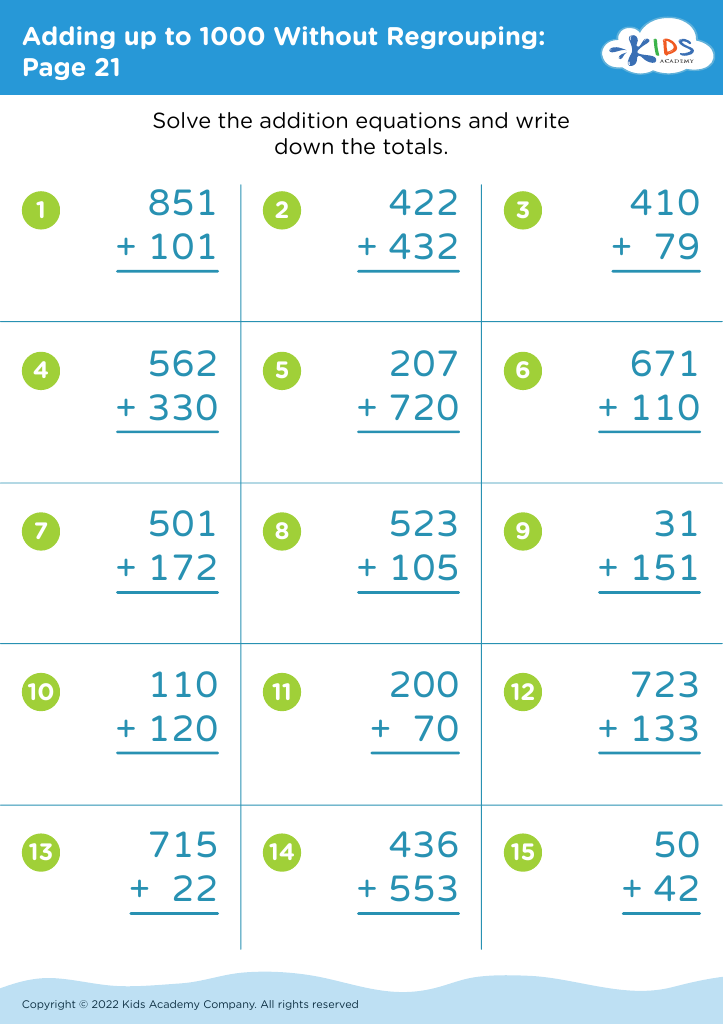


Developing counting skills that include adding up to 1000 without regrouping is crucial for 9-year-olds as it lays a foundation for more advanced mathematical concepts. At this age, children are transitioning from concrete to abstract thinking, and mastering these skills promotes cognitive development. Strong counting abilities enhance a child's confidence in math, encouraging a positive attitude toward the subject.
Understanding how to count and add without regrouping is essential for problem-solving and critical thinking. It enables children to tackle everyday situations, such as shopping or cooking, where they must make quick calculations. Moreover, it serves as a building block for mastering more complex operations, such as multiplication and division, which are integral to the curriculum.
Parents and teachers play a vital role in fostering these skills through engaging activities and practical applications. When children see the relevance of math in real-life contexts, they are more likely to retain and enjoy the learning process. Furthermore, a solid grasp of these foundational skills can aid in ensuring children do not struggle with math later, leading to better academic performance overall. Thus, investing time and effort in developing counting skills is important for every child's long-term success in education.