Improving math skills Adding up to 1000 Without Regrouping Worksheets for 9-Year-Olds
3 filtered results
-
From - To
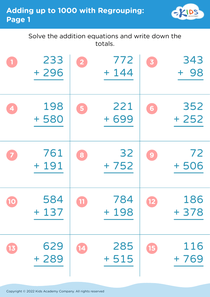
Boost your child's math skills with our "Adding Up to 1000 Without Regrouping" worksheets, specially designed for 9-year-olds! These engaging and educational printable sheets help students practice and improve their addition fluency up to 1000 without the complexity of regrouping. Each worksheet offers a variety of problems that build confidence and enhance arithmetic skills, setting a solid foundation for future math success. Fun and interactive, these resources from Kids Academy make learning enjoyable and effective. Visit our webpage for a wide range of free printable worksheets tailored to support your child's math journey.
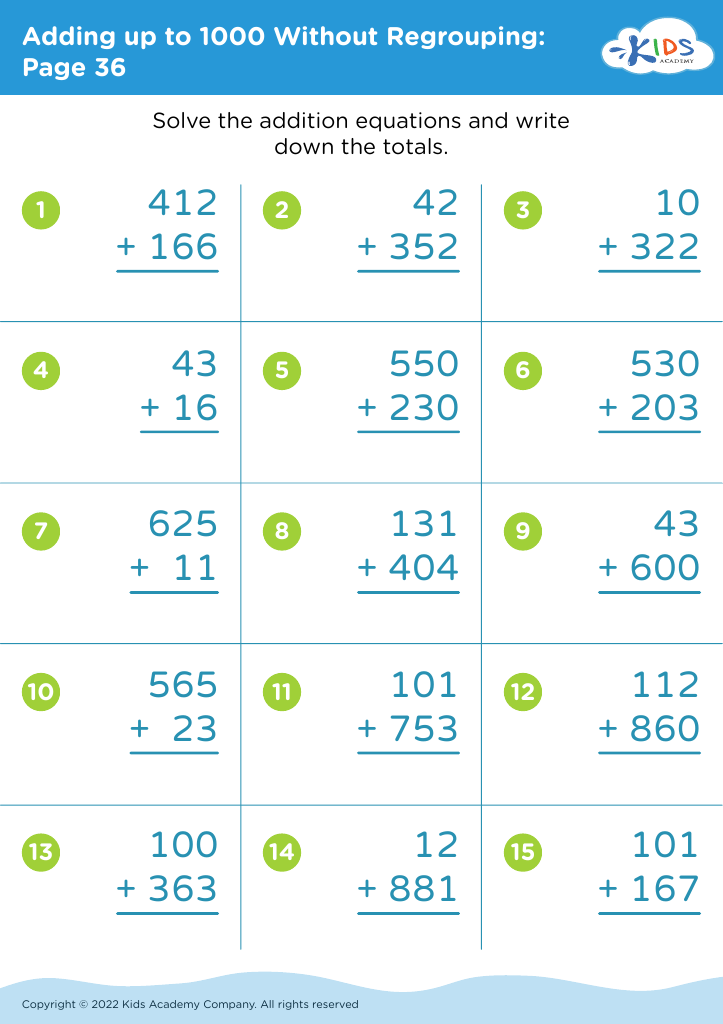
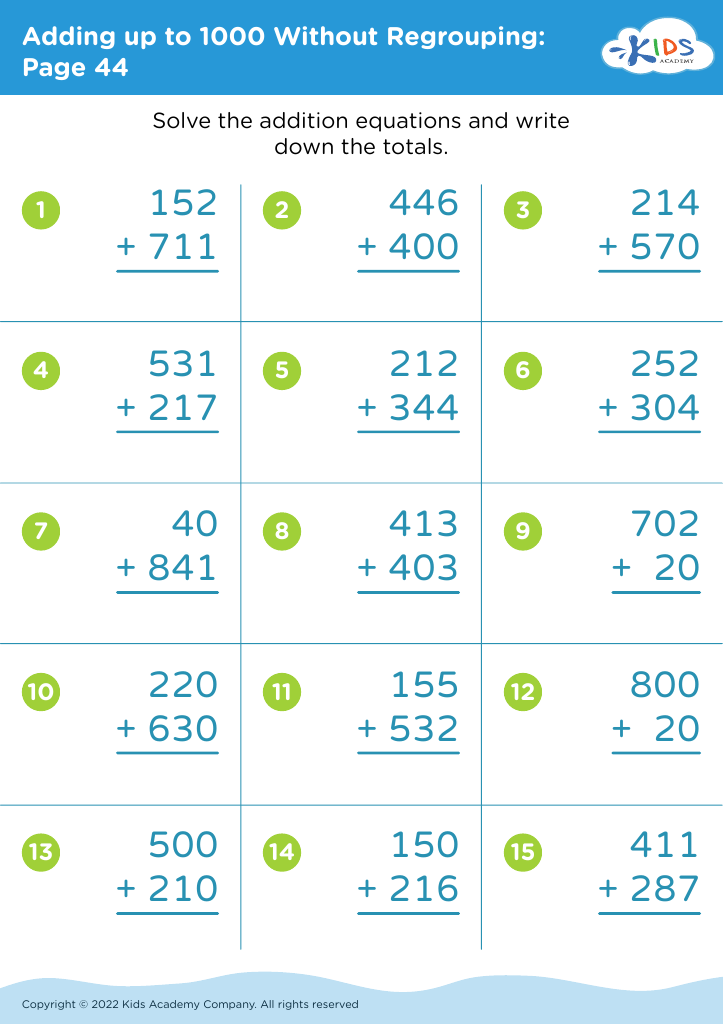
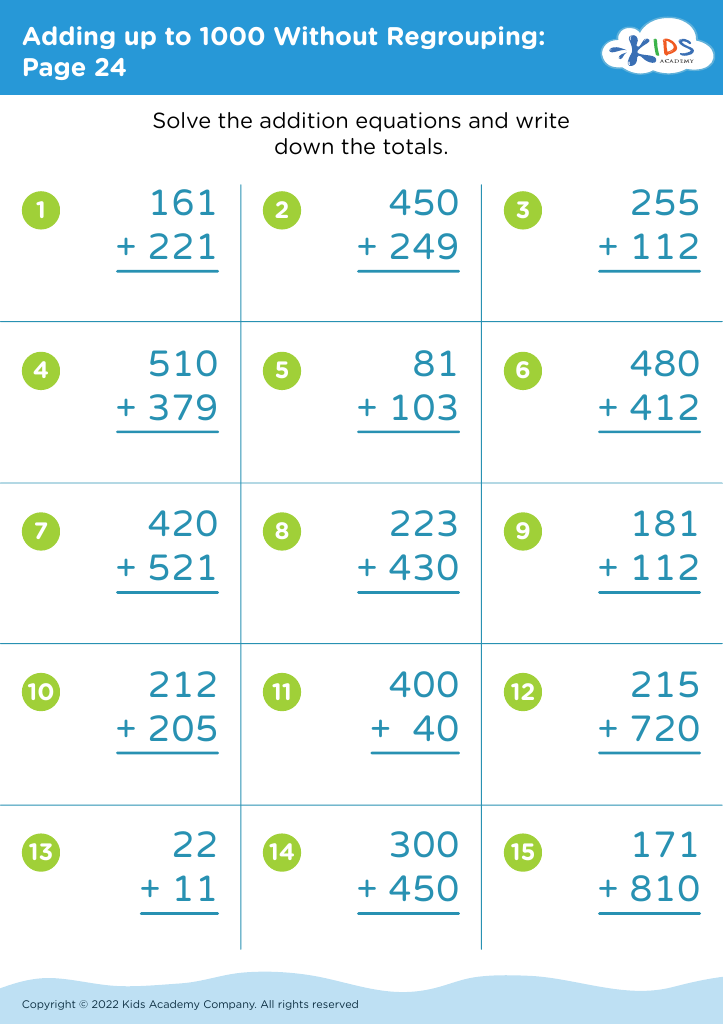


Improving math skills, particularly the ability to add numbers up to 1000 without regrouping, is crucial for 9-year-olds as it lays a strong foundation for their future mathematical learning and daily practical use. At this age, children are transitioning from basic arithmetic to more complex concepts that require a solid understanding of number sense and place value. Mastering addition without regrouping helps these young learners to comprehend how numbers interact and ensures they are clear on the positional value of digits, enhancing their overall computational fluency.
For parents and teachers, nurturing these skills is essential for several reasons. Firstly, it boosts the child's confidence and encourages a positive attitude towards math, making subsequent learning more approachable and enjoyable. Secondly, the cognitive skills developed through such exercises are transferable to other subject areas, fostering critical thinking, problem-solving, and logical reasoning. Equipping children with these essential skills early paves the way for their success not only in mathematics but in practical, everyday tasks such as budgeting or time management.
Moreover, the ability to perform straightforward arithmetic operations efficiently prepares children for standardized tests and academic evaluations, which are often prerequisites for advanced learning opportunities. In essence, fostering these skills is an investment in the child’s academic and real-life success.