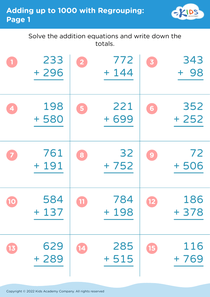
Understanding division Adding up to 1000 Without Regrouping Worksheets for 9-Year-Olds
3 filtered results
-
From - To
Explore our engaging "Understanding Division: Adding Up to 1000 Without Regrouping" worksheets designed specifically for 9-year-olds! These resources seamlessly blend division concepts with addition, helping young learners build a solid foundation in math. Through carefully crafted exercises, children will practice dividing numbers and adding results without regrouping, enhancing both their computational skills and problem-solving abilities. Our worksheets promote independent learning, while fostering confidence in tackling math challenges. Perfect for classroom use or at-home practice, these activities are not only educational but also fun! Help your child excel in mathematics with our comprehensive worksheets tailored to their developmental needs.
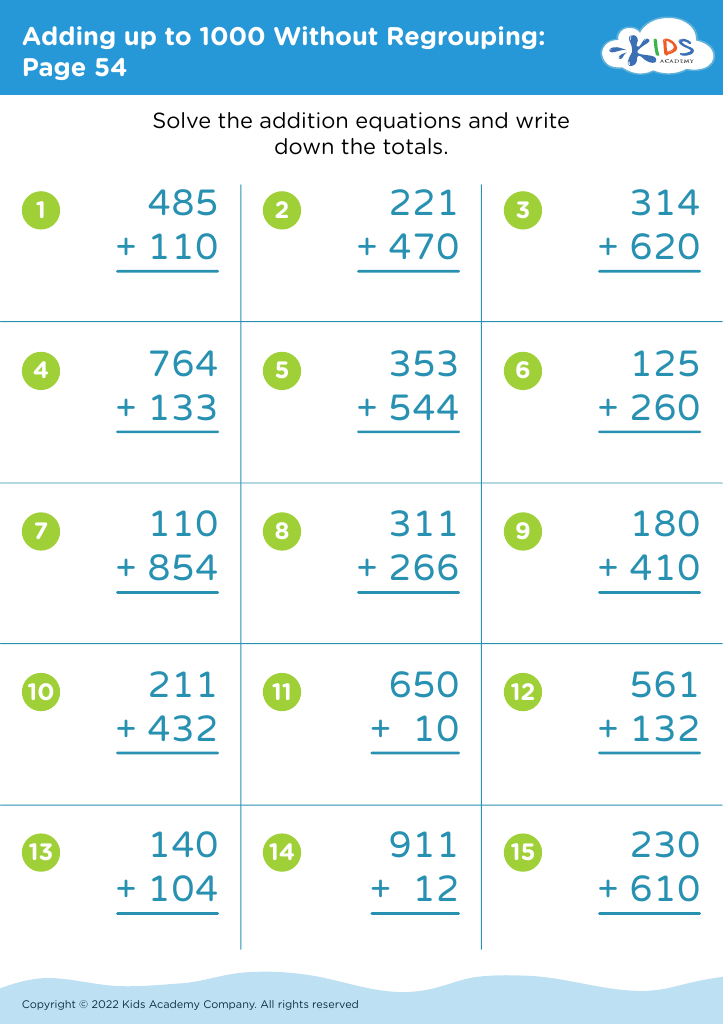
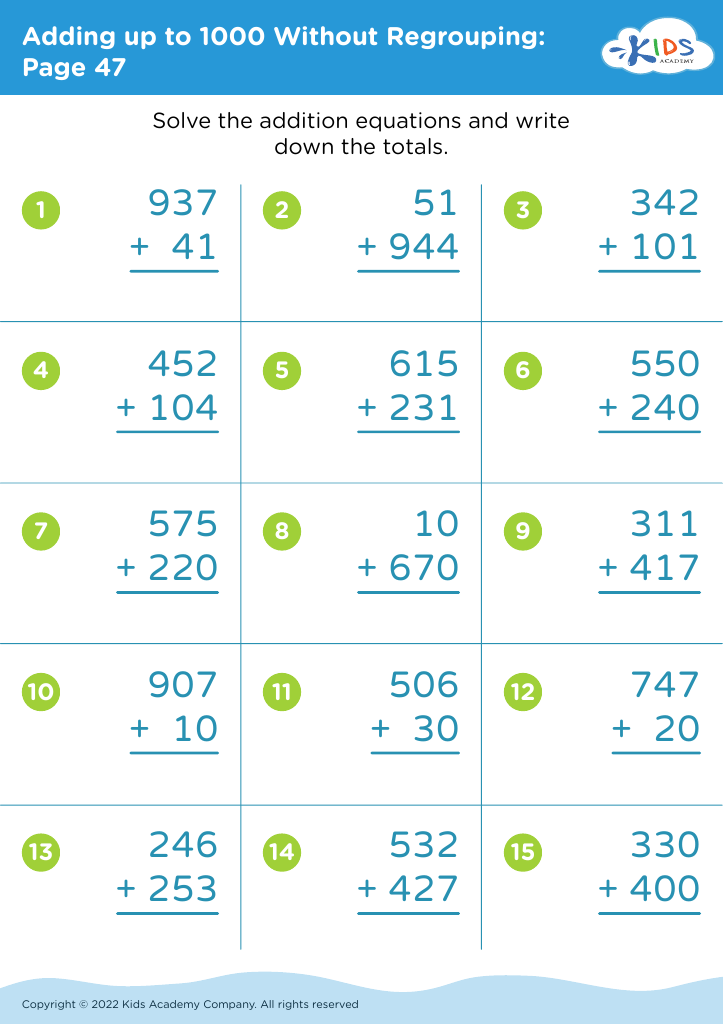
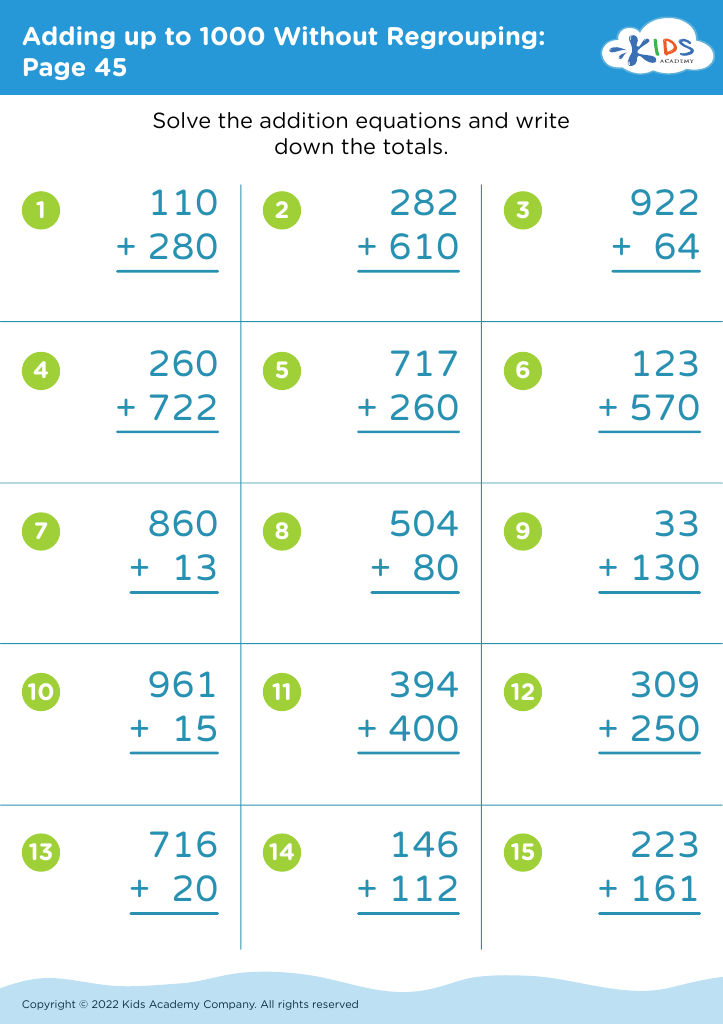


Understanding division and addition concepts, particularly "adding up to 1000 without regrouping," is essential for 9-year-olds as it lays a foundational groundwork for their mathematical skills. Parents and teachers should care about these concepts for several reasons.
Firstly, division helps children grasp the idea of sharing and equal distribution, key concepts in everyday life. It also enhances their problem-solving skills, encouraging logical thinking. For example, when students can divide numbers effectively, they will find it easier to tackle word problems and real-world scenarios.
Adding up to 1000 without regrouping is important as it builds a child’s arithmetic fluency. This skill is fundamental for more complex math topics they'll encounter in the future, such as fractions, decimals, and word problems. Mastery of simple addition promotes confidence, enabling them to approach challenging tasks without fear.
Furthermore, early mastery of these concepts has shown to correlate positively with performance in later mathematics. When students are comfortable with arithmetic operations, it fosters a positive attitude toward math, sharpening their critical thinking abilities, and preparing them for academic success. By prioritizing these learning goals, parents and teachers are nurturing a generation that can approach math with confidence and capability.