Develop critical thinking Adding up to 1000 Worksheets for 9-Year-Olds
3 filtered results
-
From - To
Help your 9-year-old master addition while fostering critical thinking skills with our expertly designed worksheets focused on adding up to 1000. Our engaging and interactive sheets not only reinforce fundamental arithmetic but also promote problem-solving and logical reasoning. Tailored to challenge and inspire, these printable resources are perfect for enhancing math fluency and building confidence in young learners. Watch your child's analytical skills blossom as they navigate through creative exercises that make learning fun and effective. Ideal for both classroom and at-home use, these worksheets are a must-have tool for math education.
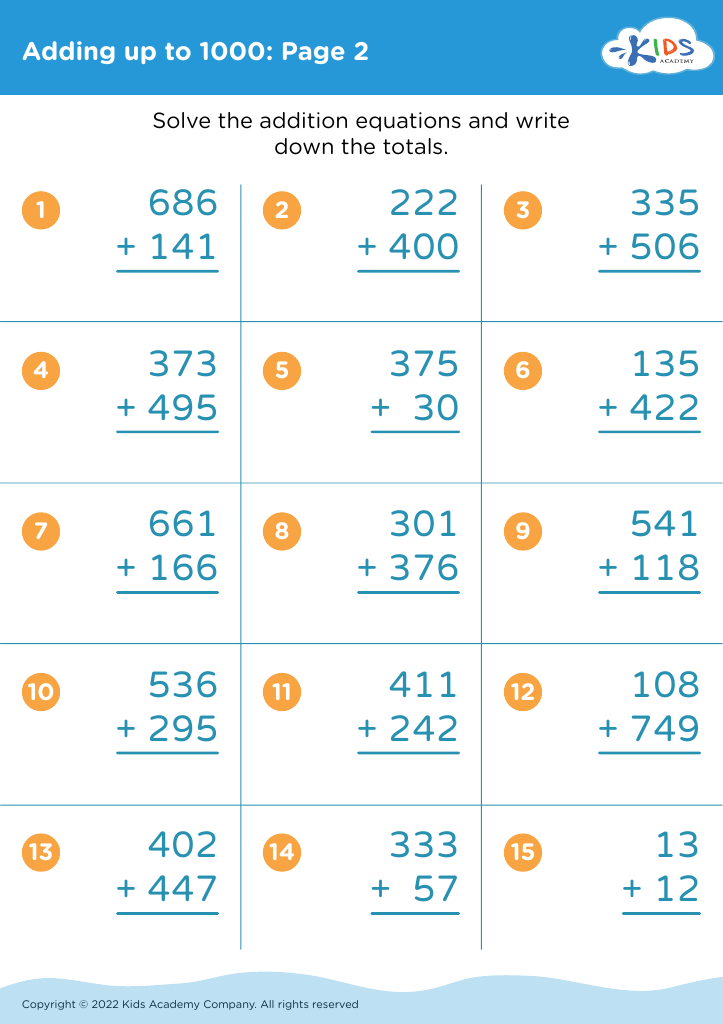
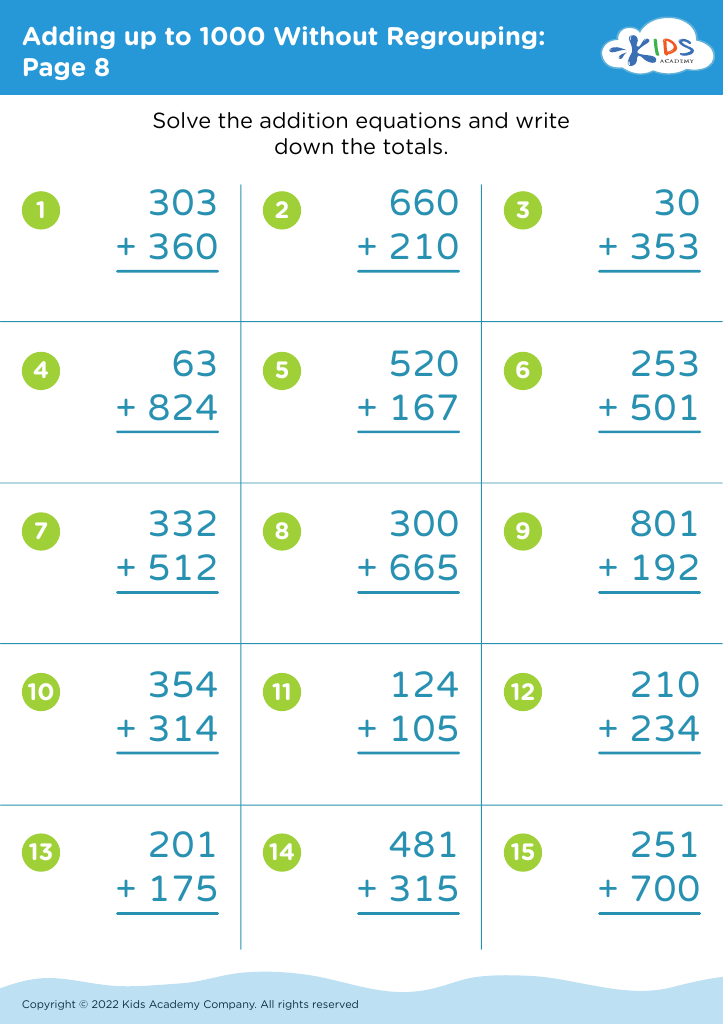
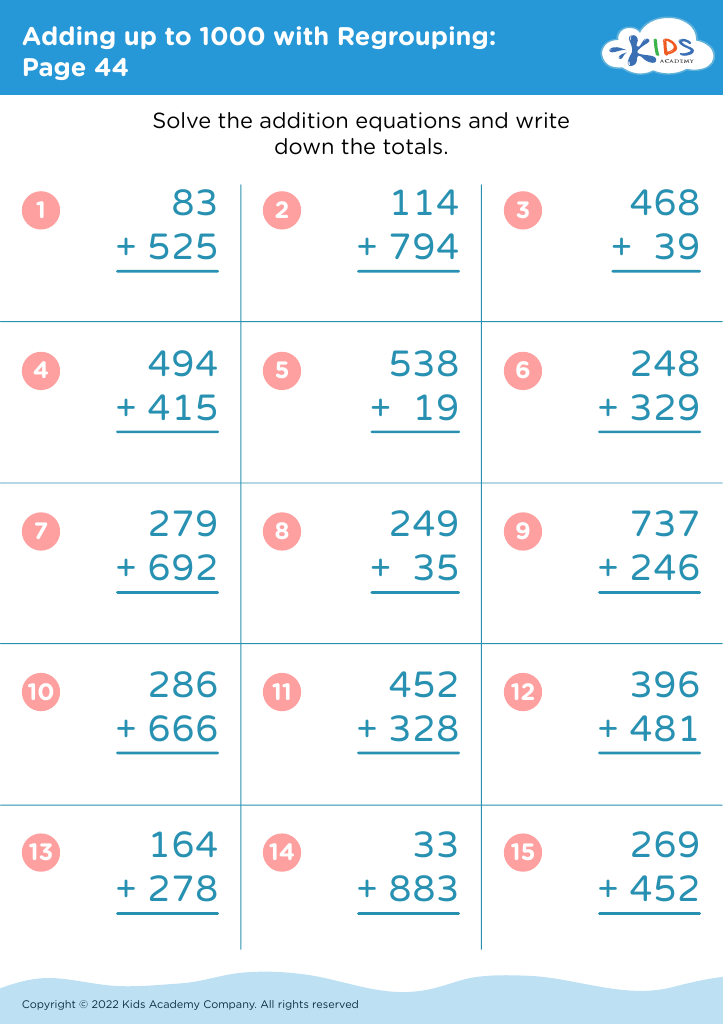



Parents and teachers should prioritize developing critical thinking and numerical skills, such as adding up to 1000, for 9-year-olds because these foundational abilities have far-reaching benefits for a child's overall development and future success. Critical thinking equips children with the skills to analyze information, solve problems creatively, and make reasoned decisions. These are essential for academic success and navigating real-world situations.
Specifically, teaching children to add up to 1000 sharpens their mathematical proficiency, builds confidence, and makes complex calculations more approachable in later stages of education. It also enhances their ability to understand patterns, recognize relationships between numbers, and develop logical reasoning skills. These mathematical and critical thinking abilities are interconnected; when children solve math problems, they practice logical sequencing, error-checking, and analytical thinking.
Moreover, a strong foundation in mathematics and critical analysis promotes cognitive development, improves attention span, and encourages a mindset inclined toward lifelong learning. Engaging young minds in these challenging yet achievable tasks fosters curiosity and resilience, ensuring that they are well-equipped to face academic challenges and real-life scenarios with confidence and competence. Therefore, a concerted effort to build these skills at an early age forms the bedrock of a child's educational journey and overall intellectual growth.








