Pattern recognition Adding up to 1000 Worksheets for 9-Year-Olds
3 filtered results
-
From - To
Boost your child's math skills with our engaging "Pattern Recognition Adding up to 1000 Worksheets for 9-Year-Olds". These educational worksheets are designed to enhance pattern recognition and arithmetic abilities in young learners, making addition effortless and fun. By solving the addition problems, your child will learn to recognize numerical patterns and improve their mental math. Tailored specifically for 9-year-olds, these worksheets provide a balanced mix of challenges and encouragement. Ideal for both classroom and at-home learning, they aim to build confidence and proficiency in math, preparing your child for more advanced mathematical concepts. Try them today!


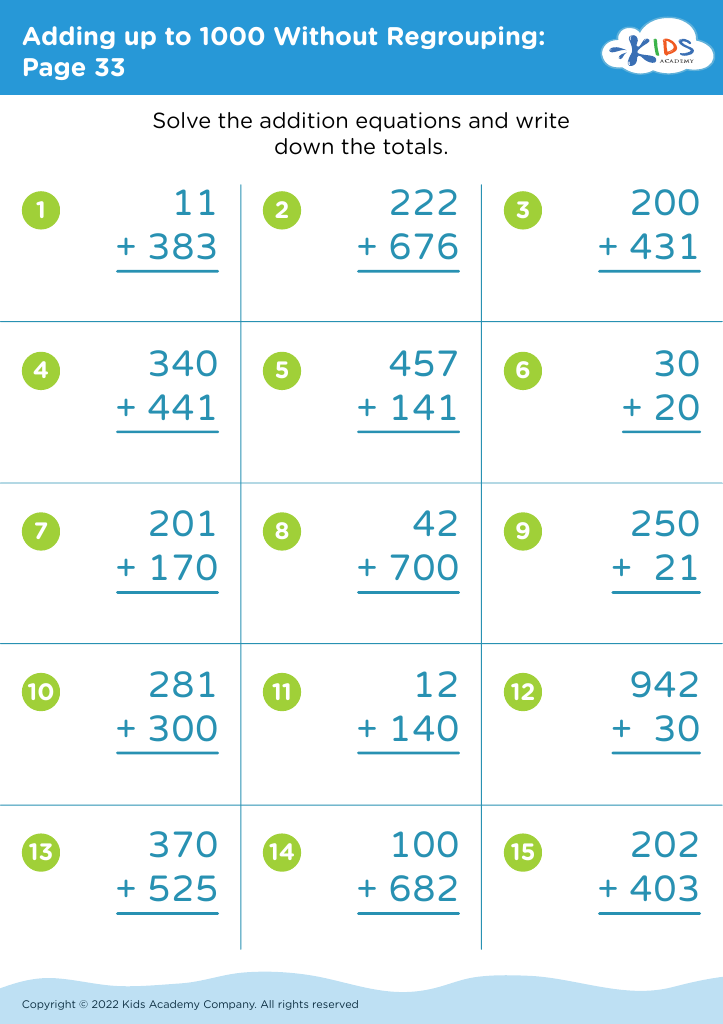



Pattern recognition and the ability to add up to 1000 are critical skills for 9-year-olds, and parents and teachers should prioritize them for several reasons.
First, pattern recognition plays a foundational role in cognitive development, enabling children to understand and predict sequences and structures in both mathematical and non-mathematical contexts. It enhances their problem-solving abilities, logical thinking, and ability to make connections between different concepts.
Second, learning to add up to 1000 ensures that children grasp fundamental arithmetic operations that are crucial for more advanced mathematical concepts. Working with larger numbers helps students understand place value, improves mental math skills, and builds confidence in handling complex calculations.
Together, these skills form a vital part of a child's educational foundation. They support learning in subjects such as mathematics, computer science, and even reading and writing, where recognizing patterns in letters and words is essential. Beyond academics, these abilities are also important for daily life tasks like budgeting, measuring, and following schedules.
Therefore, fostering pattern recognition and arithmetic skills at this age prepares children for future academic success and practical, real-world problem-solving. This proactive approach ultimately equips them with tools to better understand and navigate their environment, laying a groundwork that benefits lifelong learning and adaptation.








