Problem-solving practice Adding up to 1000 Worksheets for 9-Year-Olds
3 filtered results
-
From - To
Enhance your child's mathematical skills with our "Problem-Solving Practice: Adding Up to 1000 Worksheets" designed specifically for 9-year-olds! This engaging resource focuses on improving your child's problem-solving abilities through a variety of activities that encourage critical thinking and reasoning. Students will tackle real-world math problems, honing their addition skills while striving to reach the total of 1000. Each worksheet promotes interactive learning and nurtures a positive attitude toward mathematics. Perfect for home study or classroom use, these worksheets are a fun way to build confidence and competence in foundational math concepts. Get ready for a math adventure!
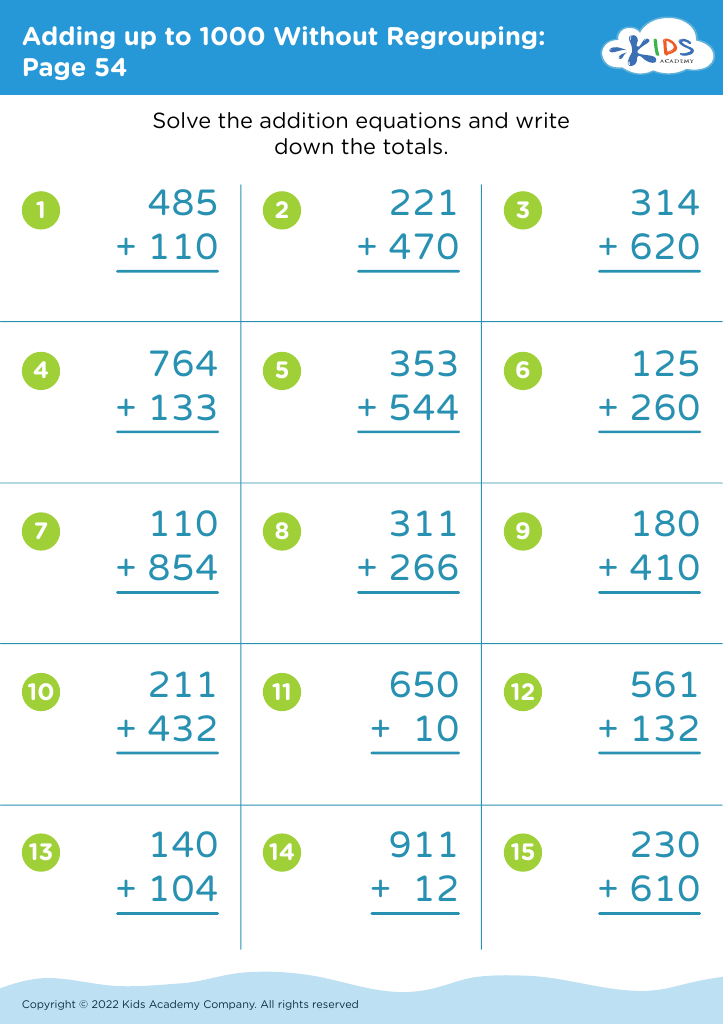
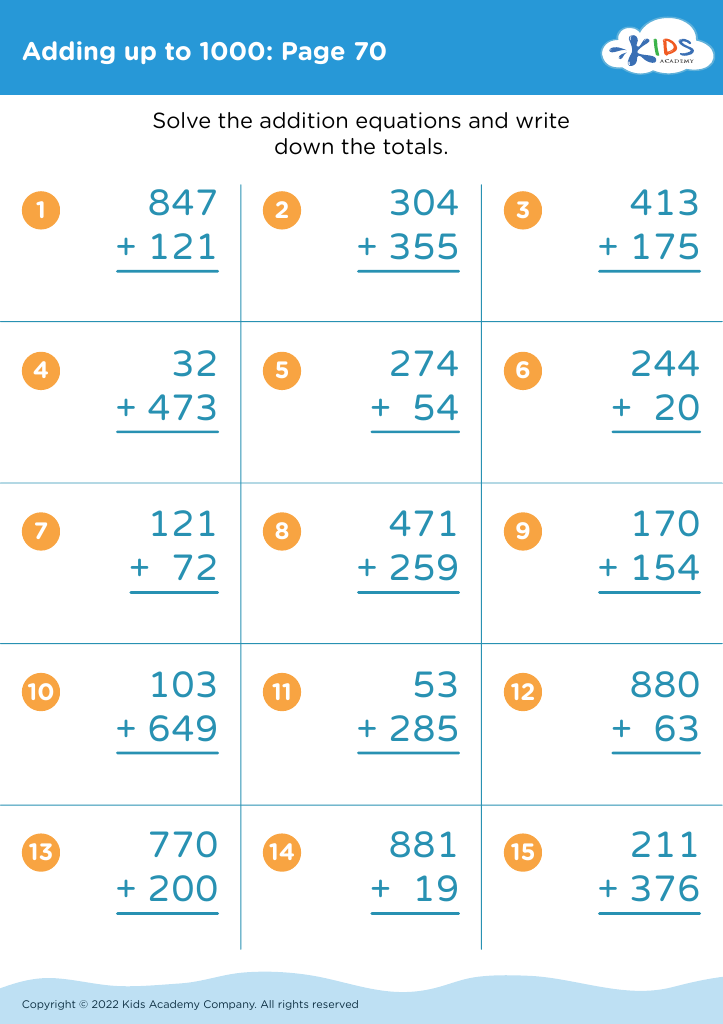
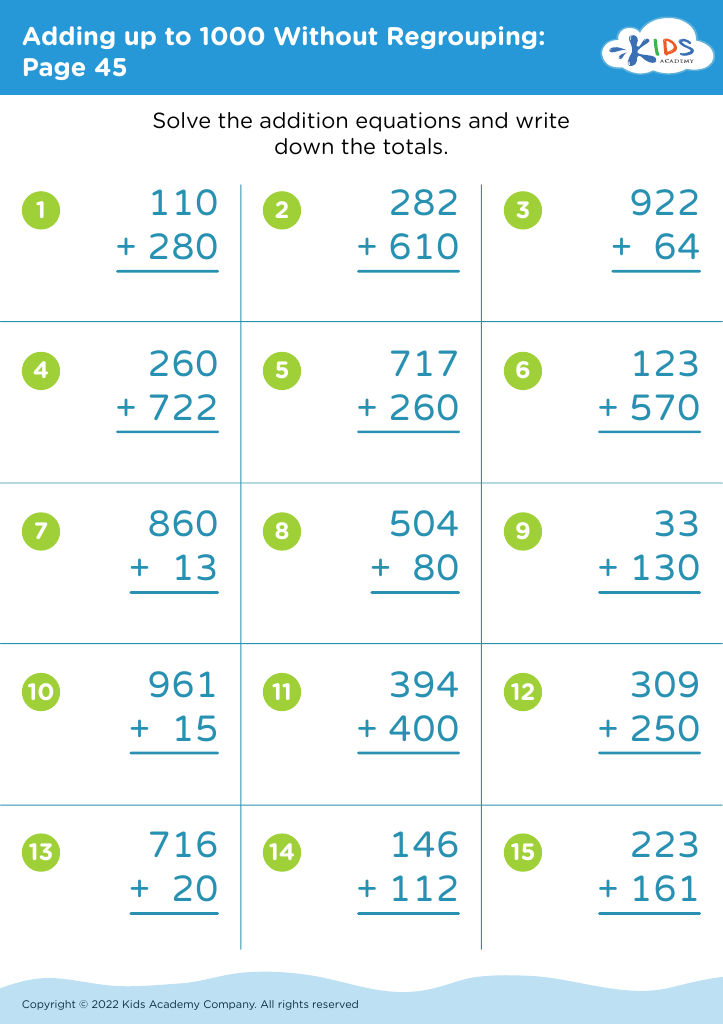



Problem-solving practice, particularly focused on adding up to 1,000, is essential for 9-year-olds as it fosters critical thinking skills and enhances mathematical fluency. At this age, children are at a pivotal stage in their cognitive development, and engaging them in problem-solving tasks significantly boosts their ability to manage complex concepts.
By practicing addition up to 1,000, children learn not just to add numbers, but to understand relationships between different numerical values. This foundational skill underpins more advanced math concepts such as subtraction, multiplication, and division. Furthermore, problem-solving encourages perseverance; children learn to approach a problem methodically, explore different strategies, and evaluate their solutions.
Additionally, problem-solving practice promotes self-confidence. As children tackle challenges and master them, they gain a sense of achievement that encourages them to take on further challenges. Moreover, this practice often includes real-world applications, helping children see the relevance of math in everyday life.
For parents and teachers, fostering this practice cultivates a love for learning and math in children, setting them up for success not only in their academic journey but also in everyday scenarios as they grow. In a world increasingly driven by quantitative reasoning, these skills are invaluable.








