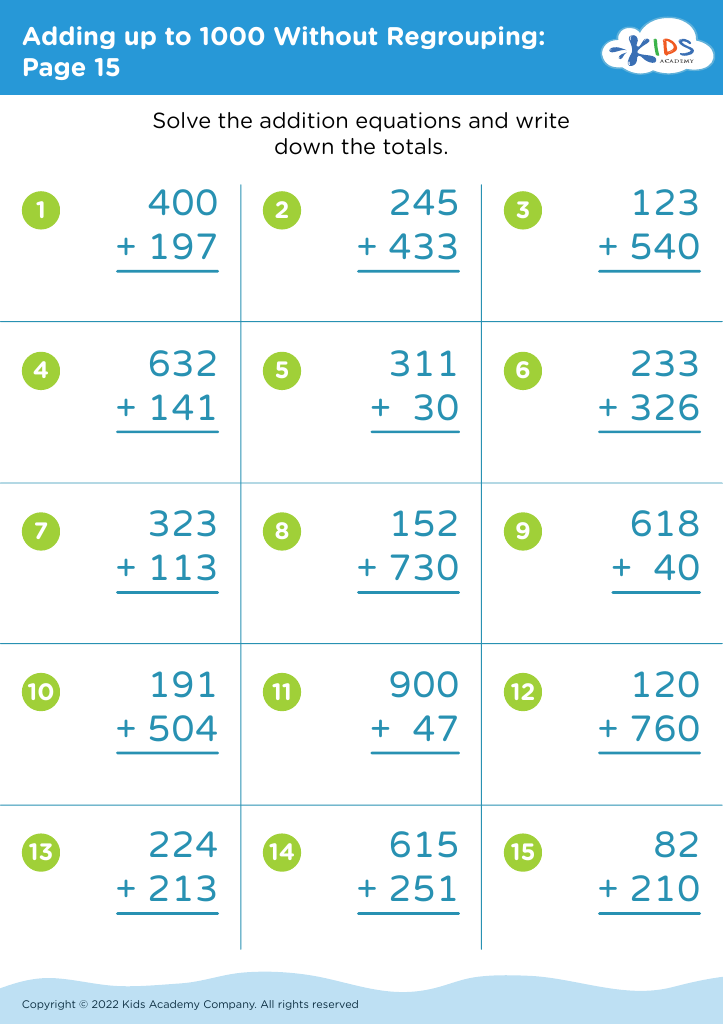




Parents and teachers should prioritize teaching problem-solving skills involving addition up to 1000 for 9-year-olds because these skills are foundational to mathematical proficiency and critical thinking. At this age, children are transitioning from basic arithmetic to more complex mathematical concepts, and mastering addition up to 1000 serves as a crucial stepping stone.
Such problem-solving abilities enhance cognitive development by encouraging logical reasoning and analytical thinking. These processes help students not only with mathematics but in handling real-life situations that require systematic problem-solving approaches. For instance, when a child can confidently add large numbers, they also learn to break down complex problems into manageable parts, a skill applicable in many areas beyond mathematics.
Moreover, achieving proficiency in adding numbers up to 1000 builds a child’s confidence in their mathematical abilities, fostering a positive attitude towards challenging tasks. This confidence can translate to better performance across all subjects, as problem-solving skills are widely applicable.
Additionally, consistent practice in addition bolsters memory and strengthens neural connections in the brain, which enhance overall cognitive function. Teachers and parents should thus recognize the importance of these skills and incorporate them effectively into learning activities to provide a strong educational foundation for future academics and everyday problem-solving.








