Understanding sequencing Addition Worksheets for 9-Year-Olds
3 filtered results
-
From - To
Understanding sequencing in Addition is crucial for 9-year-olds to build strong math foundations. Our carefully crafted worksheets mix fun and learning to help kids master this concept. These worksheets guide children through numerical order and arranging addends in sequential patterns. Each activity enhances critical thinking and problem-solving skills, ensuring students comprehend addition sequences comprehensively. Aligned with standard math curricula, our colorful, engaging printables make learning addition both enjoyable and effective. Perfect for classroom use or home practice, these worksheets will give children the confidence and skills needed to excel in math. Explore our collection to elevate your child's math proficiency today!
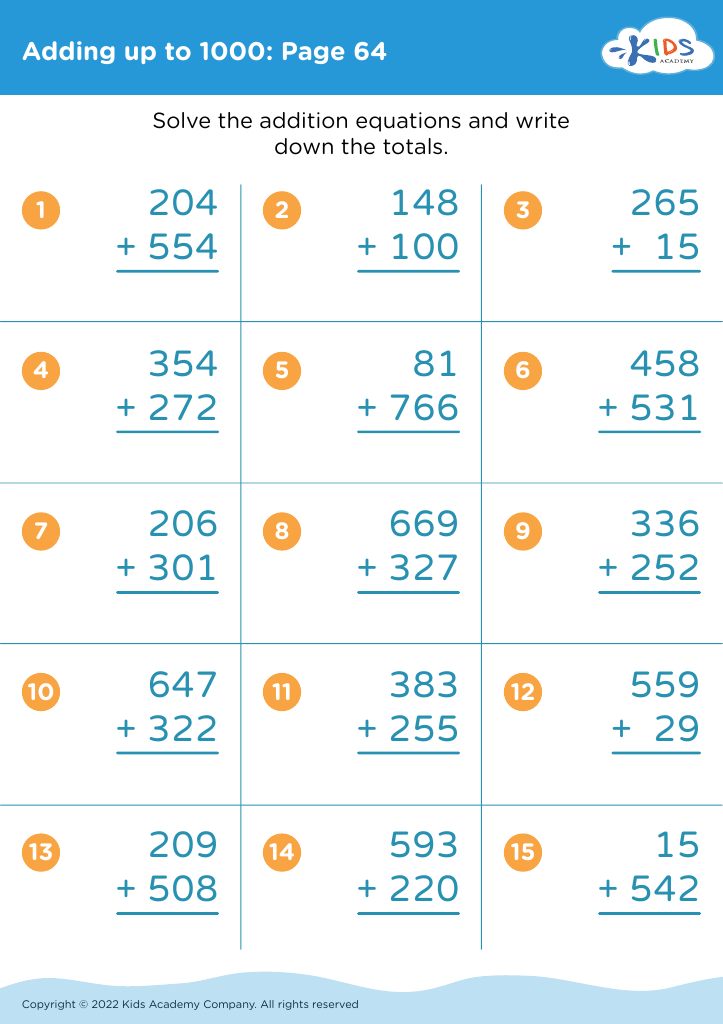
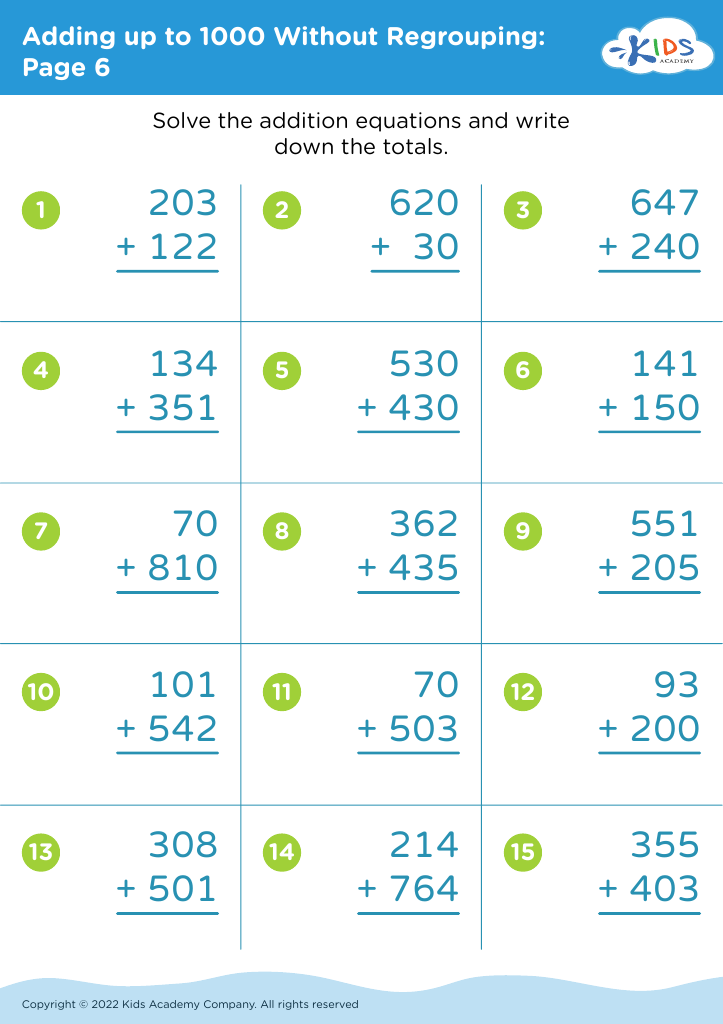
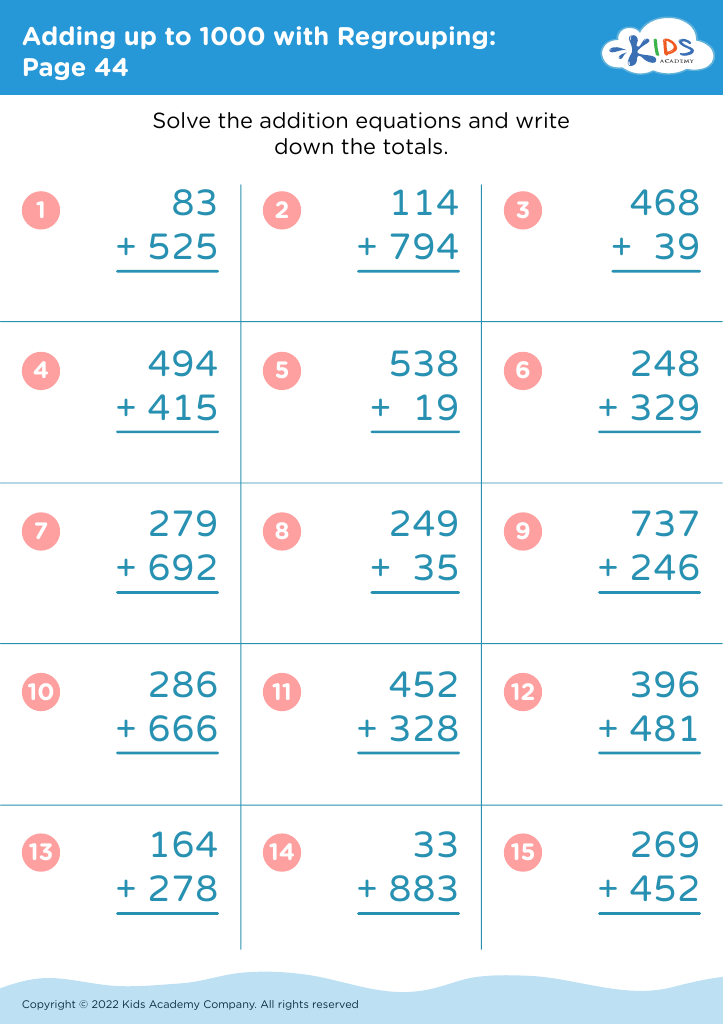






.jpg)

Understanding sequencing in addition is foundational for 9-year-olds, as it underpins their broader mathematical comprehension and real-world problem-solving skills. At this age, children transition from simple arithmetic to more complex mathematical concepts, and sequencing assists in this shift.
First, grasping the order of addition—knowing that changing the sequence does not change the sum (commutative property)—builds their numerical confidence and flexibility. This knowledge is crucial when tackling more advanced problems involving multi-digit numbers, carrying, and later, algebraic equations.
Second, sequencing skills extend beyond mathematics. They promote logical thinking and cognitive precision, directly influencing a child's ability to follow multi-step instructions in everyday tasks, such as preparing a meal or organizing their schoolwork. Understanding sequences also aids reading comprehension, as children need to follow the order of events in narratives to grasp storylines fully.
Finally, the ability to correctly sequence addition lays a crucial groundwork for future learning. As children grow, math concepts become interlinked, building upon earlier knowledge. A firm understanding of sequencing ensures they are equipped to delve into higher mathematics, fostering academic success. Thus, for teachers and parents, emphasizing sequencing in addition isn't just about improving math grades—it's about fueling overall cognitive and practical development.








