Understanding quantity Math Worksheets for 9-Year-Olds
5 filtered results
-
From - To
Welcome to our Understanding Quantity Math Worksheets for 9-Year-Olds! These engaging and interactive worksheets are designed to help young learners grasp key concepts of quantity through fun exercises. Students will explore numbers, grouping, and measurement, honing their abilities to compare, estimate, and manipulate values. Each worksheet offers a variety of activities—from counting objects to solving practical math problems—that encourage critical thinking and problem-solving skills. Perfect for reinforcing classroom learning or enhancing home education, our resources foster a deep understanding of quantity in a supportive environment. Empower your child’s mathematical journey today with our thoughtfully crafted worksheets!
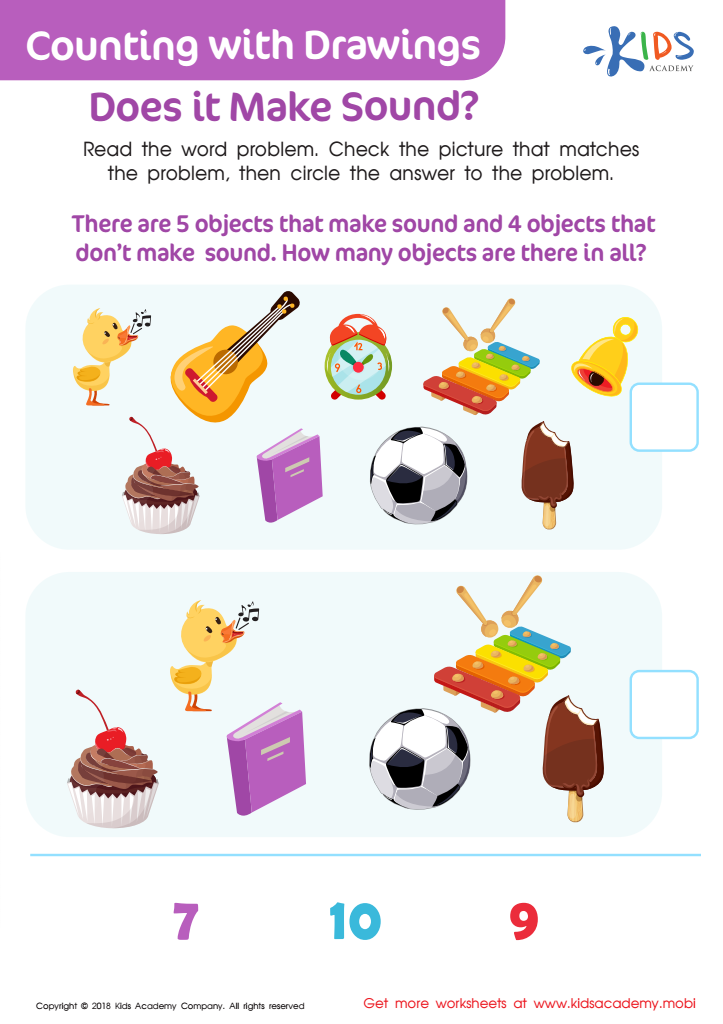
Counting With Drawings. Does It Make Sound? Worksheet
 Assign to My Students
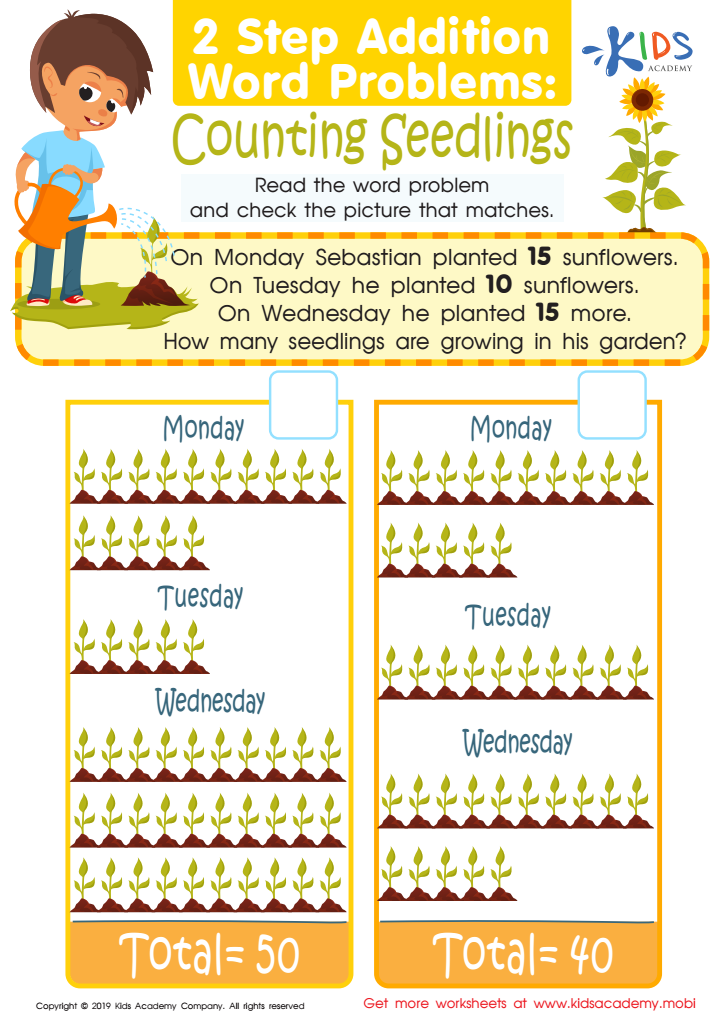
Counting Seedlings Worksheet
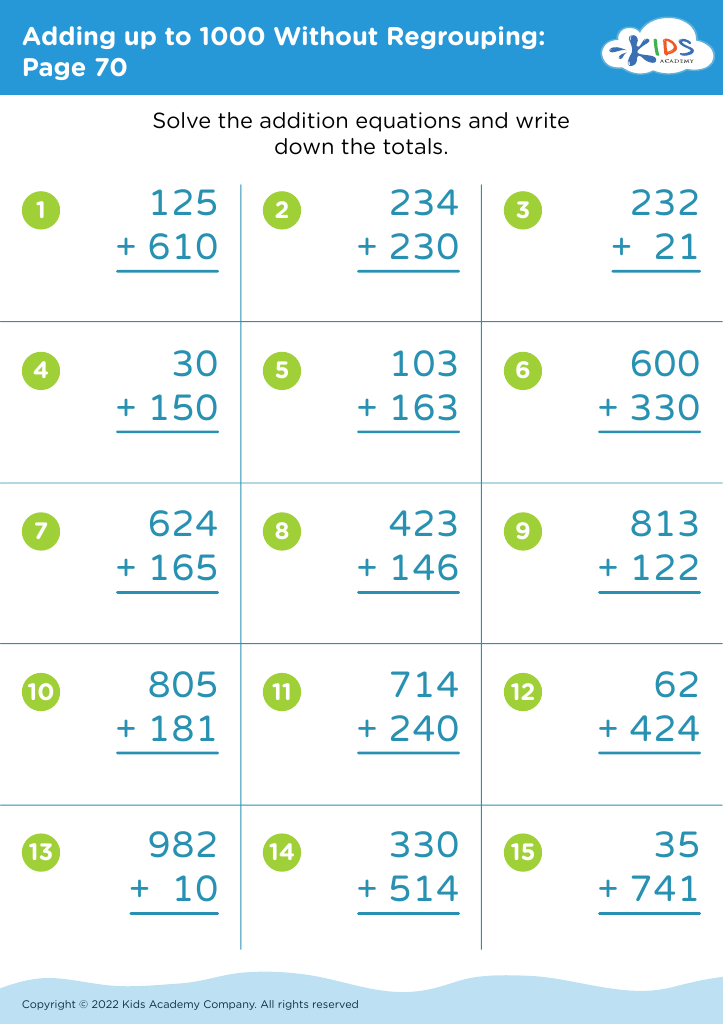








Understanding quantity is foundational for 9-year-olds, significantly influencing their overall math skills and cognitive development. At this age, children transition from concrete to more abstract mathematical concepts, making the grasp of quantity vital for their success in more complex calculations and problem-solving. Parents and teachers should care about this because it establishes benchmarks for comparison, which helps children engage with real-world math, such as measuring ingredients for cooking, budgeting, or estimating distances while traveling.
Moreover, a solid comprehension of quantity fosters critical thinking and enhances decision-making skills. Enabling children to visualize and manipulate quantities helps build confidence, encouraging them to tackle more challenging problems. This foundational understanding can also stimulate their interest in math, potentially steering them toward STEM-related fields.
Additionally, quantity concepts often serve as precursors to mastering fractions, ratios, and decimals; skills that are crucial later in their educational journey. Therefore, by placing emphasis on understanding quantity, parents and educators equip children with the tools needed for academic success, enabling them to develop a positive relationship with math that carries into adolescence and adulthood. Without this foundation, children may struggle with advanced mathematical concepts, leading to frustration and disengagement in their learning experience.








