
Visual interpretation Math Worksheets for 9-Year-Olds
4 filtered results
Difficulty Level
Grade
Age
-
From - To
Subject
Activity
Standards
Enhance your 9-year-old's mathematical skills with our engaging Visual Interpretation Math Worksheets. Designed to develop crucial problem-solving abilities, these worksheets encourage students to interpret visuals like graphs, charts, and diagrams, fostering a deeper understanding of mathematical concepts. Each activity promotes critical thinking and visual literacy, making math both fun and interactive. Our resources cater to various learning styles, ensuring that every child can connect with math in a meaningful way. Perfect for classroom or home use, these worksheets will help your child excel in visual interpretation and boost their confidence in math. Start exploring our comprehensive collection today!
Favorites
With answer key
Interactive
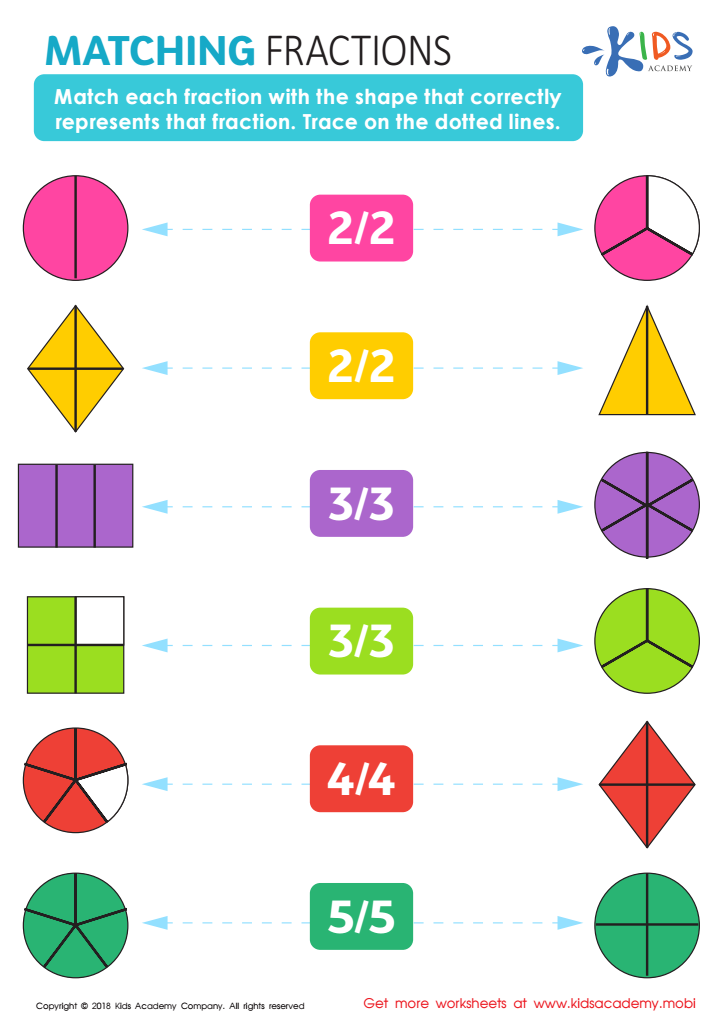
Matching Fractions Worksheet
This worksheet uses colorful images to engage students. On the left are six shapes, mirrored on the right, with fractions in the middle. Students must match up the fraction with the right shape. It's a fun way to sharpen fractions skills!
 Assign to My Students
Matching Fractions Worksheet
Worksheet
Join Kids Academy for Free
Who is primarily going to use this learning content?







Visual interpretation in mathematics is crucial for 9-year-olds as it forms a foundational skill for their mathematical reasoning and problem-solving abilities. At this age, children are beginning to explore more complex concepts, and visualizing these ideas can significantly enhance their understanding. When children can represent mathematical problems visually—through diagrams, graphs, or manipulatives—they often find it easier to grasp abstract concepts like addition, subtraction, fractions, and geometry.
Furthermore, visual aids help cater to different learning styles. Many children are visual learners who process information better when it is presented in pictures or diagrams rather than text alone. This approach promotes greater engagement and fosters a positive attitude towards math, reducing anxiety and frustration.
Visual interpretation also aids in developing critical thinking and analytical skills. By encouraging students to create visual representations of problems, parents and teachers help them learn to analyze and interpret data and become more adept problem solvers. When children learn to make connections between visual representations and numerical values, they build a stronger mathematical foundation that will benefit them as they progress in their education. Overall, prioritizing visual interpretation in math nurtures a deeper understanding and appreciation for the subject in young learners.








