Mental math skills Mixed Times Tables Worksheets for 9-Year-Olds
3 filtered results
-
From - To
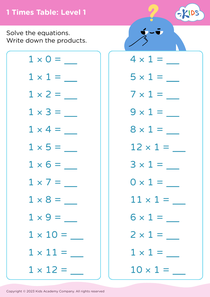
Enhance your 9-year-old's math proficiency with our curated "Mixed Times Tables Worksheets." Designed to strengthen mental math skills, these engaging worksheets provide a fun and interactive way for children to practice their multiplication facts. The versatile activities focus on various times tables, ensuring kids build confidence and speed in solving problems without relying on calculators. Perfect for classroom use or at-home learning, these worksheets encourage critical thinking and reinforce foundational math concepts. Watch your child improve their calculation skills while enjoying a variety of entertaining formats that make learning multiplication an exciting adventure. Strengthen math abilities today!
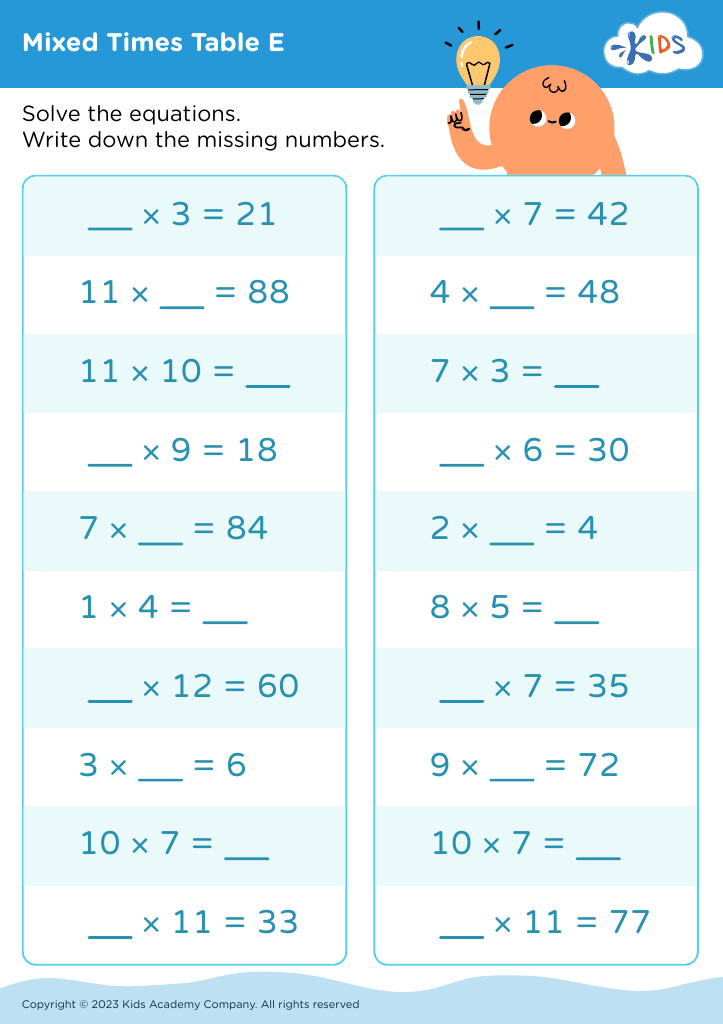
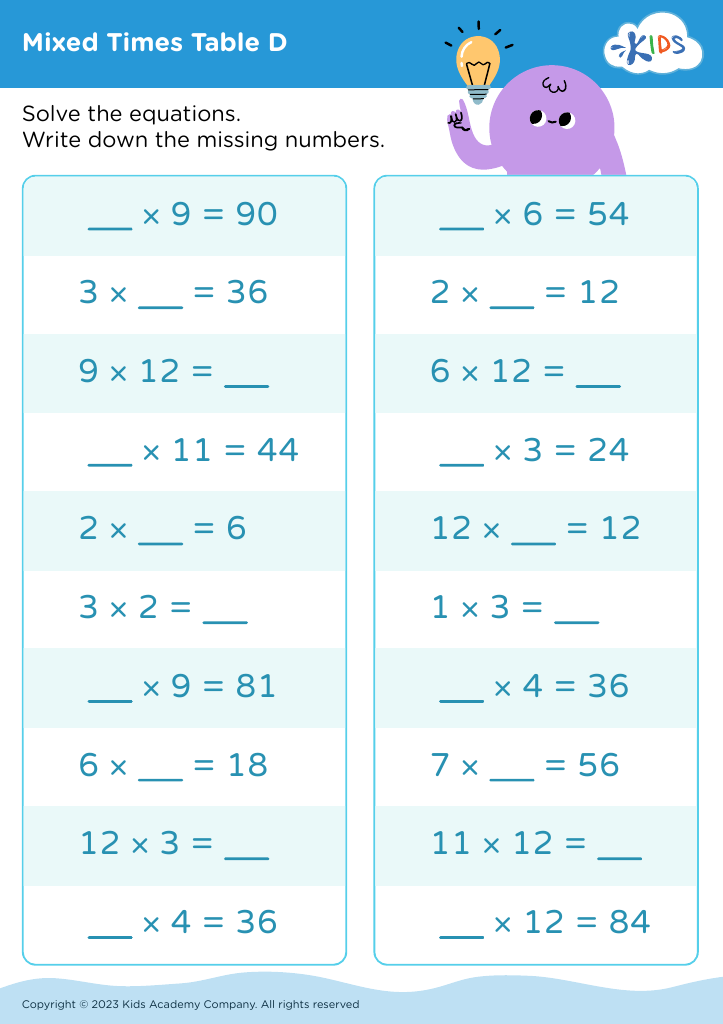
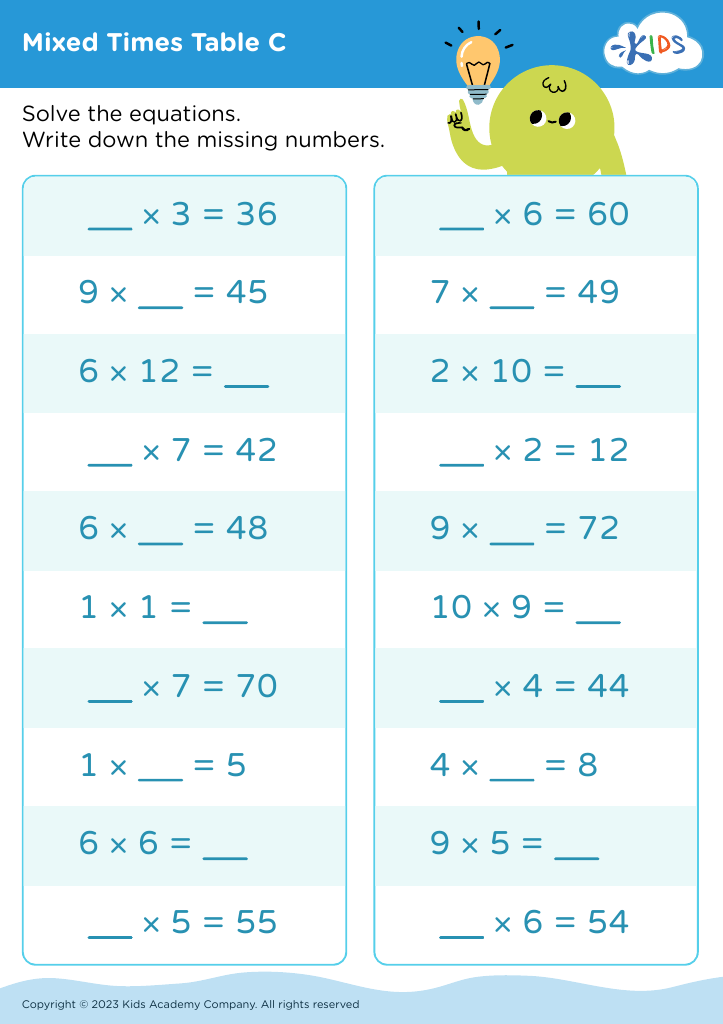


Mental math skills, particularly in mixed times tables, are crucial for 9-year-olds as they build a strong foundation for mathematical understanding and problem-solving abilities. At this age, children are developing cognitive skills and learning to manipulate numbers, making it an ideal time to focus on mental math.
Fostering mental math fluency helps children become more confident and competent in mathematics. When they practice mixed times tables, they learn to recognize patterns in numbers, enhancing their speed and accuracy. This skill not only aids in everyday tasks, such as budgeting or cooking, but also prepares them for more advanced mathematical concepts as they progress in school.
Additionally, mental math encourages critical thinking. Students learn to approach problems flexibly, choosing the best strategies to arrive at solutions without relying solely on calculators. This independence enhances their analytical skills, vital for academic success across subjects.
For parents and teachers, encouraging mental math can minimize math anxiety and create a more positive attitude towards the subject. It engages children in active learning, better equipping them for future challenges. Overall, nurturing mental math skills in mixed times tables is essential for fostering a child's overall mathematical competency and resilience.