Easy Two-step Word Problems Worksheets for 9-Year-Olds
5 filtered results
-
From - To
Introducing our Easy Two-step Word Problems worksheets, expertly crafted for nine-year-old students! These educational homework sheets are designed to challenge and engage young minds while reinforcing essential math skills. Each worksheet features a variety of problems that require learners to apply critical thinking and basic arithmetic in two stages to find solutions. Perfect for enhancing problem-solving abilities, these worksheets make learning fun and effective. Watch your child's confidence grow as they master the art of tackling two-step word problems with ease. Ideal for home or classroom use, our worksheets are a must-have for any young learner's educational journey.
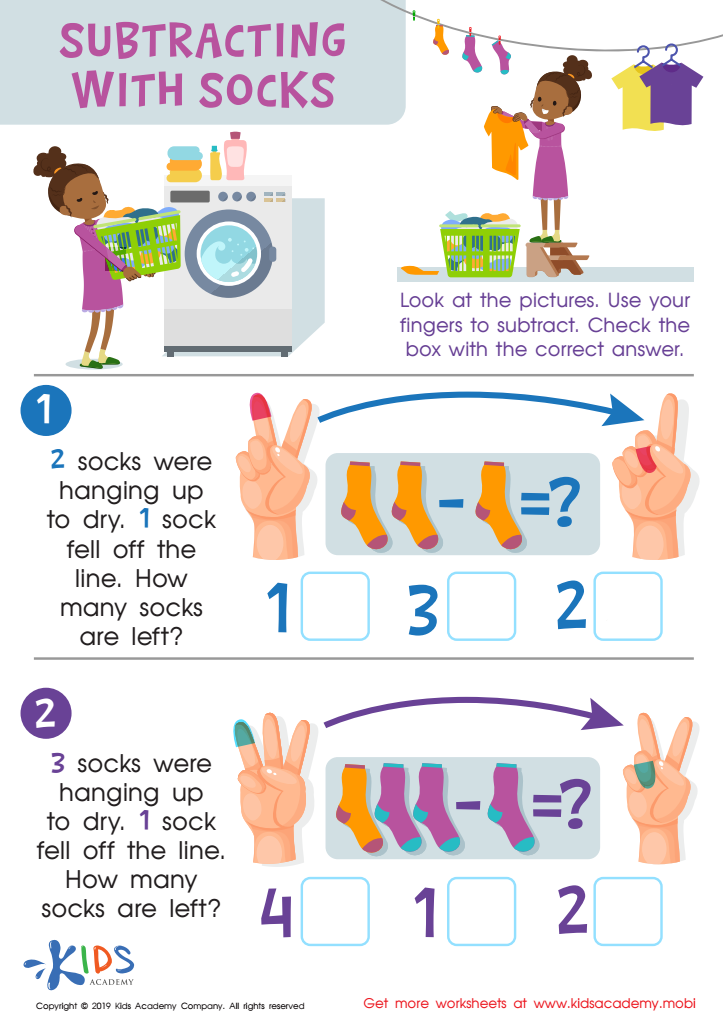
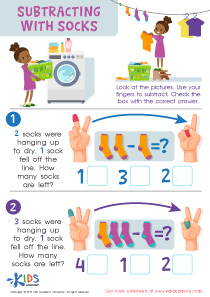
Subtracting Socks Worksheet
 Assign to My Students
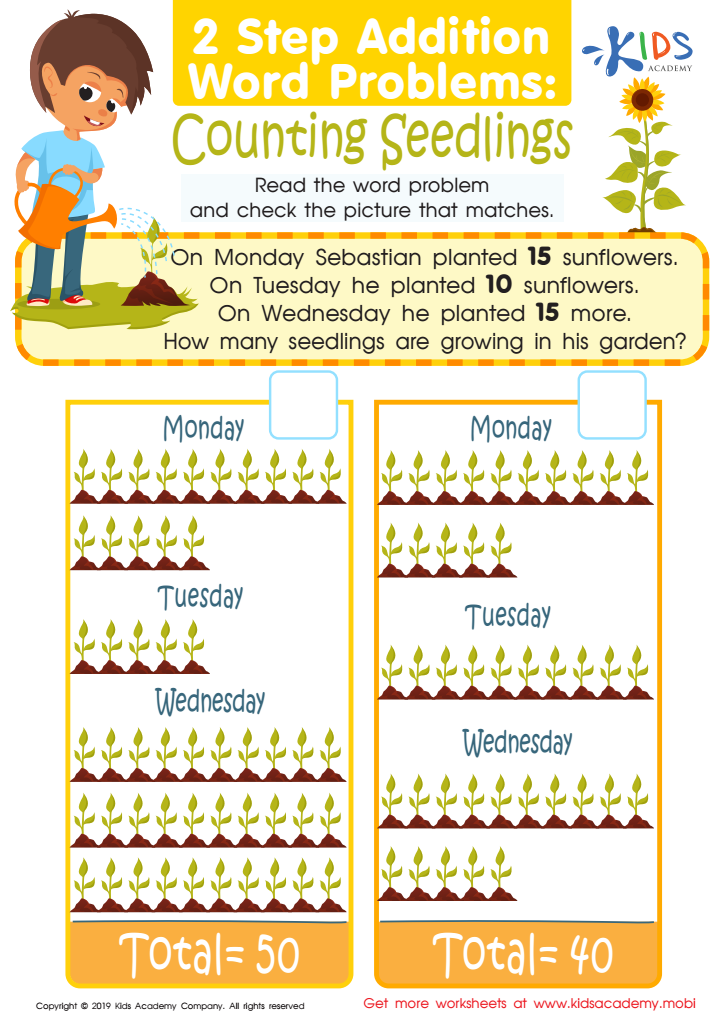
Counting Seedlings Worksheet
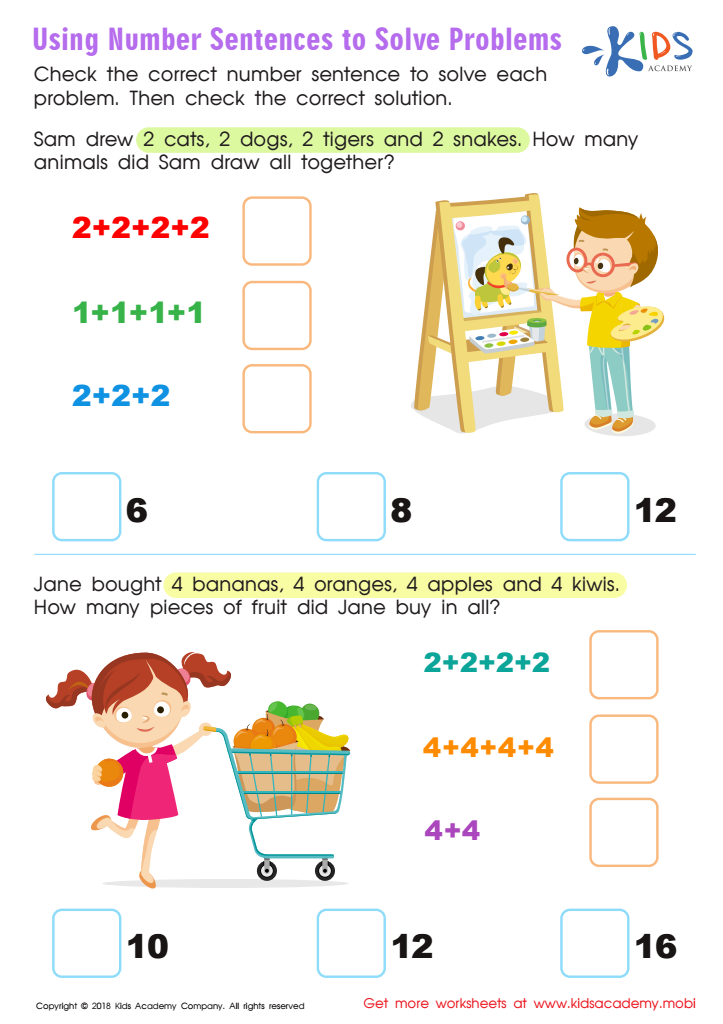
Using Number Sentences to Solve Problems Worksheet
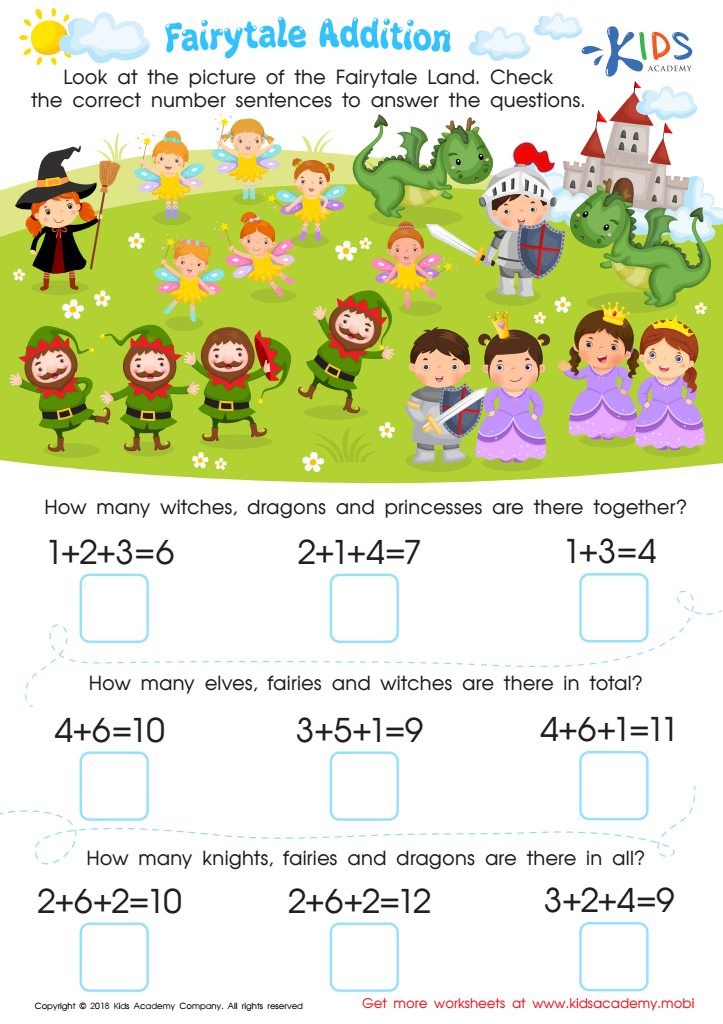
Fairytale Addition Worksheet
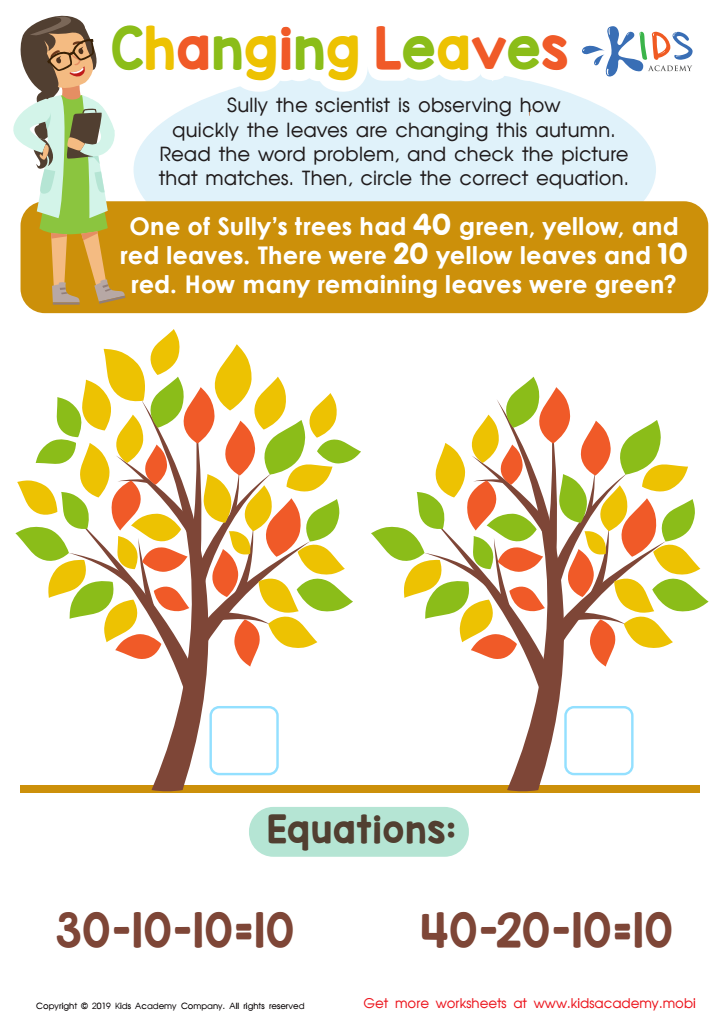
Changing Leaves Worksheet



Why Easy Worksheets on Two-Step Word Problems Are Useful for 9-Year-Olds
As children progress through their academic journey, the complexity of the concepts they need to grasp increases progressively. One crucial area in math where students, particularly nine-year-olds, can benefit significantly is the mastery of two-step word problems. These problems not only enhance mathematical skills but also improve cognitive abilities like logical thinking and problem-solving. Easy worksheets on two-step word problems, often included as part of school worksheets, play a pivotal role in making this learning both accessible and enjoyable.
At the age of nine, children are usually in the third or fourth grade, a stage where they are transitioning from simple arithmetic operations to more complex mathematical concepts. Two-step word problems are an excellent bridge in this regard. They require students to perform two sequential operations to arrive at a solution. This could involve any combination of addition, subtraction, multiplication, or division. The challenge here doesn't lie solely in performing these operations, but in deciding which operations to use and in what order. This is where easy worksheets specifically designed for these problems become indispensable.
Development of Critical Thinking and Problem-Solving Skills
School worksheets that focus on two-step word problems encourage children to read carefully, understand the problem, and think critically about which mathematical operations to apply. This process enhances their problem-solving skills, as they must determine the steps necessary to reach a solution. By providing a structured way to tackle complex problems, these worksheets help children develop a methodical approach to problem-solving that is applicable in many other areas of learning and everyday life.
Building Confidence with Incremental Challenges
Easy worksheets are tailored to be age-appropriate, ensuring that the problems are not too daunting for nine-year-olds. This is crucial in maintaining their confidence and interest in mathematics. When children successfully solve these problems, their confidence grows, encouraging them to tackle increasingly challenging problems. School worksheets often include a variety of problems that progressively increase in difficulty, helping children build their skills incrementally.
Enhancing Reading and Comprehension Skills
Two-step word problems also improve reading comprehension. As these problems are presented in a narrative form, students must parse through the information, distinguishing between necessary and extraneous details. This enhances their ability to comprehend and analyze text, a skill that is invaluable across all subjects.
Real-World Applications
The ability to solve two-step word problems equips children with the skills to apply mathematics in real-world scenarios. Whether it's figuring out the total cost of items during shopping, calculating time durations for activities, or splitting tasks into manageable parts, the skills learned from these worksheets translate directly into practical, everyday use. By learning to identify the problem, break it down into manageable steps, and apply appropriate mathematical operations, children can solve complex problems that they will inevitably encounter outside the classroom.
Supporting Diverse Learning Styles
School worksheets on two-step word problems cater to diverse learning styles. Visual learners, for instance, might benefit from worksheets that include diagrams or visual aids to map out the problem-solving process. Kinesthetic learners might engage with interactive or hands-on worksheets that involve physical manipulation of objects to understand the problem better. This versatility ensures that all students have the opportunity to grasp the concepts in a way that best suits their learning preferences.
Encouraging Cooperative Learning
Often, these worksheets are used in group settings where children can collaborate to solve problems. This not only makes the learning process more engaging but also teaches important social skills such as communication, sharing ideas, and working together towards a common goal. It fosters a sense of community and cooperation among classmates, enhancing their social development alongside their academic growth.
Preparation for Future Academic Success
Mastering two-step word problems at a young age sets a strong foundation for more advanced mathematical concepts that students will encounter in higher grades. As they progress to more complex algebra, calculus, and beyond, the skills honed from working through these simple yet effective worksheets will serve them well. The ability to think critically, solve problems efficiently, and apply mathematical operations flexibly are all skills that will contribute to their future academic success.
In conclusion, easy worksheets on two-step word problems are an invaluable tool for nine-year-olds. They not only enhance mathematical and cognitive skills but also prepare children for real-world applications and future academic endeavors. School worksheets that tackle these challenges in an age-appropriate and engaging way are essential in nurturing a child’s growth and development in both academic and practical realms.