Identifying shapes Easy Math Worksheets for 7-Year-Olds
3 filtered results
-
From - To
Empower your 7-year-old’s math skills with our "Identifying Shapes Easy Math Worksheets." Designed specifically for young learners, these fun and engaging worksheets help children recognize, name, and differentiate between various shapes, boosting their spatial awareness and geometry skills. Perfect for both classroom use and home practice, each worksheet is crafted to make learning shapes enjoyable and accessible. Download now to support your child's educational journey with colorful and developer-backed activities that spark curiosity and foster a love of learning. Explore more shape identification resources at Kids Academy and watch your child’s confidence soar!
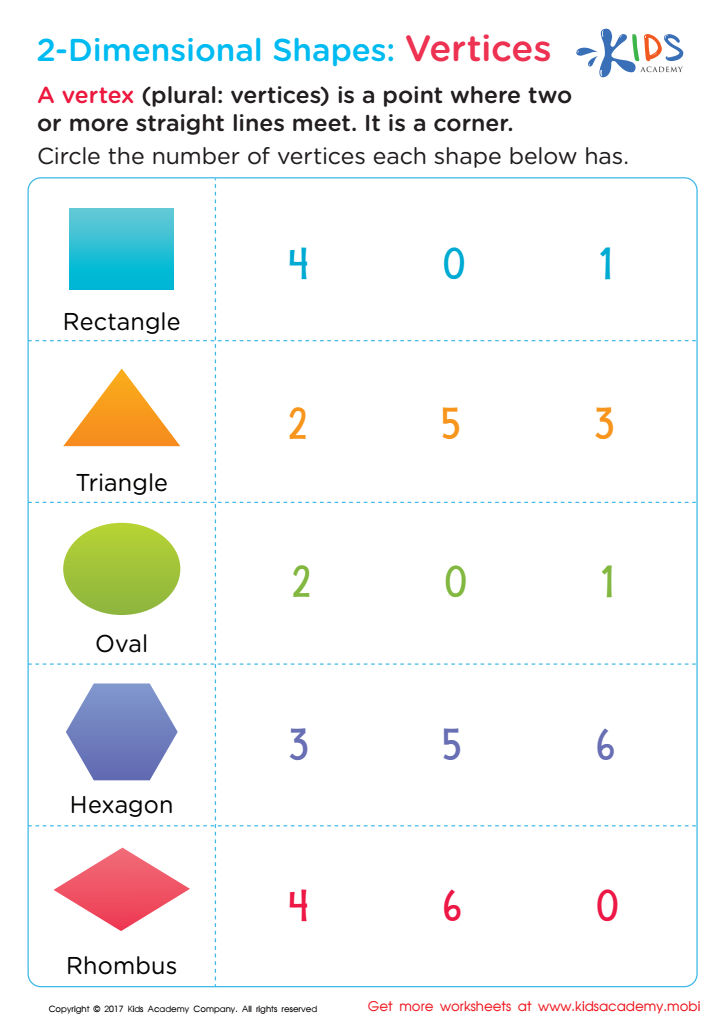
Two–Dimensional Shapes: Vertices Printable
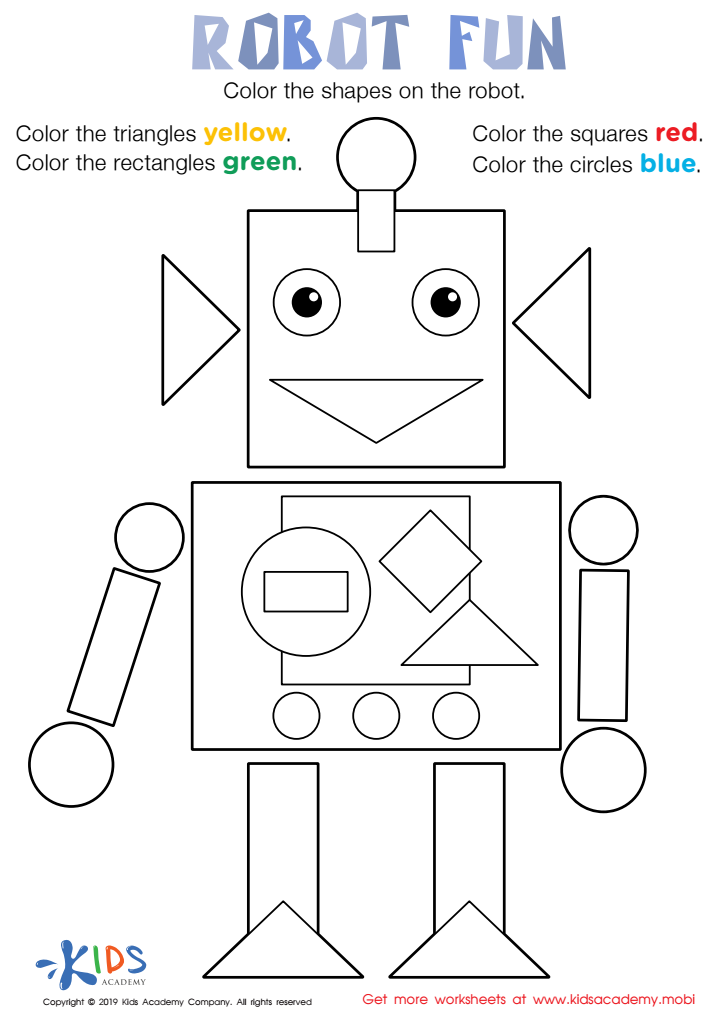
Robot Fun Worksheet
 Assign to My Students
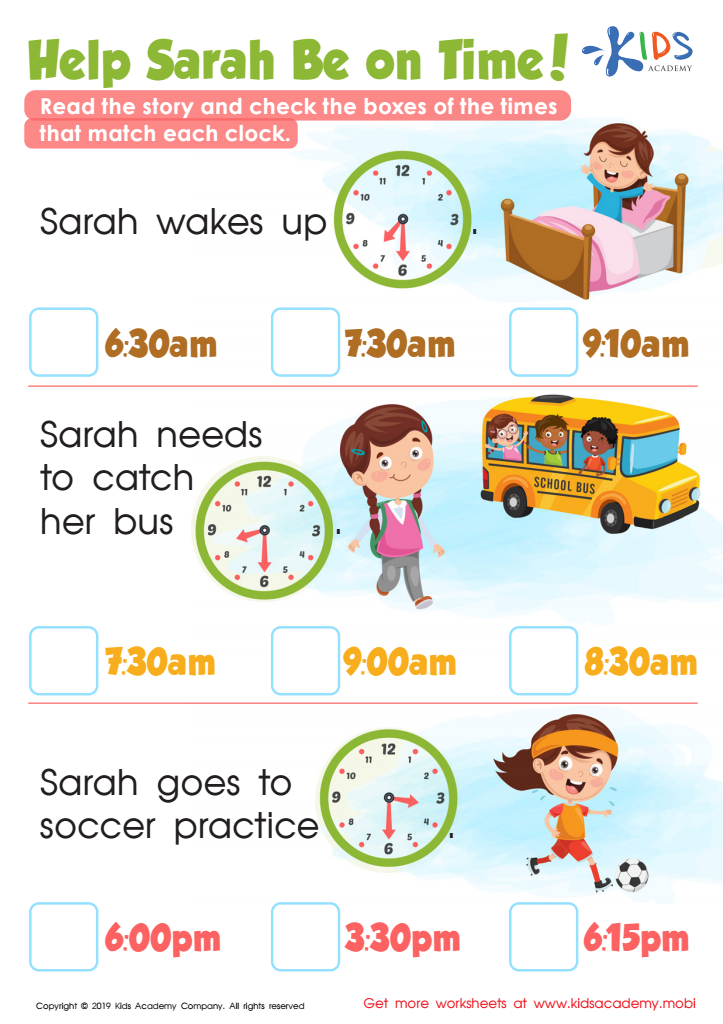
Help Sarah Be on Time! Worksheet








Identifying shapes is a foundational math skill that plays a crucial role in a child's cognitive development and future academic success. For 7-year-olds, recognizing shapes – such as triangles, squares, circles, and rectangles – is more than just identifying geometric figures. This skill helps children understand the basic properties of objects and their surroundings, fostering spatial awareness and problem-solving abilities.
Parents and teachers should care about this area of early math because it establishes building blocks for more advanced mathematical concepts. Understanding shapes aids in the development of children’s abilities to categorize and compare objects, enhancing their reasoning and logical thinking skills. Furthermore, recognizing shapes supports literacy development; children learn shape names and the vocabulary necessary to describe objects' attributes and positions.
Introducing shape identification through playful and engaging activities helps to stimulate curiosity and a love for learning. Activities like drawing, cutting out, or building with different shaped objects offer hands-on learning experiences that reinforce these concepts. Moreover, this early exposure increases children's confidence in their mathematical abilities, paving the way for easier comprehension of more complex topics such as geometry, measurement, and algebra later on.
Therefore, integrating shape identification in early education sets a solid foundation for a child’s lifelong journey in mathematics and critical thinking, making it an essential focus for both parents and educators.








