
Counting practice Extra Challenge Money Worksheets for Ages 3-4
4 filtered results
Difficulty Level
Grade
Age
-
From - To
Subject
Activity
Standards
Introducing the "Counting Practice Extra Challenge Money Worksheets" designed for ages 3-4, based on the time-tested methodologies from Kids Academy! These engaging and educational worksheets help young learners master counting skills using familiar currency symbols. Perfectly crafted for preschoolers, each fun and interactive worksheet aids in early math proficiency, enhancing their ability to recognize and count different denominations. By combining play with learning, these worksheets provide a more challenging environment for cognitive development. Transform counting into an exciting adventure and lay a strong foundation for your child's future mathematical growth. Explore and download today!
Favorites
With answer key
Interactive
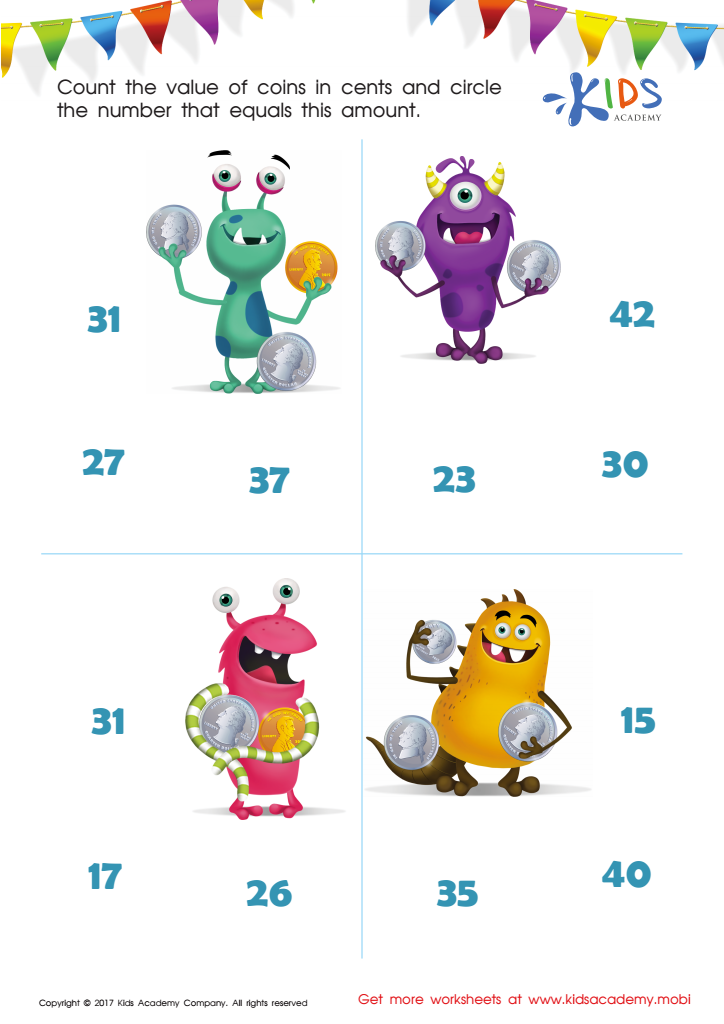
How Many Coins Money Worksheet
Have fun while counting coins: look at the monsters and count the coins in their hands. Challenge your little learners to count and write down the number of coins each one has. Enjoy the time together!
 Assign to My Students
How Many Coins Money Worksheet
Worksheet
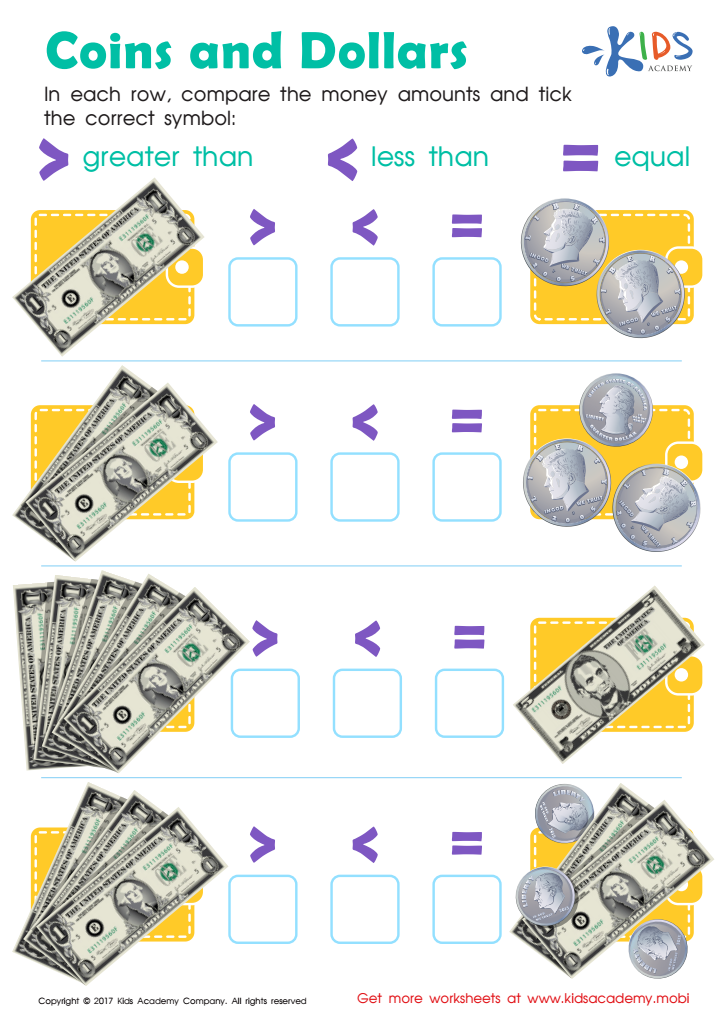
Money: Coins Dollars Printable
Motivate your kid to learn and practise essential math skills, like 'greater than' and 'less than', by introducing the importance of money! The money worksheet "Coins and Dollars" will give them a hands-on experience of counting coins and dollars, making math symbols more memorable.
Money: Coins Dollars Printable
Worksheet
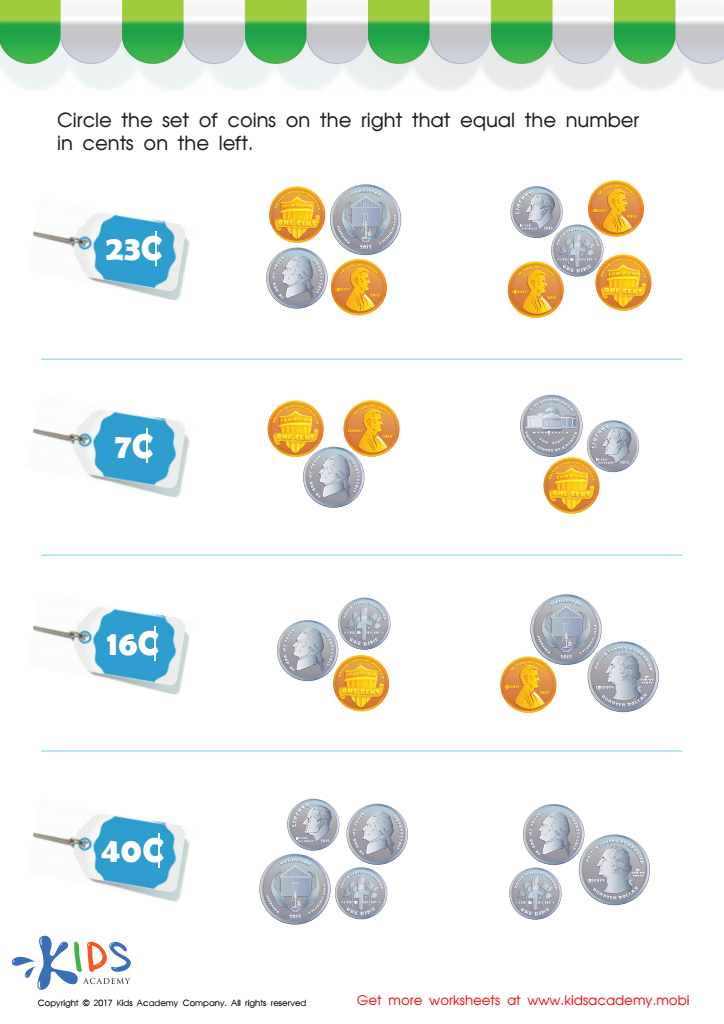
Picking the Coins You Need Money Worksheet
Let's learn to count money with Parents and Kids Academy! Investigate a real shop together: buy a globe, pencils, books, and a school bag using coins. Then, circle the coins you'll need. Visit our website for more free and fun money games for kids!
Picking the Coins You Need Money Worksheet
Worksheet
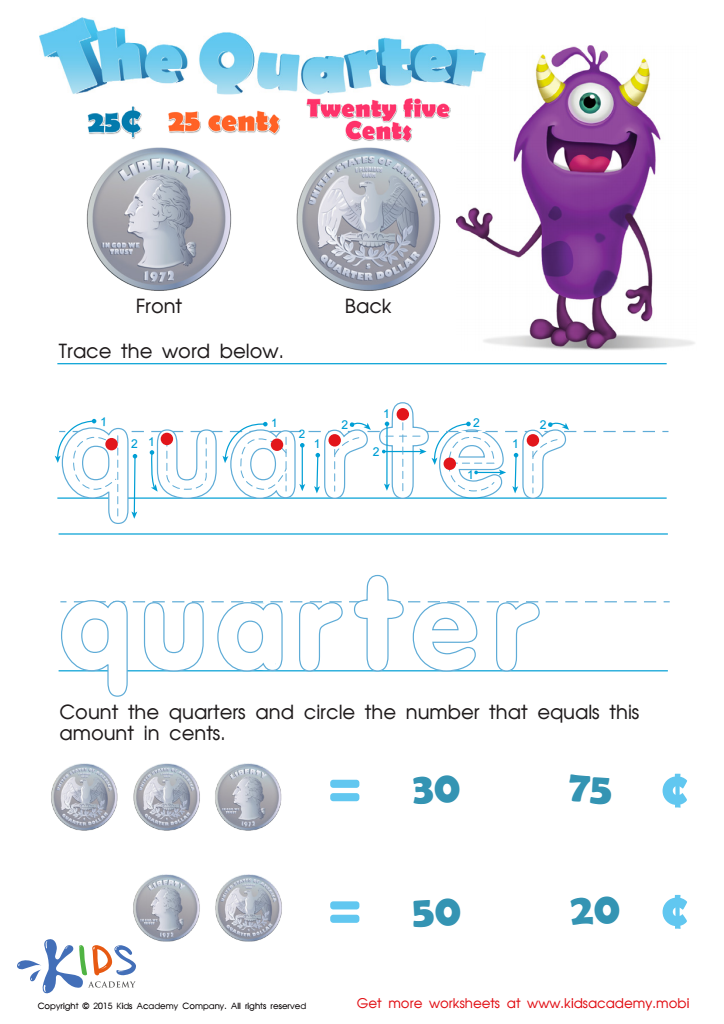
Twenty Five Cents or the Quarter Money Worksheet
Check out our new printable money games - learn to count money easily! With quarters, trace the word, count them and calculate the amount in cents. More worksheets at our website. Give it a try!
Twenty Five Cents or the Quarter Money Worksheet
Worksheet
Join Kids Academy for Free
Who is primarily going to use this learning content?





.jpg)


Counting practice with an added focus on money for children ages 3-4 is crucial for several developmental reasons and should be a priority for both parents and teachers. At this tender age, children are in the foundational stages of conceptual understanding and numerical cognition. Introducing counting through the context of money not only makes the activity engaging but also lays the groundwork for practical life skills.
First, by incorporating money into counting practices, children can develop a basic understanding of financial literacy. This early exposure helps demystify the concept of money, promoting thoughtful and measured spending behaviors later in life.
Second, hands-on counting practice, especially with tangible objects like coins, enhances fine motor skills and spatial understanding. Handling coins gives kids tactile and visual experiences that enrich their learning. Additionally, the differentiation in size and color of coins can bolster their ability to categorize and recognize patterns, setting a solid foundation for arithmetic and problem-solving skills.
Third, framing counting exercises around real-world items like money keeps children engaged, making learning both fun and relevant. Such activities can significantly boost their attention span and foster an intrinsic motivation for learning, creating a positive attitude towards education.
Therefore, merging counting exercises with early lessons in money not only teaches fundamental math skills but also instills invaluable life skills, fostering both cognitive and practical development in young children.








