Understanding plurals Extra Challenge Grammar Worksheets for Ages 3-4
3 filtered results
Difficulty Level
Grade
Age
-
From - To
Subject
Activity
Standards
Enhance your child's understanding of plurals with our "Understanding Plurals Extra Challenge Grammar Worksheets" designed specifically for ages 3-4. These engaging worksheets foster essential language skills through interactive activities that help children recognize and form plural nouns. Each worksheet is crafted to captivate young minds, encouraging them to differentiate between singular and plural objects in a fun and playful way. As children complete these challenges, they will gain confidence in their vocabulary, paving the way for stronger communication skills. Perfect for home or classroom use, these worksheets create a solid foundation in grammar while sparking curiosity and creativity.
Favorites
With answer key
Interactive
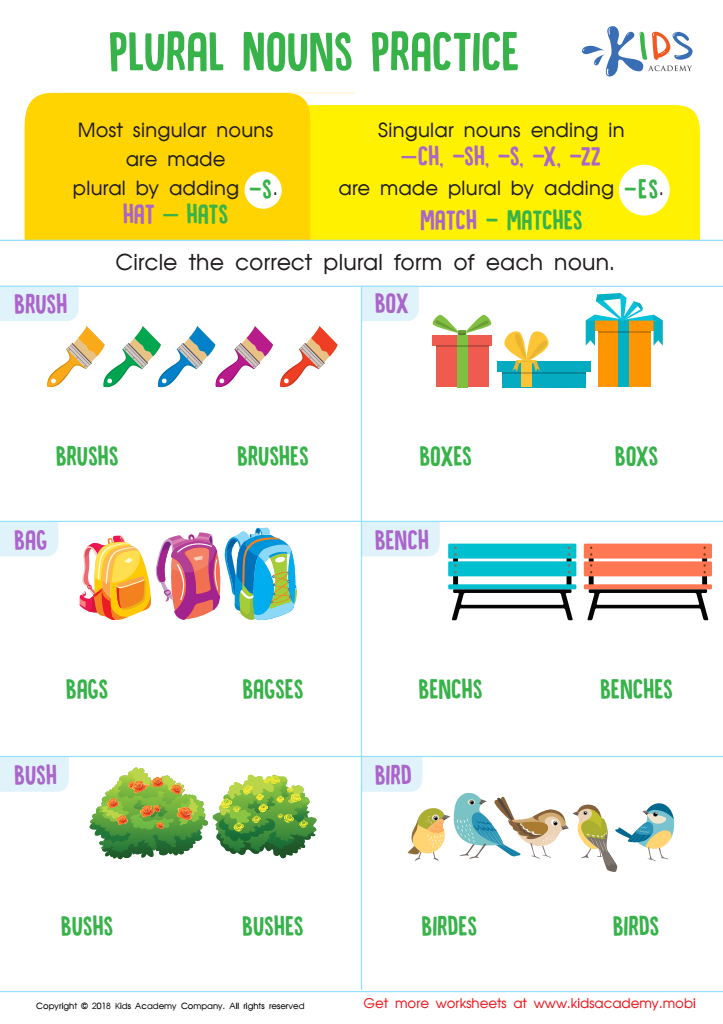
Plural Nouns Practice Worksheet
Explain to your child that most singular nouns become plural by adding "-s". E.g. "cat"->"cats". For words ending in "-ch", "-sh", "-s", "-x", or "-zz", add "-es". E.g. "buzz"->"buzzes". Then, get them to circle the right plural form of each noun on the worksheet.
 Assign to My Students
Plural Nouns Practice Worksheet
Worksheet
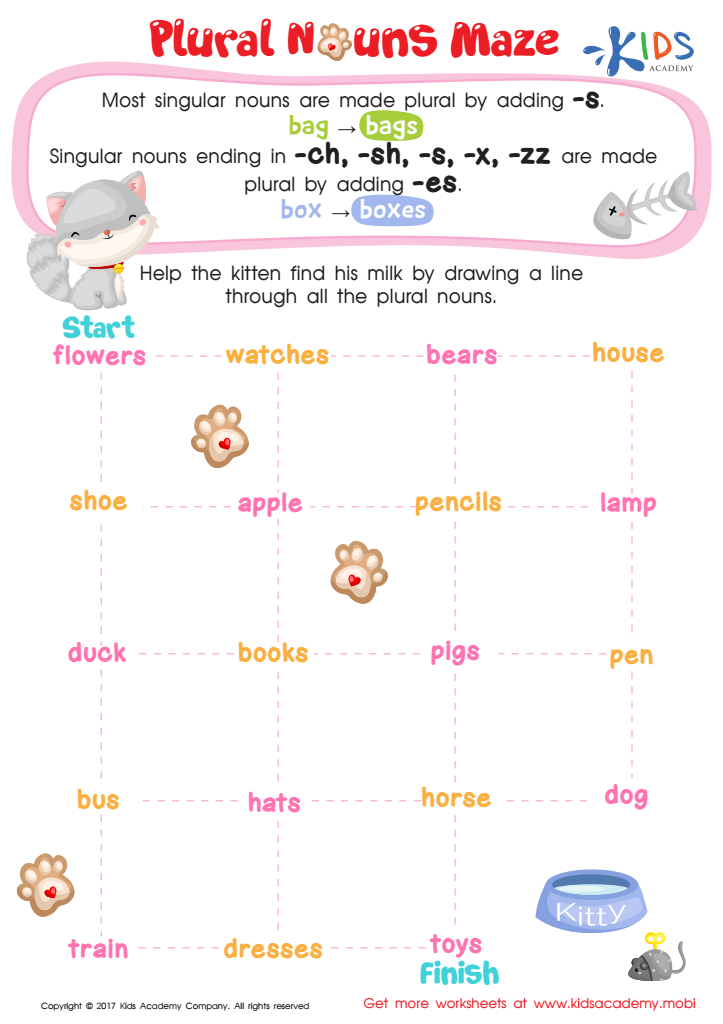
Plural Nouns Maze Worksheet
Oh no, the kitty needs her milk! Help your learner navigate the maze by drawing a line through the plural words. Review the grammar rules on -s and -es endings, then get to work to guide the kitten to her bowl! Download this PDF worksheet to start.
Plural Nouns Maze Worksheet
Worksheet
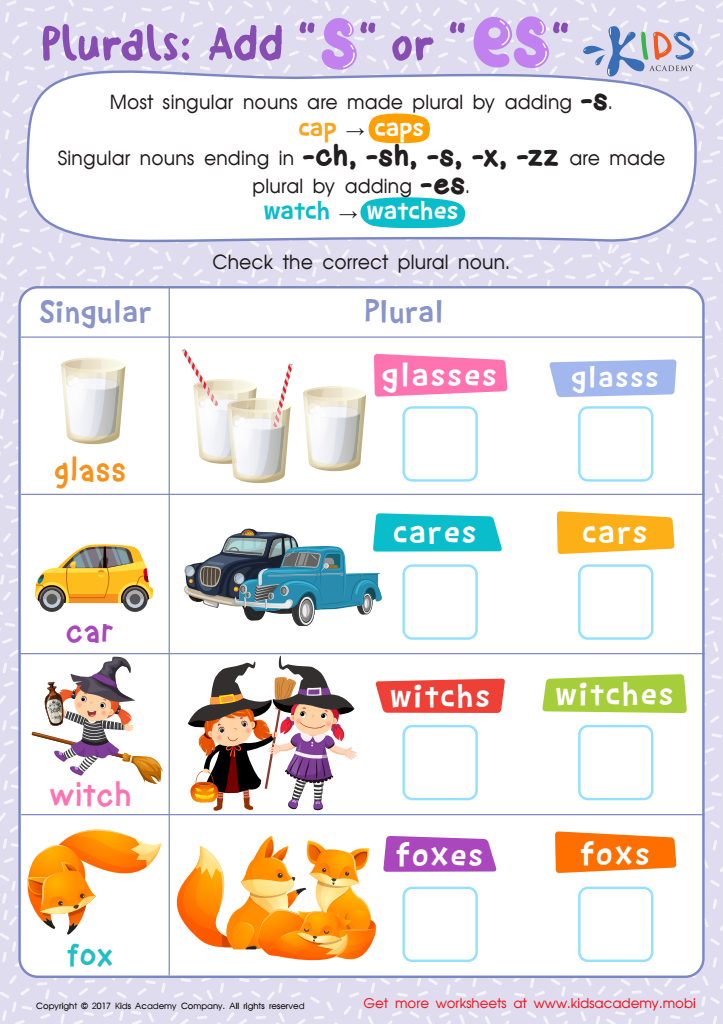
Plurals: "–es" or "–es"? Worksheet
Learning plural nouns can be tough for young readers. This worksheet shows them the difference between singular and plural spelling with cute images. Read each word and check the correct version. Remind them why the other ending can't be used.
Plurals: "–es" or "–es"? Worksheet
Worksheet
Join Kids Academy for Free
Who is primarily going to use this learning content?


.jpg)




Understanding plurals is a critical aspect of language development for young children, particularly for ages 3-4. Parents and teachers should prioritize this grammar lesson because it lays a strong foundation for effective communication. Recognizing the difference between singular and plural forms aids children in expanding their vocabulary, enhancing both their verbal and written skills.
At this pivotal age, children are naturally curious and are exploring language through play and interaction. Teaching them about plurals helps them describe the world accurately and encourages observation and categorization—a key cognitive skill. When children learn to express that “one cat” becomes “two cats,” they not only understand quantity but also engage in fundamental mathematical concepts.
Moreover, grasping plurals fosters social interactions as children can better articulate their needs and thoughts, reducing frustration and enhancing cooperation with peers. For parents and teachers, nurturing this understanding paves the way for smoother communication and deeper learning experiences.
Incorporating plural lessons can be fun and interactive, using games, books, and creative activities, making language development enjoyable. By focusing on plurals, parents and teachers empower children with the tools needed for effective communication and future academic success.