Comparing lengths Extra Challenge Math Worksheets for Ages 3-5
3 filtered results
Difficulty Level
Grade
Age
-
From - To
Subject
Activity
Standards
Looking to challenge your little learner's understanding of measurements? Our Comparing Lengths Extra Challenge Math Worksheets for Ages 3-5 are perfect for preschoolers seeking to master new skills. Designed by educators, these worksheets offer fun activities that help young children compare and contrast different lengths using everyday objects. Through engaging visuals and playful tasks, kids will sharpen their observational skills while gaining a solid grasp of measurement concepts. Ideal for enhancing early math abilities in a fun and interactive way! Suitable for home or classroom use, this extra challenge builds confidence and fosters a love for learning in young mathematicians.
Favorites
With answer key
Interactive
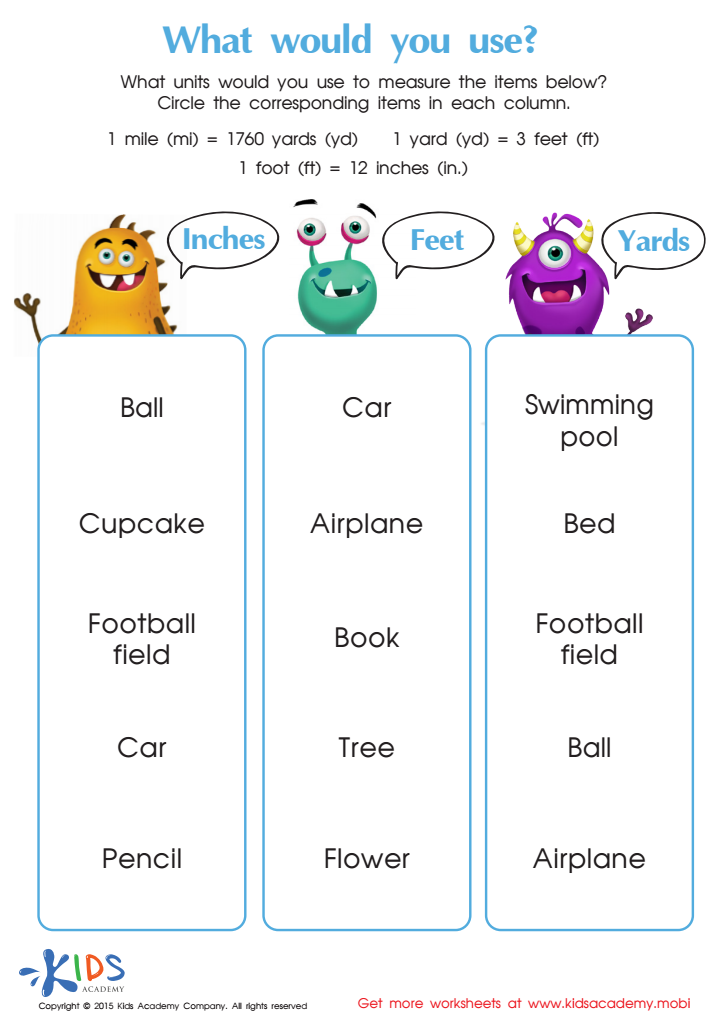
Learning about measuring objects in inches, feet and yards Worksheet
Download, cut and let your preschoolers learn and have fun estimating objects like pencils, airplanes and swimming pools in inches, feet and yards!
 Assign to My Students
Learning about measuring objects in inches, feet and yards Worksheet
Worksheet
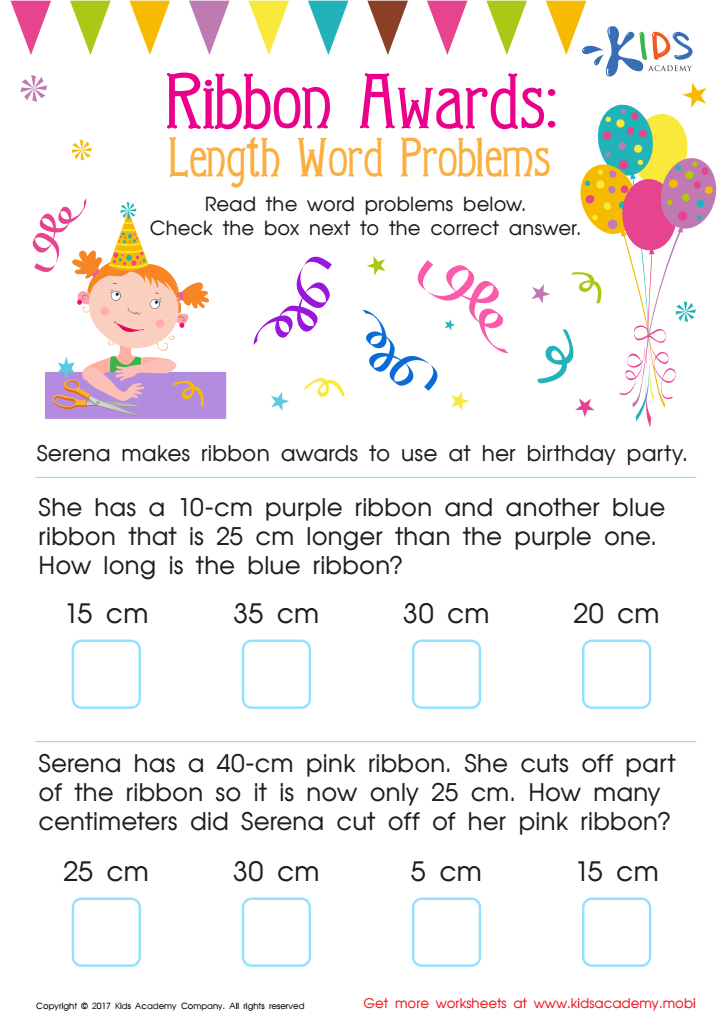
Length Word Problems Worksheet
Word problems help grade 2 students practice measurement using everyday scenarios. This worksheet provides practice in working with centimeters and inches, like measuring ribbon. It's a great way to learn and apply math skills.
Length Word Problems Worksheet
Worksheet
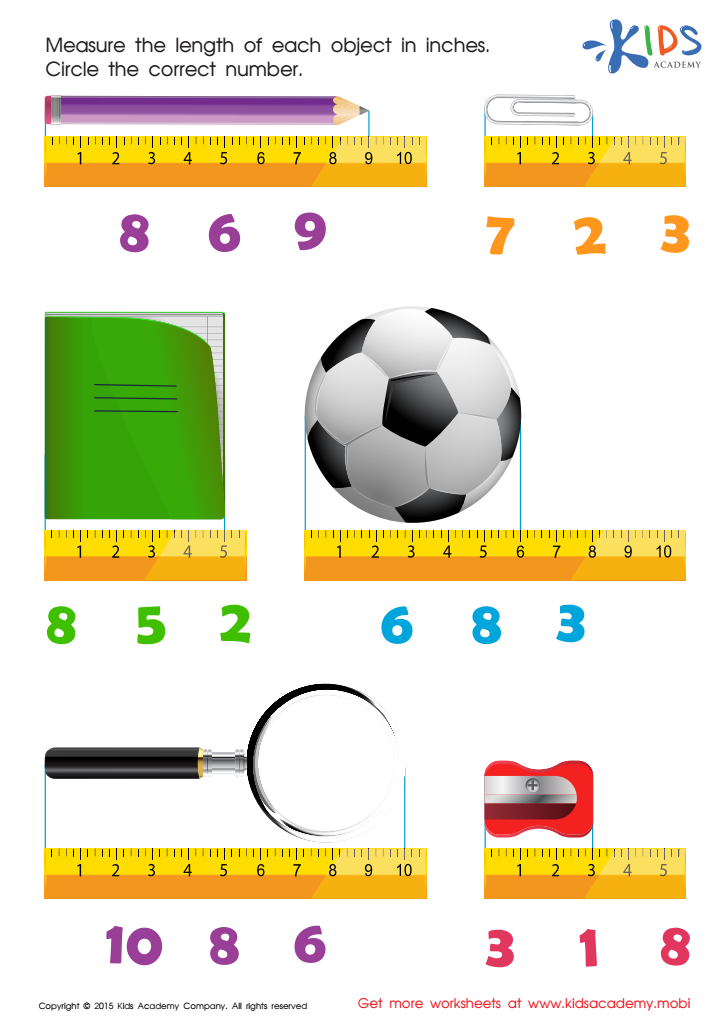
Learning measuring objects in inches Worksheet
Help your little learners gain confidence in using a ruler! Print out our free worksheet, cut out the inch ruler, and let them measure and record objects' width and length. Kids Academy has a variety of math worksheets to make learning math fun! Check out our website for more free printables!
Learning measuring objects in inches Worksheet
Worksheet
Join Kids Academy for Free
Who is primarily going to use this learning content?





Comparing lengths and engaging in extra challenge math activities for children ages 3-5 is foundational in developing critical early math skills and cognitive abilities. During these formative years, young children are exceptionally receptive to learning, and introducing concepts like length comparison helps in fostering their natural curiosity and cognitive growth.
First, comparing lengths introduces the foundational concept of measurement. By using everyday objects, children start to understand that sizes can be different and can be compared. They begin to grasp crucial basic math ideas, such as longer, shorter, taller, and smaller, setting the stage for more complex mathematical thinking.
Secondly, these activities enhance problem-solving and analytical thinking. When children are tasked with comparing lengths, they actively sort, classify, and differentiate objects based on physical attributes. This boosts their observation skills and attention to detail, directly benefiting their overall cognitive development.
Additionally, math challenges around length comparison promote language development. Discussing their observations requires children to articulate and reason out loud, enriching their vocabulary and communication skills.
Finally, engaging in interactive and fun math activities supports a positive attitude toward learning. This early positive association with math encourages a lifelong love for the subject, laying a strong foundation for future academic success. Therefore, parents and teachers should prioritize such early math challenges to nurture well-rounded, intellectually curious, and capable young learners.