
Comparing lengths Extra Challenge Measurement Worksheets for Ages 3-6
5 filtered results
Difficulty Level
Grade
Age
-
From - To
Subject
Activity
Standards
Unlock your child's potential with our "Comparing Lengths Extra Challenge Measurement Worksheets" designed specifically for ages 3-6. These engaging and educational worksheets help little ones grasp the concept of length by comparing objects in fun and interactive ways. Carefully crafted to be age-appropriate and visually appealing, they enhance critical thinking and fine motor skills. Perfect for home or classroom use, our worksheets offer an extra challenge to inspire confidence and curiosity in young learners. Discover endless opportunities for growth and practice in measurement, and make learning an enjoyable adventure for your preschooler!
Favorites
With answer key
Interactive
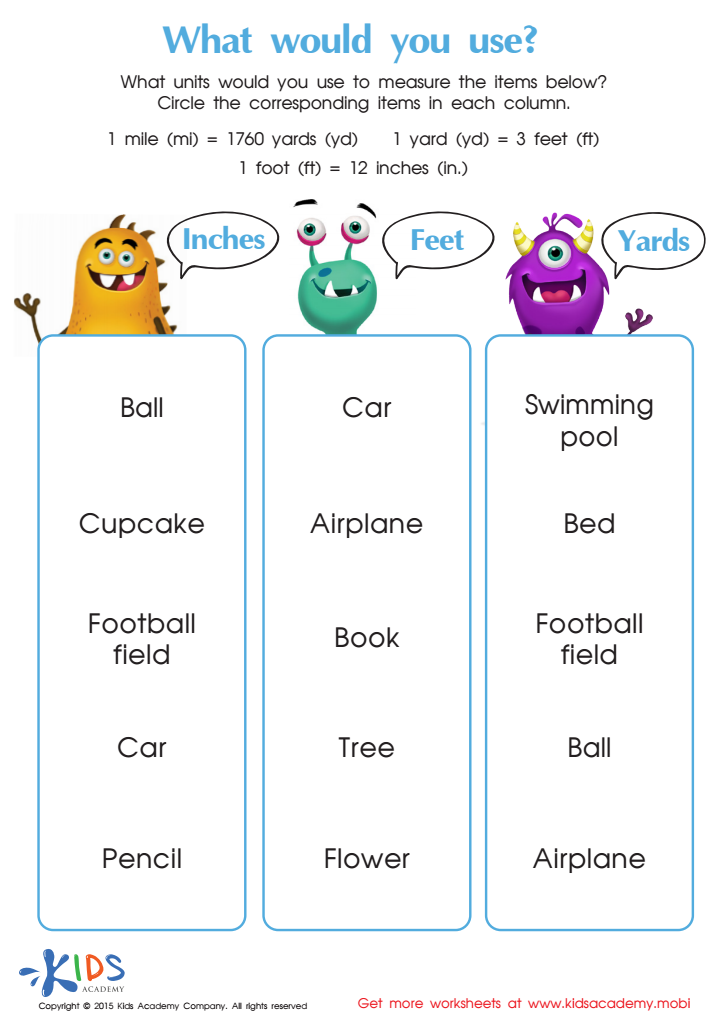
Learning about measuring objects in inches, feet and yards Worksheet
Download, cut and let your preschoolers learn and have fun estimating objects like pencils, airplanes and swimming pools in inches, feet and yards!
 Assign to My Students
Learning about measuring objects in inches, feet and yards Worksheet
Worksheet
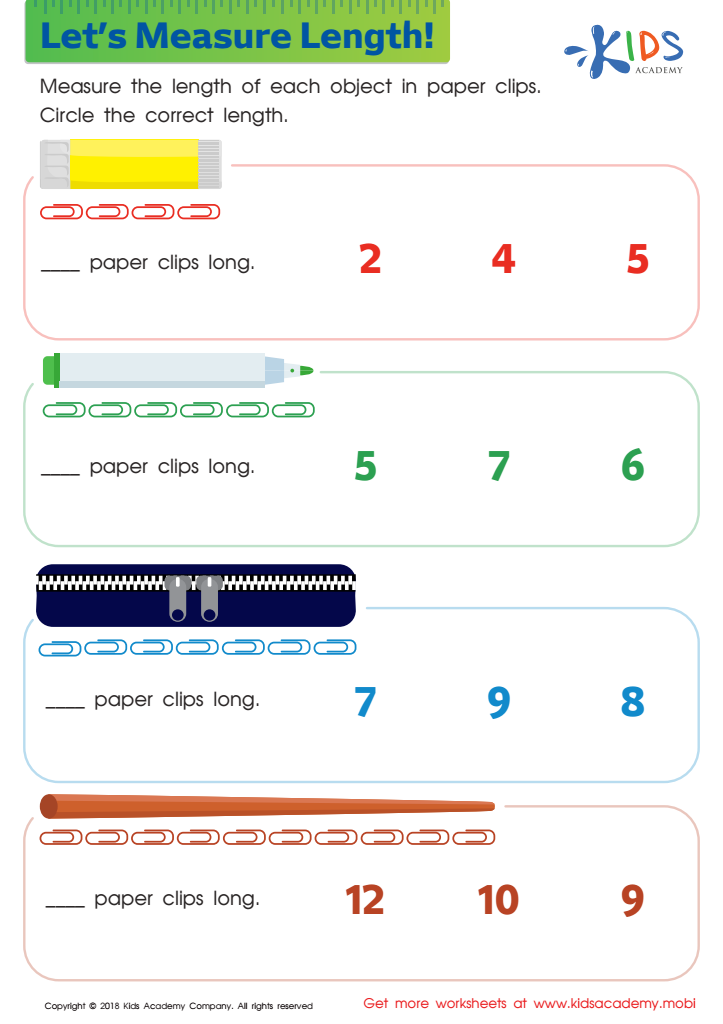
Lets Measure Length Worksheet
It's time to help your child take their measuring skills up a notch! This colorful PDF sheet from Kids Academy introduces kids to measuring with paperclips. Guide them through the page, showing them how to count the clips to measure each image. Then, circle the correct length for each to complete the sheet!
Lets Measure Length Worksheet
Worksheet
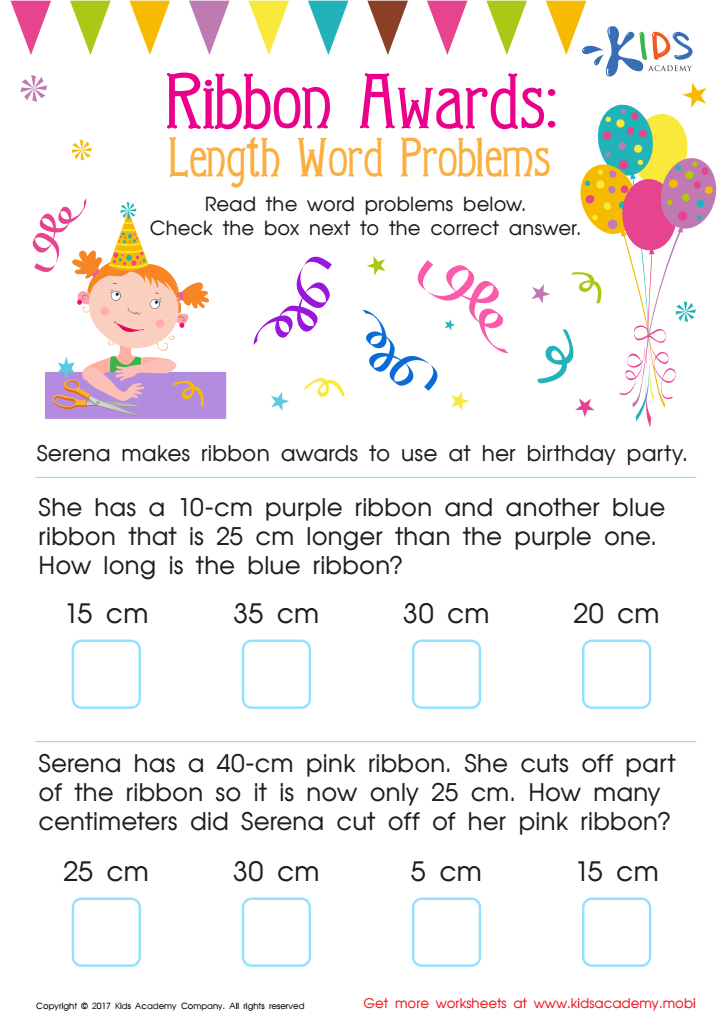
Length Word Problems Worksheet
Word problems help grade 2 students practice measurement using everyday scenarios. This worksheet provides practice in working with centimeters and inches, like measuring ribbon. It's a great way to learn and apply math skills.
Length Word Problems Worksheet
Worksheet
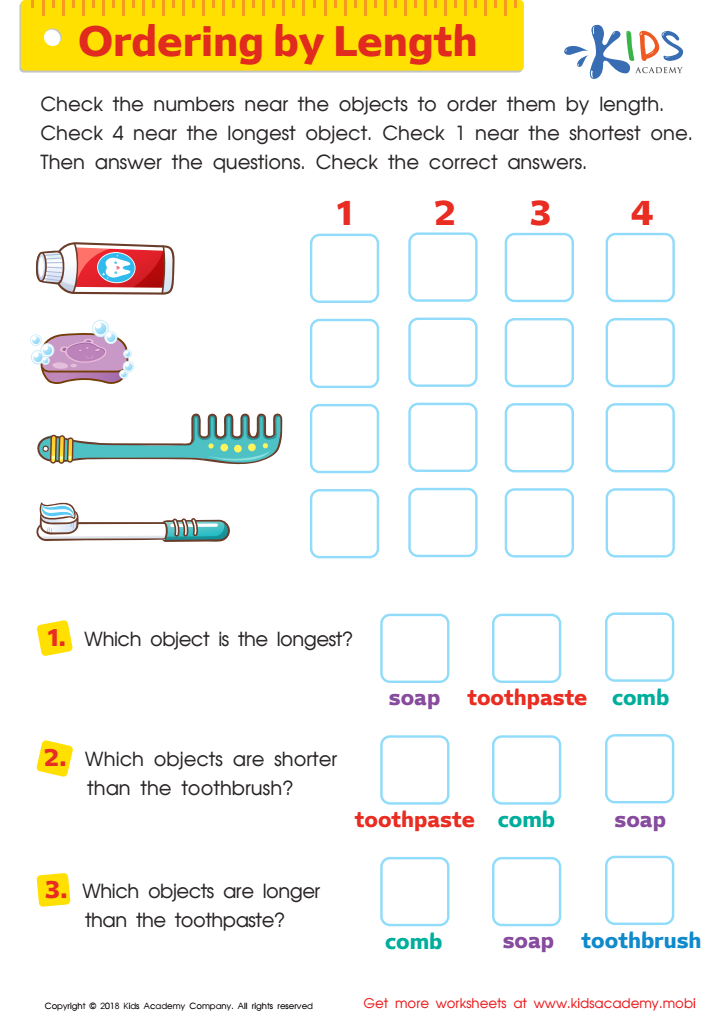
Ordering by Length Worksheet
Compare objects to learn about measurement! Before purchasing a ruler, get kids to understand length by comparing objects and labeling them as longer or shorter than others. Use this printable math worksheet to help children think about measurement. It will show pictures of objects and ask children to categorize them by length.
Ordering by Length Worksheet
Worksheet
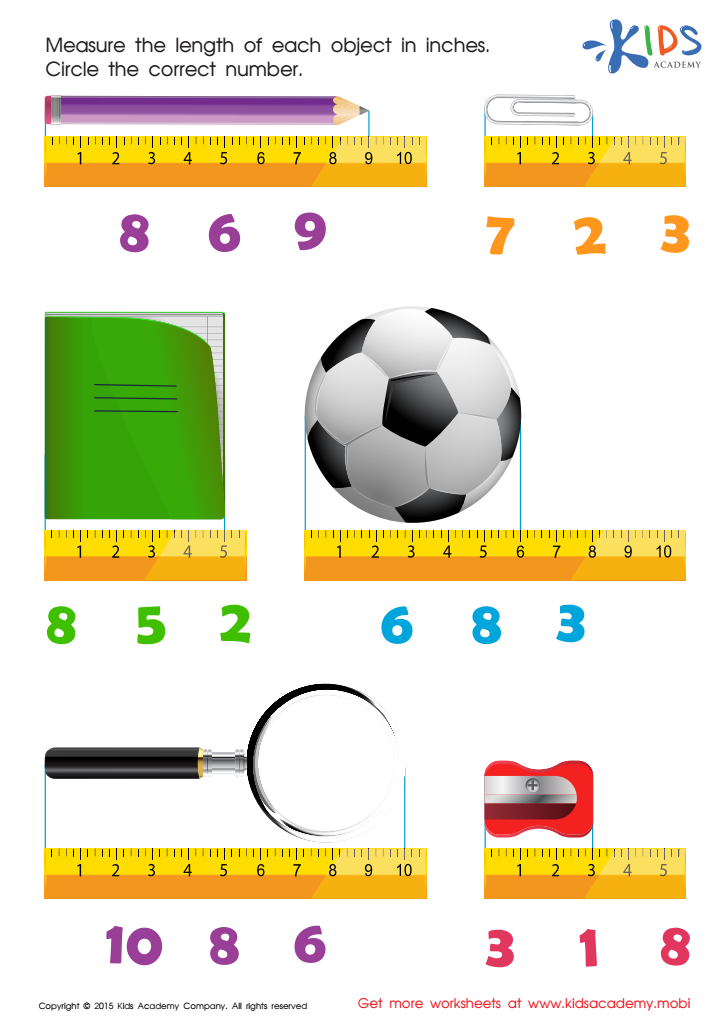
Learning measuring objects in inches Worksheet
Help your little learners gain confidence in using a ruler! Print out our free worksheet, cut out the inch ruler, and let them measure and record objects' width and length. Kids Academy has a variety of math worksheets to make learning math fun! Check out our website for more free printables!
Learning measuring objects in inches Worksheet
Worksheet
Join Kids Academy for Free
Who is primarily going to use this learning content?








Parents and teachers play a crucial role in fostering early cognitive development in children aged 3-6, and comparing lengths through measurement activities serves as an excellent developmental tool. Engaging young children in comparing lengths introduces fundamental mathematical concepts in a hands-on, understandable way. It helps them develop critical problem-solving skills and spatial awareness, which are foundational for more complex mathematical thinking.
When children participate in activities that involve measuring and comparing the lengths of different objects, they learn to observe, describe, and categorize their environment. This not only builds their vocabulary but also enhances their ability to communicate comparisons using terms such as “longer,” “shorter,” and “same length.”
Moreover, these activities develop fine motor skills and hand-eye coordination as children manipulate objects and use simple tools like rulers or measuring tapes. Participation in measuring exercises encourages logical reasoning as children decide the most appropriate ways to measure and compare items.
By emphasizing these foundational skills through fun, engaging activities, parents and teachers are setting up young learners for future success in various subjects such as math, science, and even reading comprehension. The practical experience of comparing lengths also aligns with real-world tasks, making learning relevant and meaningful for young children.








