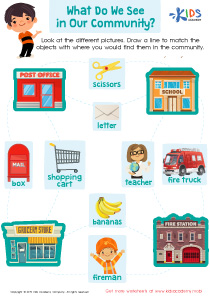
Understanding currency Extra Challenge Math Worksheets for Ages 3-7
3 filtered results
-
From - To
Introduce your young learners to the fundamentals of money with our "Understanding Currency Extra Challenge" math worksheets, tailored for ages 3-7. These engaging worksheets are designed to boost early math skills, combining learning with fun illustrations. Children will explore the value of coins and bills through a progressive series of challenges, ensuring they grasp basic financial literacy early on. Perfect for parents and teachers looking to enhance their kids' understanding of currency while reinforcing counting, addition, and recognition skills. Help your child build a strong mathematical foundation with these captivating and educational activities!
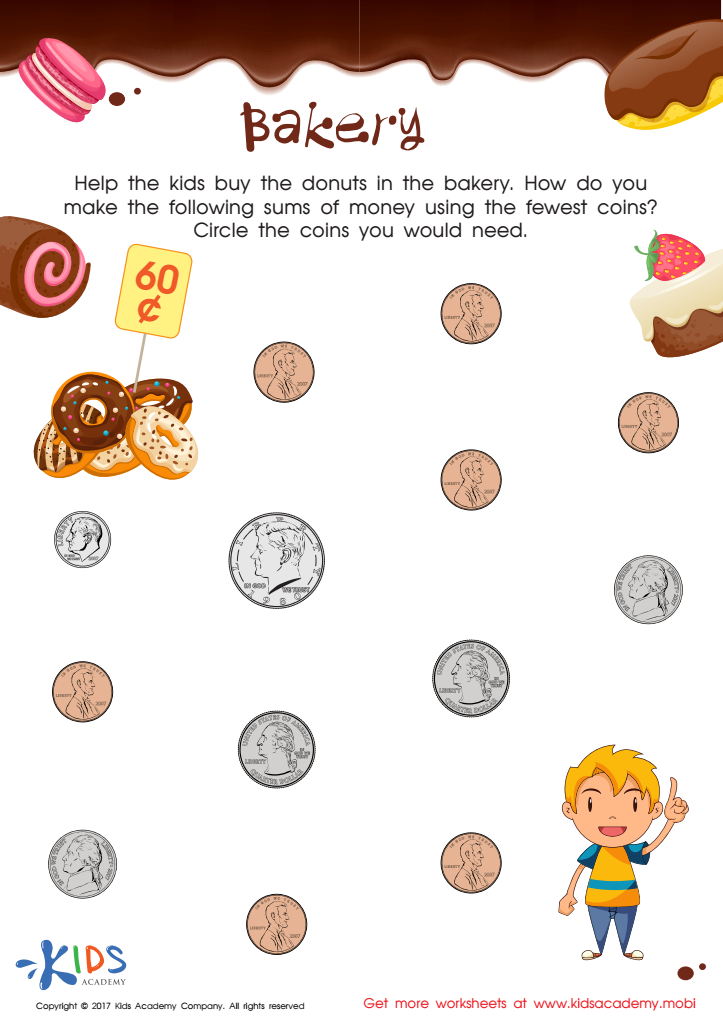
Counting Coins Worksheet
 Assign to My Students
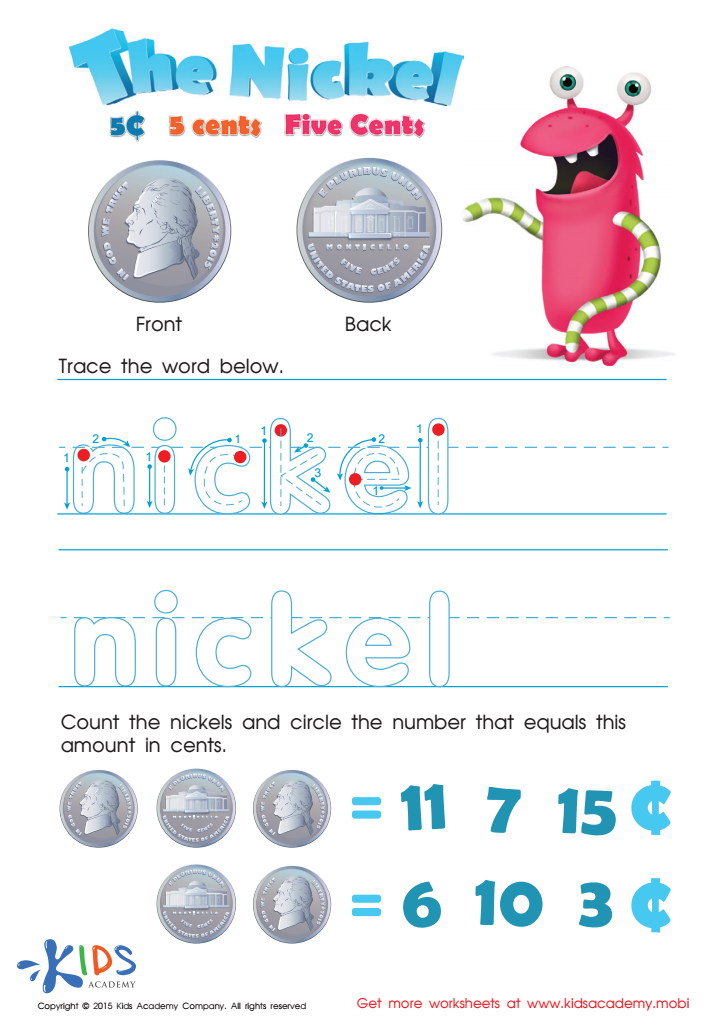
Five Cents or the Nickel Money Worksheet
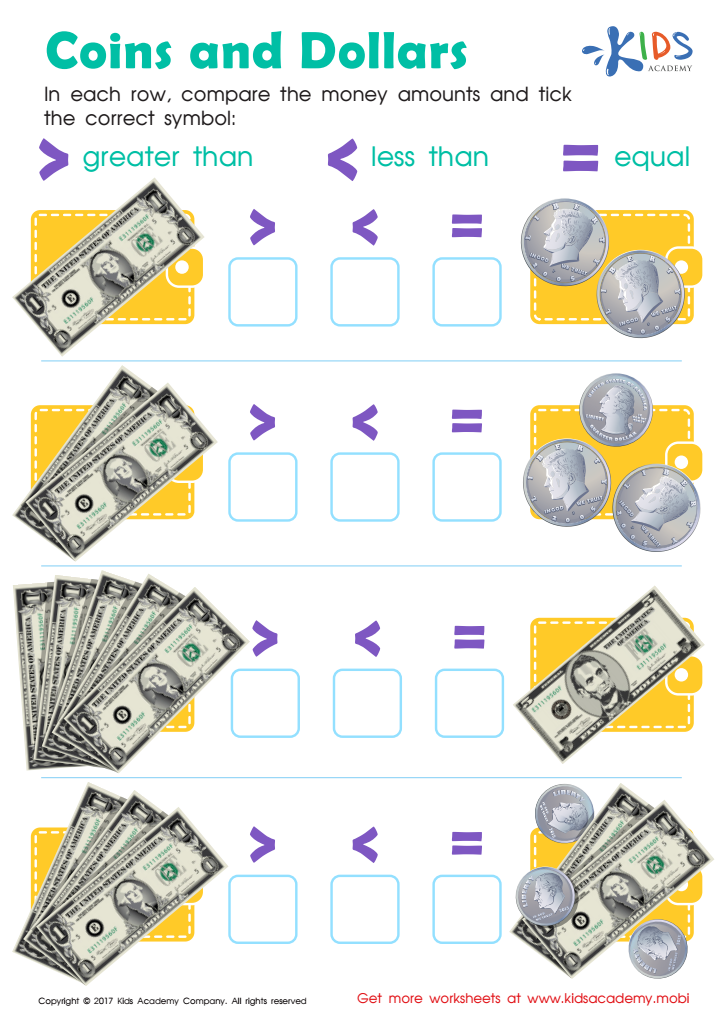
Money: Coins Dollars Printable








Understanding currency is an essential life skill that lays the foundation for financial literacy. For children ages 3-7, it is crucial to introduce the concept of money in a fun and engaging manner to foster early math skills. Parents and teachers should care about integrating currency-oriented activities because it helps children grasp real-world applications of math, aiding in their overall cognitive development.
Early exposure to currency teaches children to recognize coins and bills, understand their values, and perform simple transactions. This practical knowledge builds a strong basis for addition and subtraction, as kids often start with tasks like counting coins or making change. Involving currency in play, such as in pretend stores and games, makes learning interactive and relatable, ensuring better retention.
Moreover, these activities encourage problem-solving and critical thinking. When faced with challenges like "Do I have enough money to buy two toys?" children learn decision-making and the importance of saving. Socially, it fosters responsibility and the understanding of earning and spending, laying the groundwork for good financial habits later in life.
In essence, focusing on currency in early education equips children with essential, practical skills that extend beyond the classroom. Teachers and parents play a pivotal role in embedding these foundational concepts, ultimately setting the stage for more sophisticated math and financial understanding.