Fraction visualization Extra Challenge Fractions of Shapes Worksheets for Ages 4-7
3 filtered results
Difficulty Level
Grade
Age
-
From - To
Subject
Activity
Standards
Enhance your child's understanding of fractions with our "Fraction Visualization Extra Challenge Fractions of Shapes Worksheets” designed for ages 4-7. These engaging printable activities introduce young learners to the basics of fractions through fun and interactive visualization of shapes. Perfect for reinforcing mathematical concepts, these worksheets help children develop critical thinking skills and improve their ability to partition shapes into equal parts. Designed by educational experts, our fraction worksheets provide an excellent head start in math proficiency. Perfect for classroom use or home learning, foster your child's love for math and boost their confidence with our specially crafted resources.
Favorites
With answer key
Interactive
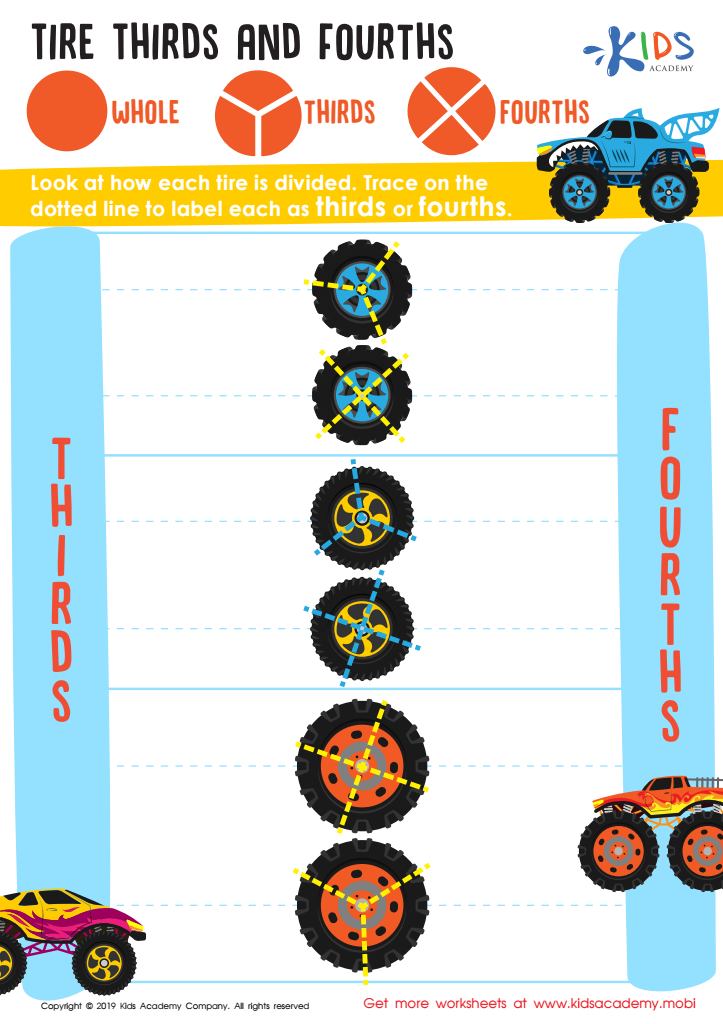
Tire Thirds and Fourths Worksheet
Learning geometry is key in your child's education. Have them identify and name shapes cut into 2, 3 and 4 parts. Test their knowledge with this worksheet - trace the dotted line to label each as third or fourth. Encourage them to keep learning!
 Assign to My Students
Tire Thirds and Fourths Worksheet
Worksheet
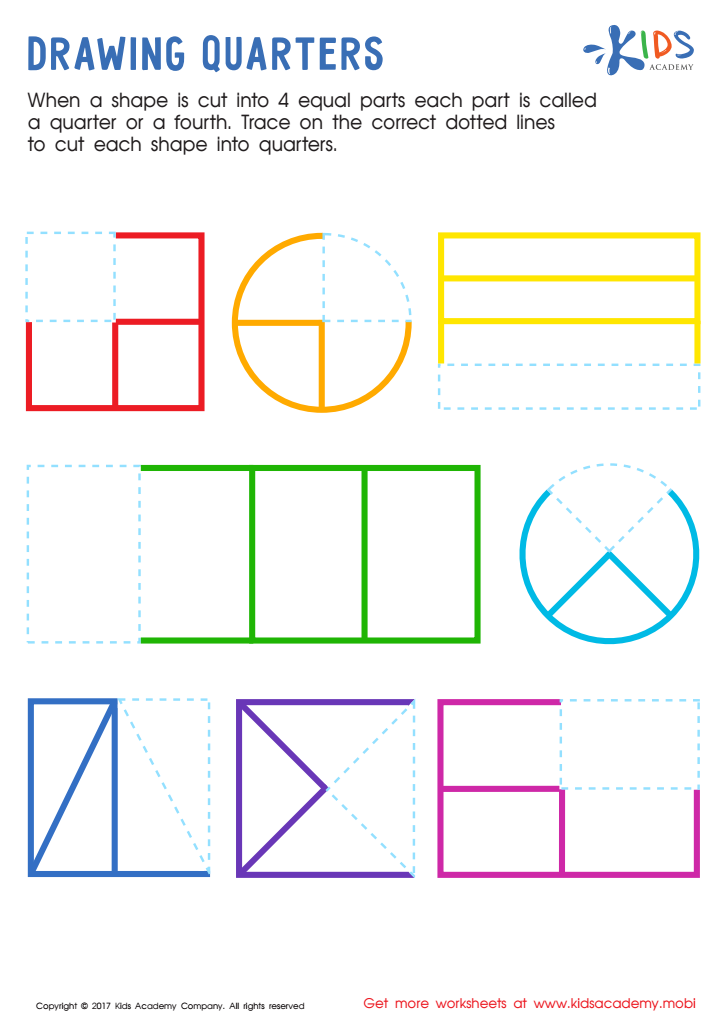
Drawing Quarters Worksheet
Help your kids divide shapes into quarters! Have them trace dotted lines to cut each shape into 4 equal parts. Each of the 4 parts is called a quarter or a fourth. This worksheet will help kids learn more about dividing shapes into four equal parts.
Drawing Quarters Worksheet
Worksheet
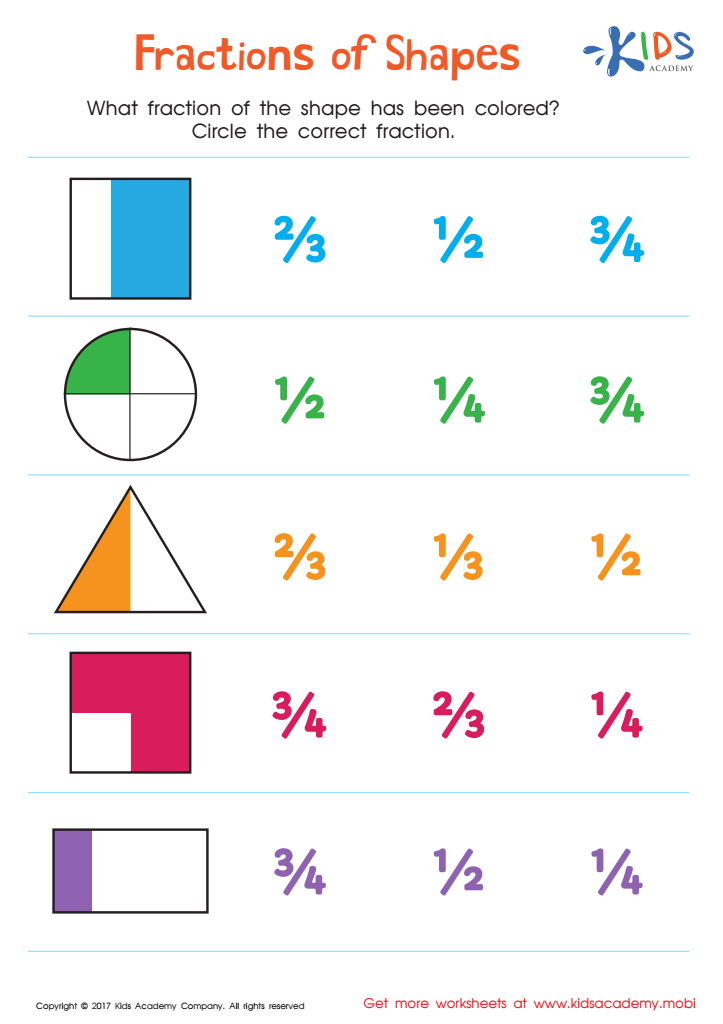
Fractions of Shapes: Math Concept Worksheet
Fractions can be tricky, but with pictures to illustrate them, they become much easier to understand. Our fractions of shapes worksheet is a great way to help children visualize fractions and gain a better understanding of them.
Fractions of Shapes: Math Concept Worksheet
Worksheet
Join Kids Academy for Free
Who is primarily going to use this learning content?








Parents and teachers should care about fraction visualization for young children, specifically through activities like "Fraction Challenge: Fractions of Shapes," because it builds foundational mathematical skills in a fun and engaging way. At ages 4-7, children are naturally curious and enjoy hands-on learning experiences. Visualizing fractions using shapes, like dividing a circle into equal parts, helps children comprehend complex mathematical concepts through tangible and relatable examples.
This early exploration into fractions aids in developing number sense, which is crucial for future mathematical reasoning. Young learners gain a more intuitive understanding of parts and wholes, equivalence, and proportionality. Such skills are not only essential for higher-level math but also for everyday decision-making and problem-solving.
Learning fractions through shape division strengthens spatial intelligence and cognitive development. It encourages children to think critically, observe patterns, and understand relationships between different parts of a whole. Moreover, activities that involve coloring or cutting shapes to visualize fractions make learning interactive and enjoyable, thereby promoting a positive attitude towards mathematics from an early age.
In essence, focusing on fraction visualization at an early age cultivates logical thinking, boosts confidence in math, and sets a solid foundation for future educational success. Parents and teachers investing time in these activities offer children a head start in their mathematical journey.