Understanding plurals Extra Challenge Grammar Worksheets for 4-Year-Olds
3 filtered results
Difficulty Level
Grade
Age
-
From - To
Subject
Activity
Standards
Boost your child’s grammar skills with "Understanding Plurals Extra Challenge Grammar Worksheets for 4-Year-Olds." These engaging and educational worksheets are designed to introduce young learners to the concept of plurals in a fun and interactive way. With a variety of colorful activities and exercises, children will learn to recognize and form plural nouns effortlessly while enhancing their writing and reading abilities. Perfect for both classroom and at-home learning, these worksheets will give your child a head start in grammar and language development. Download today to help your child master plurals with confidence!
Favorites
With answer key
Interactive
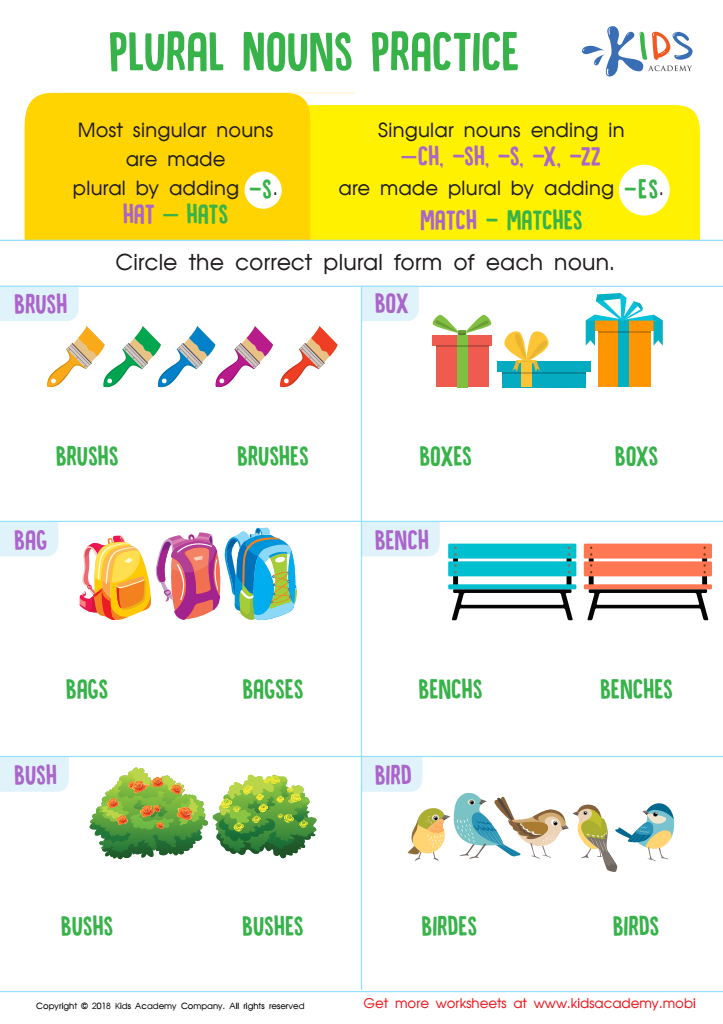
Plural Nouns Practice Worksheet
Explain to your child that most singular nouns become plural by adding "-s". E.g. "cat"->"cats". For words ending in "-ch", "-sh", "-s", "-x", or "-zz", add "-es". E.g. "buzz"->"buzzes". Then, get them to circle the right plural form of each noun on the worksheet.
 Assign to My Students
Plural Nouns Practice Worksheet
Worksheet
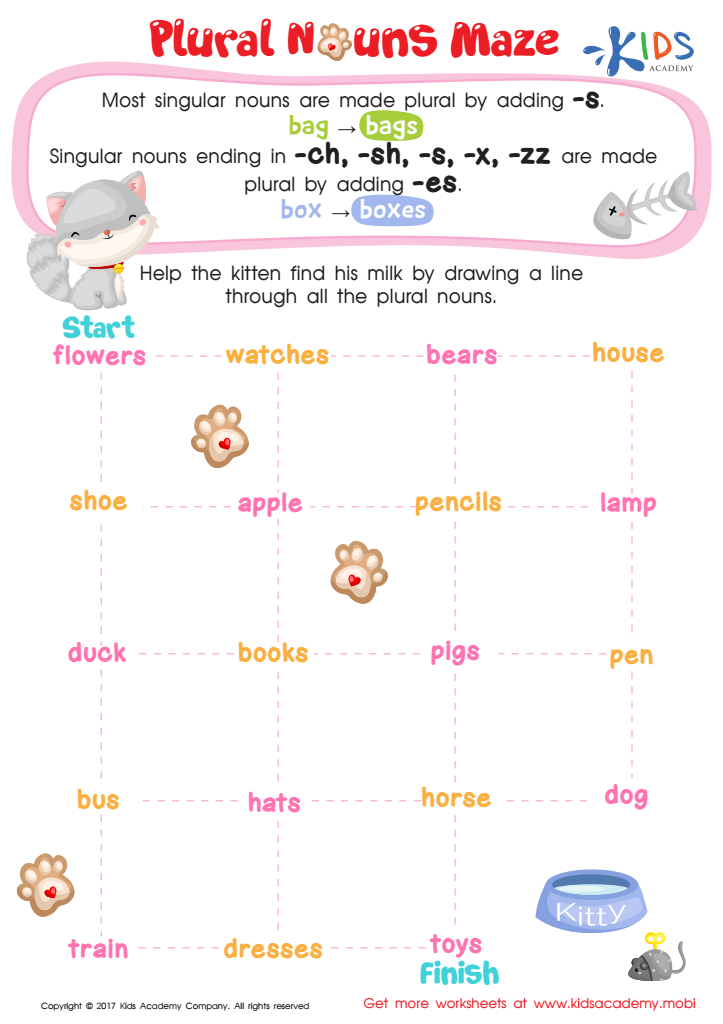
Plural Nouns Maze Worksheet
Oh no, the kitty needs her milk! Help your learner navigate the maze by drawing a line through the plural words. Review the grammar rules on -s and -es endings, then get to work to guide the kitten to her bowl! Download this PDF worksheet to start.
Plural Nouns Maze Worksheet
Worksheet
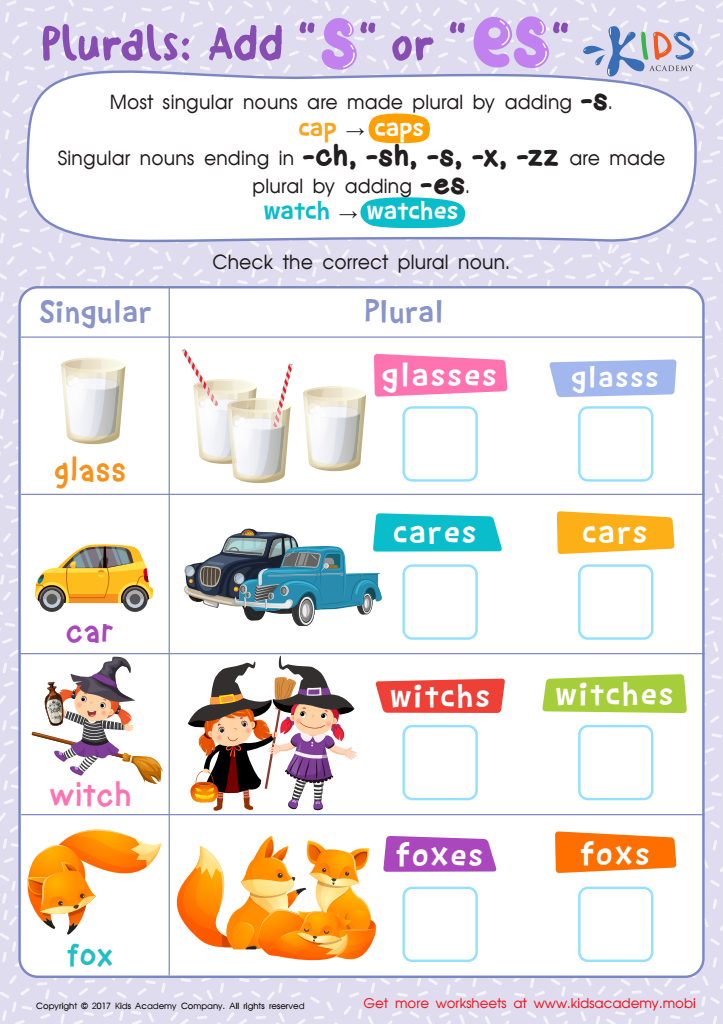
Plurals: "–es" or "–es"? Worksheet
Learning plural nouns can be tough for young readers. This worksheet shows them the difference between singular and plural spelling with cute images. Read each word and check the correct version. Remind them why the other ending can't be used.
Plurals: "–es" or "–es"? Worksheet
Worksheet
Join Kids Academy for Free
Who is primarily going to use this learning content?






Understanding plurals is a fundamental aspect of language development for young children, and extra challenges in grammar help to stimulate a 4-year-old's cognitive and linguistic skills in significant ways. At this age, children's brains are particularly receptive to learning and recognizing patterns in language. By introducing them to plural forms early on, parents and teachers help solidify their grasp of essential grammar rules, which lays the groundwork for more advanced language skills.
When children understand plurals, they enhance their ability to communicate more effectively and precisely. This proficiency not only aids them in everyday conversations but also enriches their reading and writing abilities as they eventually transition to formal education. Moreover, tackling plural forms as an extra challenge encourages critical thinking and reinforces problem-solving skills, as children learn that language isn't always straightforward and often has exceptions to rules.
Additionally, mastering a concept like plurals provides a sense of accomplishment and boosts a child's confidence as they tackle new linguistic challenges. This confidence and curiosity for language can foster a lifelong love for reading and learning. Therefore, parents and teachers who invest time in helping 4-year-olds understand plurals are laying down a crucial foundation for their future academic success and intellectual development.