Understanding plurals Extra Challenge Grammar Worksheets for 6-Year-Olds
3 filtered results
Difficulty Level
Grade
Age
-
From - To
Subject
Activity
Standards
Discover the "Understanding Plurals Extra Challenge Grammar Worksheets for 6-Year-Olds," perfect for young learners eager to master the art of plurals. These expertly designed worksheets from Kids Academy offer engaging exercises that help children practice and understand regular and irregular plural nouns. Each worksheet blends fun and learning, featuring colorful illustrations and a variety of activities to keep kids motivated. Tailored specifically for 6-year-olds, these challenges cultivate grammar skills, enhance vocabulary, and boost overall academic confidence. Equip your child with the tools they need to excel in grammar with our comprehensive and enjoyable plurals worksheets.
Favorites
With answer key
Interactive
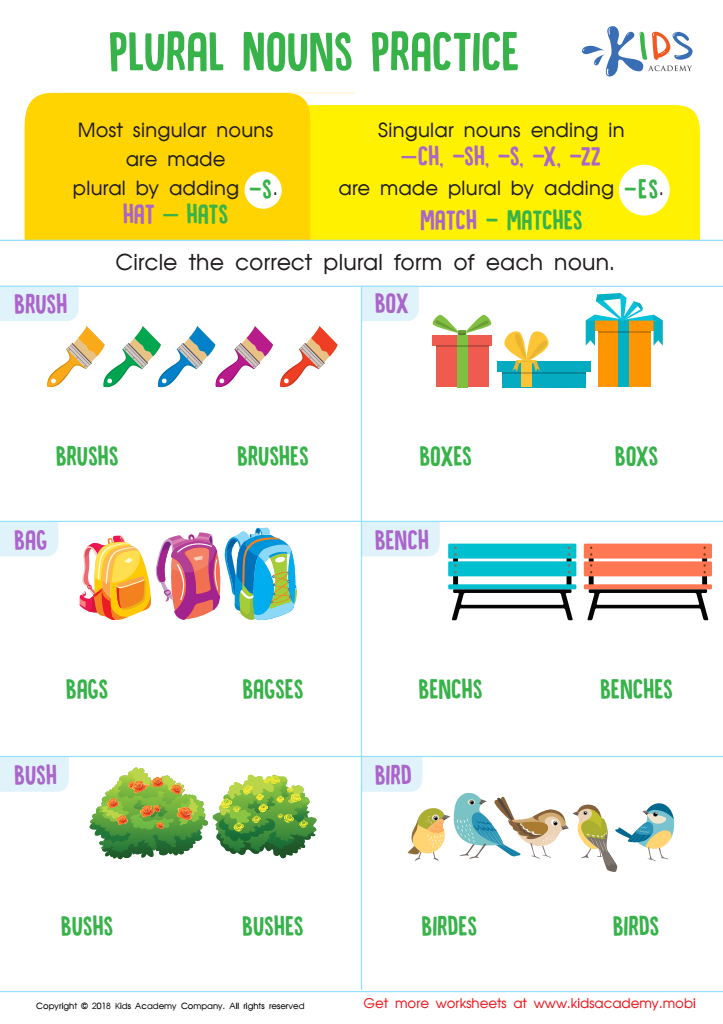
Plural Nouns Practice Worksheet
Explain to your child that most singular nouns become plural by adding "-s". E.g. "cat"->"cats". For words ending in "-ch", "-sh", "-s", "-x", or "-zz", add "-es". E.g. "buzz"->"buzzes". Then, get them to circle the right plural form of each noun on the worksheet.
 Assign to My Students
Plural Nouns Practice Worksheet
Worksheet
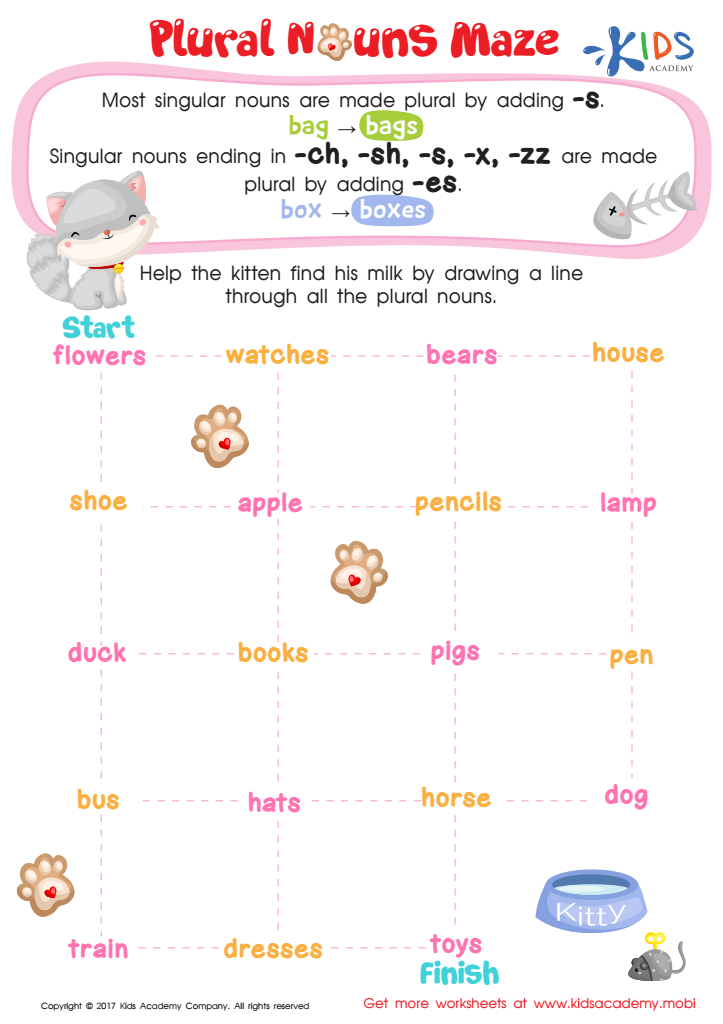
Plural Nouns Maze Worksheet
Oh no, the kitty needs her milk! Help your learner navigate the maze by drawing a line through the plural words. Review the grammar rules on -s and -es endings, then get to work to guide the kitten to her bowl! Download this PDF worksheet to start.
Plural Nouns Maze Worksheet
Worksheet
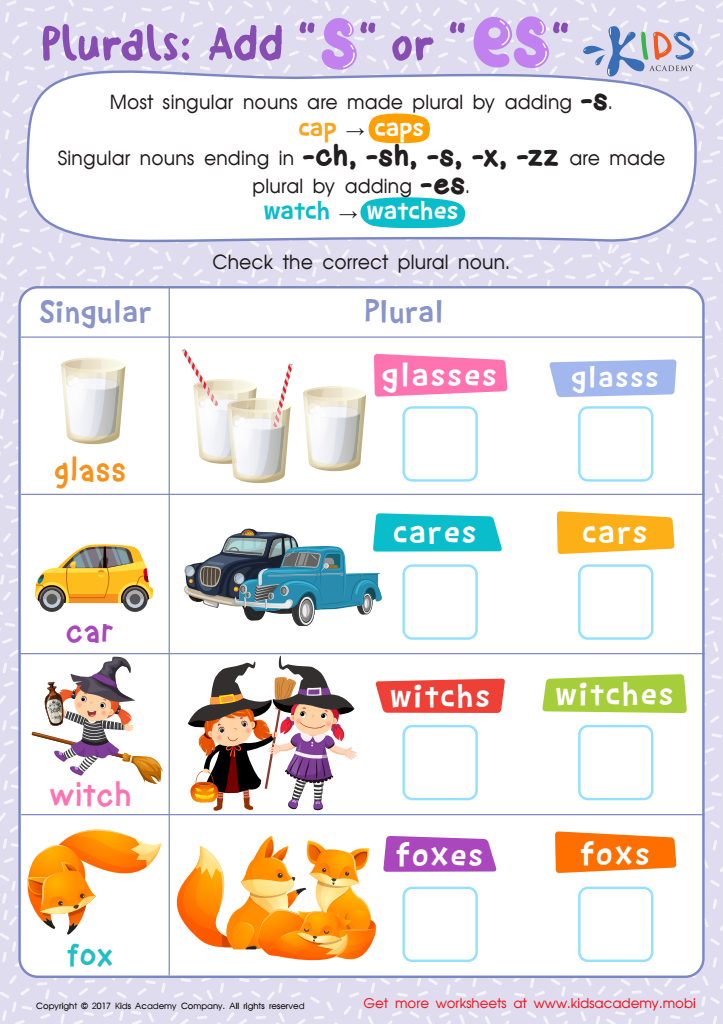
Plurals: "–es" or "–es"? Worksheet
Learning plural nouns can be tough for young readers. This worksheet shows them the difference between singular and plural spelling with cute images. Read each word and check the correct version. Remind them why the other ending can't be used.
Plurals: "–es" or "–es"? Worksheet
Worksheet
Join Kids Academy for Free
Who is primarily going to use this learning content?



.jpg)


Understanding plurals is a fundamental aspect of language development for 6-year-olds and plays a crucial role in cultivating strong grammar skills. At this age, children are rapidly expanding their vocabularies and beginning to form more complex sentences. Mastering plurals aids them in accurately conveying quantities and enhances their descriptive abilities, both of which are essential for effective communication.
Parents and teachers should care about this grammatical concept because it's a building block for reading and writing proficiency. Recognizing and using the correct forms of plurals helps children improve their spelling and pronunciation skills. It contributes to better comprehension when reading stories and helps them articulate their thoughts more clearly when speaking or writing.
Additionally, knowledge of plurals can lay the groundwork for future learning. It encourages cognitive skills such as pattern recognition and critical thinking. For educators, integrating plural exercises into the curriculum fosters an environment where children feel challenged and engaged, promoting a sense of achievement.
Introducing the 'Extra Challenge Grammar' activities keeps learning fun and interactive, keeping children motivated and enthusiastic about language learning. Parental involvement reinforces these concepts at home, creating a consistent learning environment that supports the child's overall development.