Mental math skills Extra Challenge Grade 3 Mixed Times Tables Worksheets
3 filtered results
-
From - To
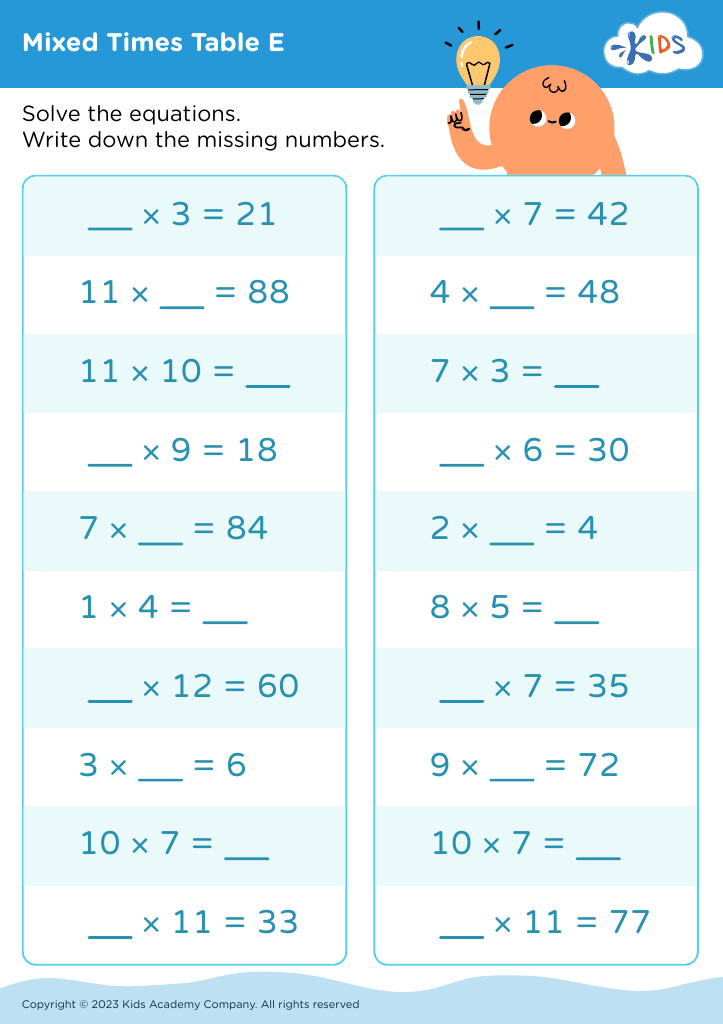
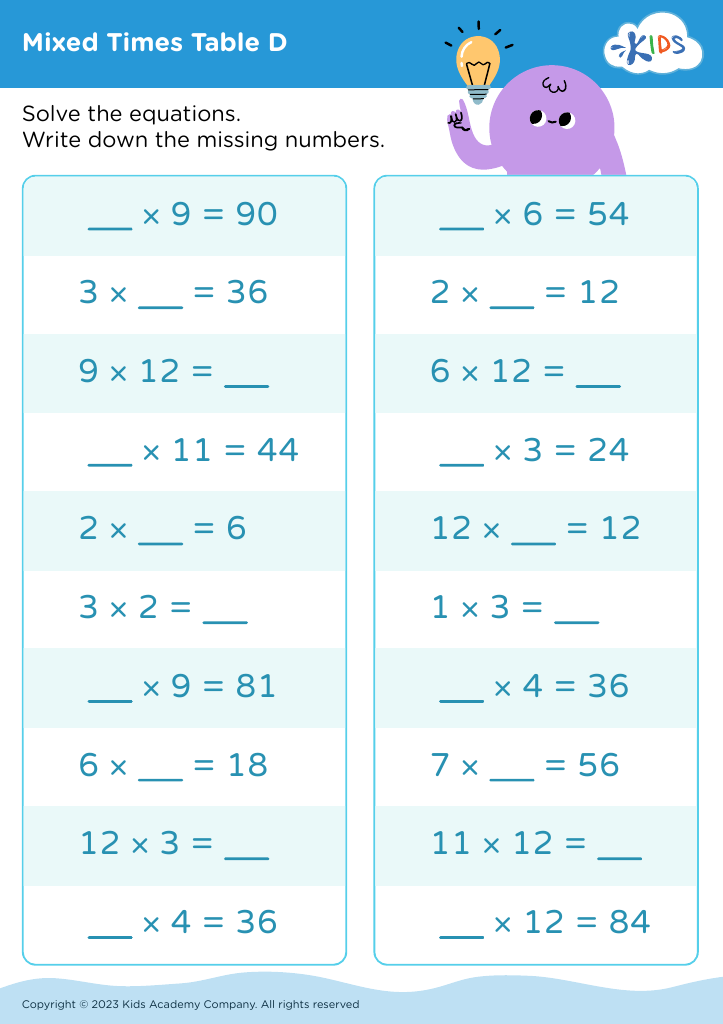
Boost your third grader's mental math prowess with our Extra Challenge Mixed Times Tables Worksheets focused on enhancing learning skills! These worksheets offer a variety of challenging problems to strengthen students' mastery of multiplication tables. Designed to improve speed and accuracy, your child will enjoy solving different questions that boost critical thinking and problem-solving abilities. Engaging and educational, our worksheets provide the perfect extra practice for young learners aiming to excel in math. Transform your child's math experience with our expertly crafted exercises, ensuring they build confidence and excel in their mathematical journey.
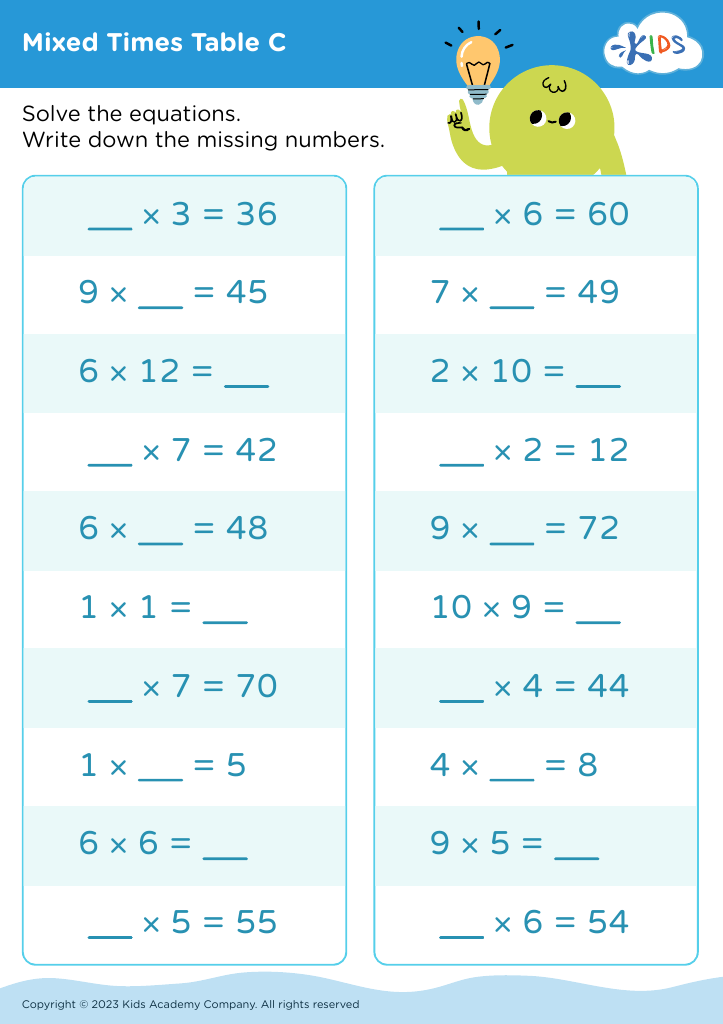


Parents and teachers should prioritize strengthening mental math skills in Grade 3 students, particularly with mixed times tables, because these skills are foundational for future mathematical success and overall cognitive development. Mental math, especially in the context of multiplication, enhances a child's numerical fluency, enabling them to solve problems quickly and accurately without relying on written calculations. This fluency cultivates confidence and reduces math anxiety, empowering children to tackle more complex mathematical concepts in higher grades.
Engaging with mixed times tables also sharpens problem-solving strategies, critical thinking, and memory retention. It encourages flexible thinking as students learn to navigate a variety of multiplication scenarios, enhancing their adaptability when faced with different types of problems. Practicing mental math strengthens neural pathways in the brain, promoting faster and more efficient information processing, which benefits learning across all subjects.
Moreover, these skills transcend the classroom, offering real-life advantages such as quick mental calculations for shopping, cooking, and budgeting. When parents and teachers actively support mental math practice, they are investing in the child's long-term academic and practical life skills, helping them to become independent, confident, and resourceful individuals. This foundational focus ensures that children build a solid mathematical base crucial for advanced STEM education and everyday life.