Spatial awareness Kindergarten Science Worksheets
3 filtered results
Difficulty Level
Grade
Age
-
From - To
Subject
Activity
Standards
Enhance your child's early learning with our "Spatial Awareness Kindergarten Science Worksheets"! Our carefully crafted worksheets are designed to develop essential spatial awareness skills in young learners through engaging activities. Kids will explore positioning, sequencing, and visual perception while having fun with vibrant illustrations and interactive tasks. These worksheets support cognitive development and are perfect for both classroom and at-home learning, making foundational math and science concepts easy to understand. Help your kindergartener boost their spatial skills, critical thinking, and confidence today with Kids Academy's expert-approved resources!
Favorites
With answer key
Interactive
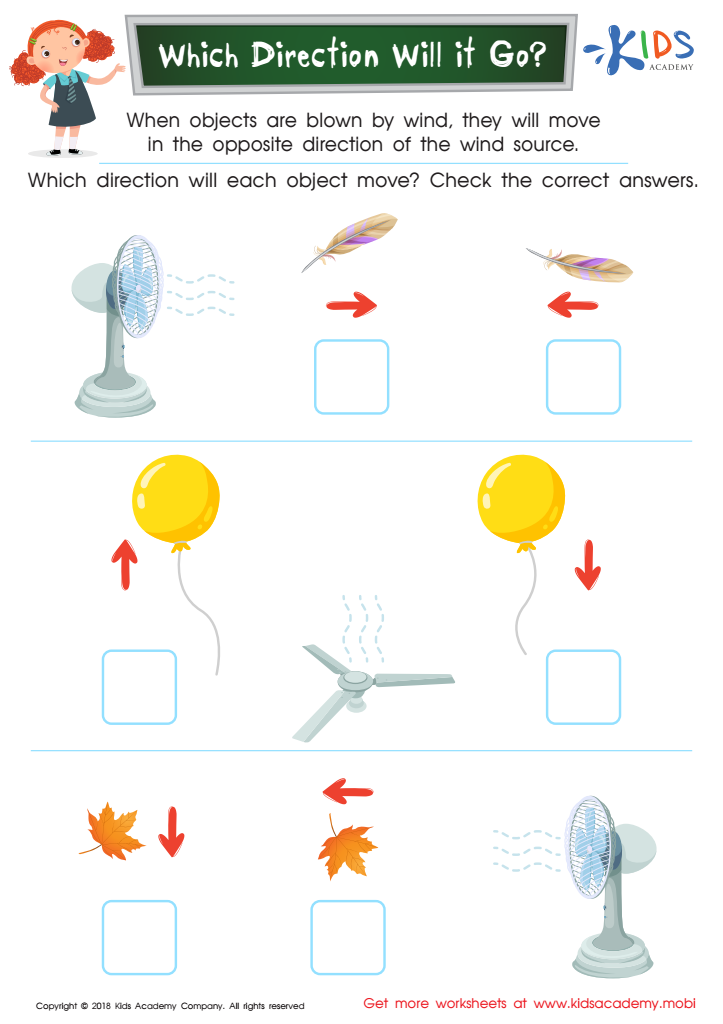
Which Direction Will it Go? Worksheet
Explain to your students: when objects are blown by wind, they will move in the opposite direction. In the worksheet, there are pictures of wind sources and objects being blown by the wind. Ask your child to identify and check the direction each object will move.
 Assign to My Students
Which Direction Will it Go? Worksheet
Worksheet
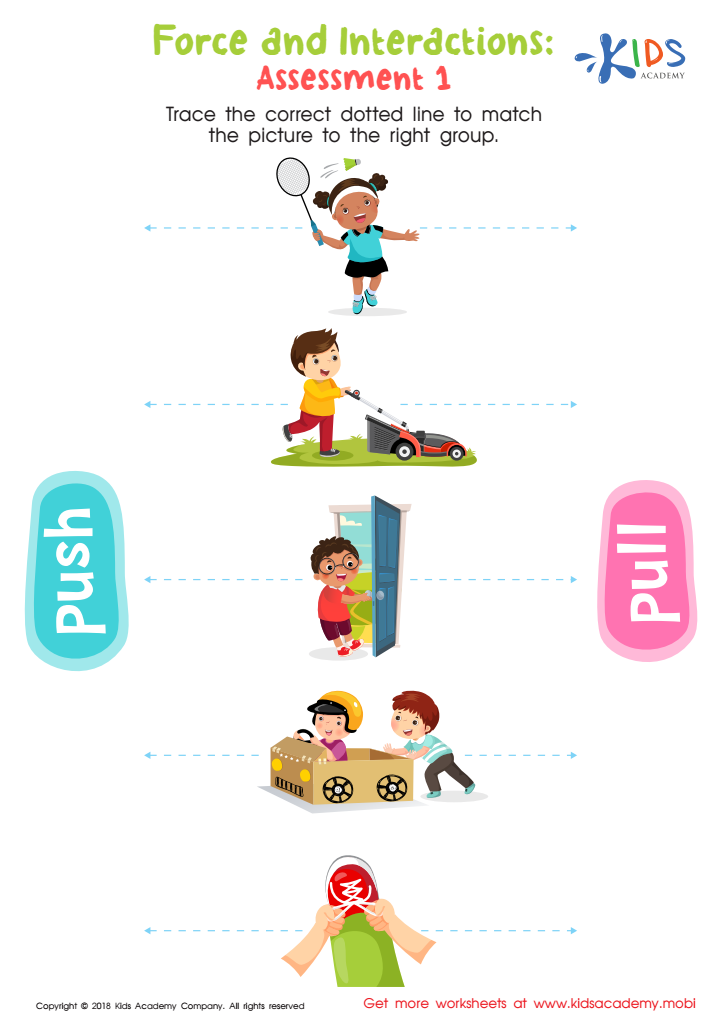
Force and Interactions: Assessment 2 Worksheet
Help your child see the difference between push and pull with this fun worksheet. Ask them to match each picture to the right group. The "push" is on the left and the "pull" is on the right. Assist them in tracing the activities and explain what it is the people are doing.
Force and Interactions: Assessment 2 Worksheet
Worksheet
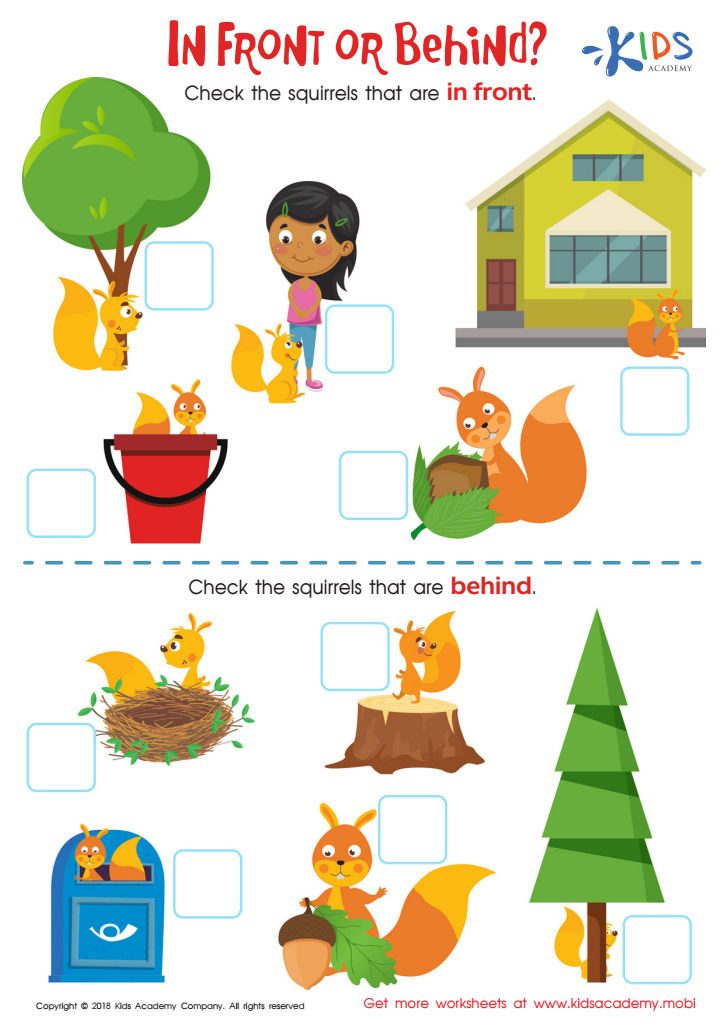
In Front or Behind: Part 2 Worksheet
Teach positional words "front" and "behind" with this fun worksheet! Students identify where the squirrel is in relation to the object - in front or behind. It's a great exercise to practice early geometry skills and understanding object movement.
In Front or Behind: Part 2 Worksheet
Worksheet
Join Kids Academy for Free
Who is primarily going to use this learning content?





.jpg)

Spatial awareness is a crucial skill for young children, and emphasizing it in kindergarten science is essential for several reasons. Firstly, spatial awareness forms the foundation for math skills. Understanding shapes, sizes, patterns, and spatial relationships helps children grasp number sense, geometry, and problem-solving strategies, making future math learning easier and more intuitive.
In science, spatial awareness is vital for understanding physical properties and relationships, such as how objects can move, fit together, or change. By developing these skills early, children become more adept at exploring and comprehending the world around them, nurturing their curiosity and scientific thinking.
Additionally, spatial awareness supports the development of motor skills and coordination. Activities that enhance spatial awareness, such as building blocks or navigating obstacle courses, help fine-tune hand-eye coordination and physical dexterity. This holistic approach to learning also resonates with principles of early childhood education, which emphasize the interconnectedness of physical, cognitive, and emotional growth.
For parents and teachers, fostering spatial awareness through engaging, playful, and hands-on learning experiences not only builds a strong academic foundation but also promotes critical life skills such as problem-solving, resilience, and creativity. Addressing spatial awareness in kindergarten yields long-term benefits, setting children on a path to academic success and personal development.