
Letter recognition Normal Reading Worksheets for Ages 3-4
3 filtered results
Difficulty Level
Grade
Age
-
From - To
Subject
Activity
Standards
Our "Letter Recognition Normal Reading Worksheets for Ages 3-4" are designed to make early learning fun and effective. Tailored for preschoolers, these worksheets help children recognize and identify letters, laying a solid foundation for reading. Each engaging activity combines playful illustrations with targeted exercises, fostering both enjoyment and learning. As kids trace, match, and color letters, they develop essential literacy skills that will support their educational journey. Perfect for parents and teachers, our worksheets make letter recognition an enjoyable adventure, promoting confidence and a love for reading from the very beginning. Explore our collection today!
Favorites
With answer key
Interactive
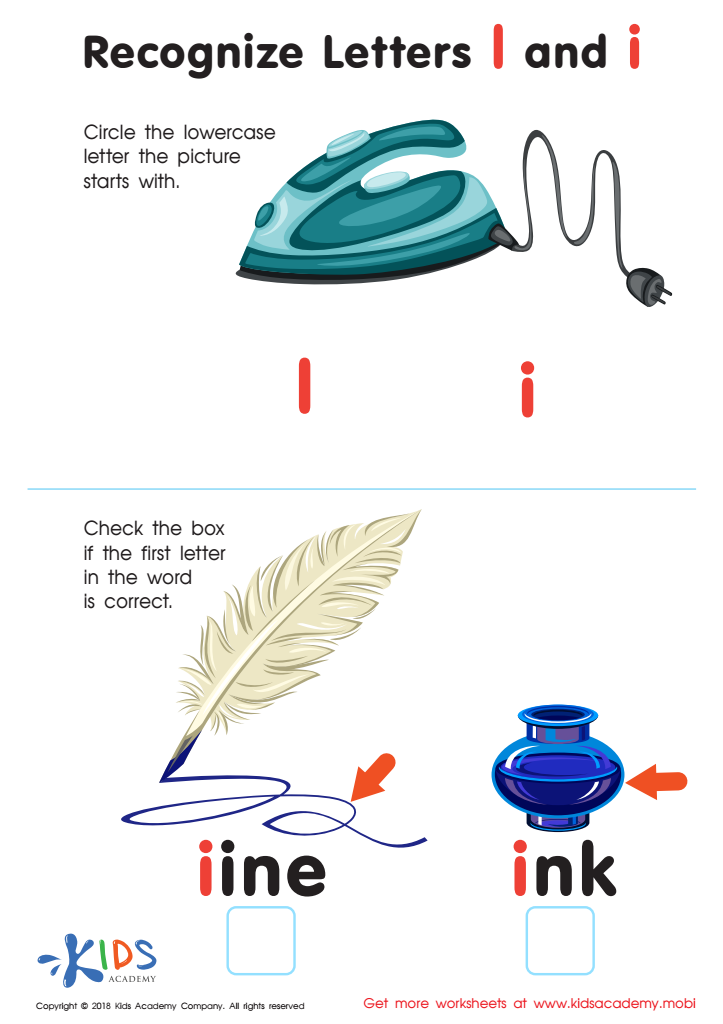
Recognize Letters l and i Worksheet
Help your child become familiar with uppercase and lowercase letters. Have them look at the pictures in the worksheet and circle the lowercase letter the picture starts with. For example: which one is the lowercase "i", the capital "I" or the small "i"?
Recognize Letters l and i Worksheet
Worksheet

Long and Short U Worksheet
Revised: Spice up your lesson on long and short vowels with this fun printout! Kids read the words "tube" and "tub," then reinforce the sound by coloring in the words and pictures. It's a great way to make phonics class enjoyable!
Download (PDF)
 Assign to My Students
Assign to My Students
Long and Short U Worksheet
Worksheet

Long and Short E Worksheet
This fun printout makes learning phonics enjoyable for Grade 3 students. Get them to read the words “tree” and “bed” to recognize the different sounds of the letter “E”. After hearing the words they can color the words and the pictures to understand differences between long and short vowels.
Download (PDF)
Assign to My Students
Assign to My Students
Long and Short E Worksheet
Worksheet
Join Kids Academy for Free
Who is primarily going to use this learning content?








For children aged 3-4, parents and teachers should prioritize letter recognition as a foundational skill that sets the stage for future academic success. During these formative years, young brains are remarkably receptive to new information, making it an ideal time to introduce letters and sounds. Recognizing letters fosters early literacy skills, which are pivotal for reading and writing proficiency later on.
Firstly, letter recognition helps children understand that written symbols correspond to sounds and, when combined, form words. This basic understanding is crucial for decoding words while reading. Familiarity with letters also enhances vocabulary development; children who recognize letters are more likely to recognize and understand new words, enriching their spoken language.
Furthermore, engaging in letter recognition activities nurtures cognitive skills such as memory, attention to detail, and logical thinking. For instance, distinguishing between the shapes of letters requires better visual discrimination and memory skills. Constructive letter games also promote interactive and playful learning, making education enjoyable.
Socially, children who develop these skills early are generally more confident and enthusiastic about learning when they start formal schooling. Parental and teacher involvement in these early stages creates a supportive learning environment, fostering a positive attitude toward education that can last a lifetime. Investing time in letter recognition now can yield significant long-term benefits for children's academic and personal development.








