
Lowercase letter writing Normal Worksheets for Ages 4-6
3 filtered results
Difficulty Level
Grade
Age
-
From - To
Subject
Activity
Standards
Enhance your child's writing skills with our engaging Lowercase Letter Writing Normal Worksheets for Ages 4-6. These expertly designed exercises focus on teaching proper letter formation, fine motor skills, and handwriting practice in a fun and interactive way. Perfect for young learners, each worksheet offers step-by-step guides and ample repetition to ensure mastery of writing lowercase letters. Ideal for both classroom and at-home learning, our worksheets are a valuable resource to foster early literacy and confidence in writing. Set your child on the path to success with these essential tools for early education.
Favorites
With answer key
Interactive
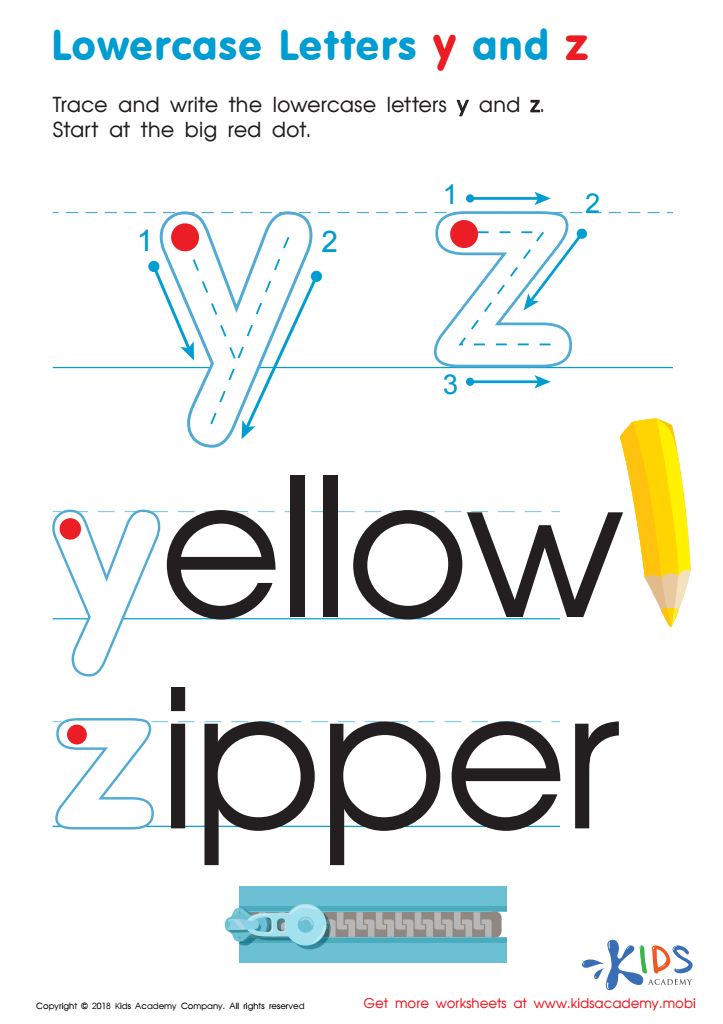
Lowercase Letters y z Worksheet
Help your child get a good start in writing and reading by tracing and writing the lowercase letters y and z. With this activity, they will learn the alphabet, which is essential for literacy success. Guide them through the worksheet and make sure they form the letters correctly. This will help them learn the basics needed to write and read fluently.
 Assign to My Students
Lowercase Letters y z Worksheet
Worksheet
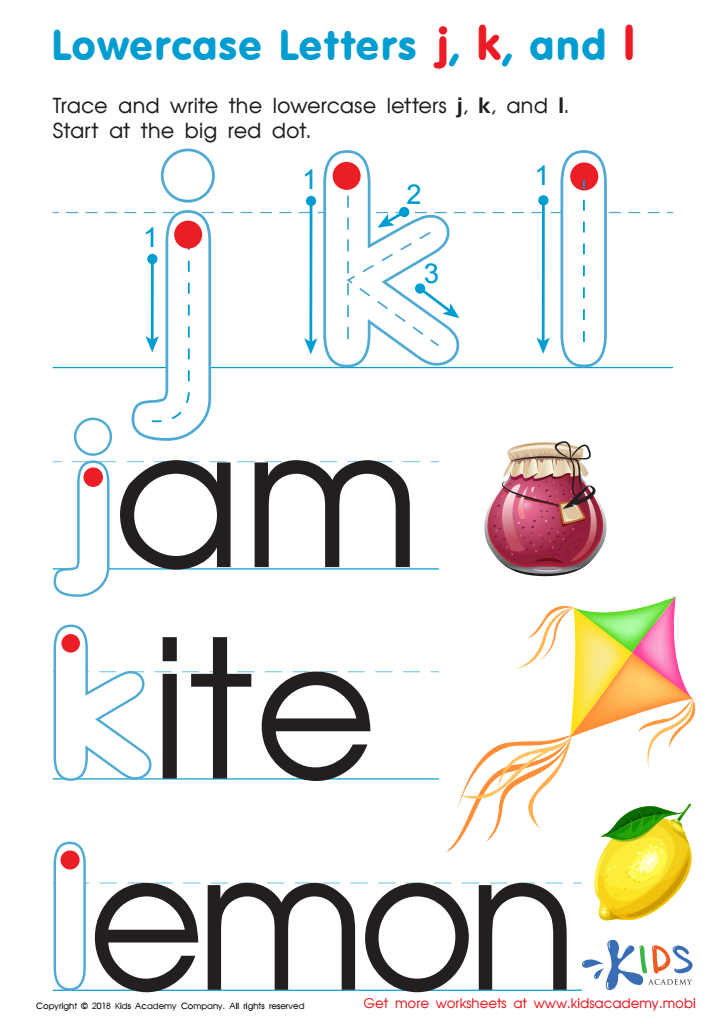
Lowercase Letters j k l Worksheet
Teach your child the difference between uppercase and lowercase letters. Have them trace and write the lowercase letters j, k, and l, starting at the red dot. Guide your child's hand to form the letters correctly.
Lowercase Letters j k l Worksheet
Worksheet
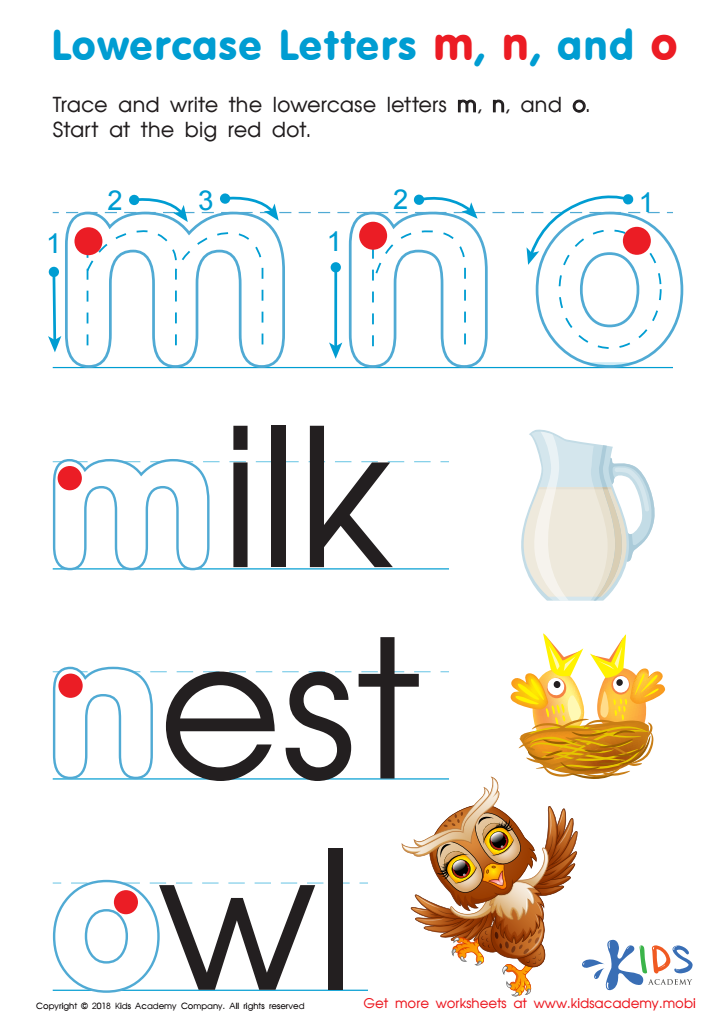
Lowercase Letters m n o Worksheet
Help your child learn the alphabet with letter tracing. Show them the difference between uppercase and lowercase letters by working through this free worksheet, tracing and writing lowercase m, n and o.
Lowercase Letters m n o Worksheet
Worksheet
Join Kids Academy for Free
Who is primarily going to use this learning content?







Teaching lowercase letter writing to children aged 4-6 plays a crucial role in their early literacy development. For parents and teachers, fostering this skill early can significantly help young learners in their journey to becoming proficient readers and writers. Lowercase letters appear more frequently in text than uppercase letters, making their recognition vital for reading fluency.
Mastering lowercase writing helps children better understand sentence structures and improve their comprehension. When kids recognize and write lowercase letters smoothly, they are more likely to grasp the flow of words within sentences and stories, enhancing their overall language acquisition.
Additionally, learning to write lowercase letters strengthens fine motor skills and hand-eye coordination. The act of controlling a pencil to create these letters supports the development of the hand muscles, which are essential for other academic tasks such as drawing or crafting.
Moreover, early proficiency in writing promotes a sense of achievement and boosts the child’s confidence. Positive reinforcement during this learning phase encourages a love for writing and reading, setting a foundation for lifelong learning. Therefore, emphasizing lowercase letter practice for children between the ages of 4-6 can unlock numerous academic and developmental benefits, making it a fundamental aspect of early education.








