Alphabetical order understanding Normal English for Beginners Worksheets for Ages 4-7
3 filtered results
-
From - To
Introduce young learners to the essential skill of alphabetical order with our "Alphabetical Order Understanding Normal English for Beginners" worksheets, catered specifically for ages 4-7. These engaging, child-friendly worksheets make it easy for beginners to grasp the basics of sequencing words alphabetically. Perfect for both classroom and home use, the activities feature vibrant illustrations and simple exercises designed to maintain children's interest and reinforce learning. These foundational skills help children recognize letters, expand their vocabulary, and enhance their reading abilities. Ideal for fostering organizational skills and language development in a fun and interactive way, these worksheets are a valuable educational resource.

Letter G Tracing Page

Letter J Coloring Sheet
 Assign to My Students
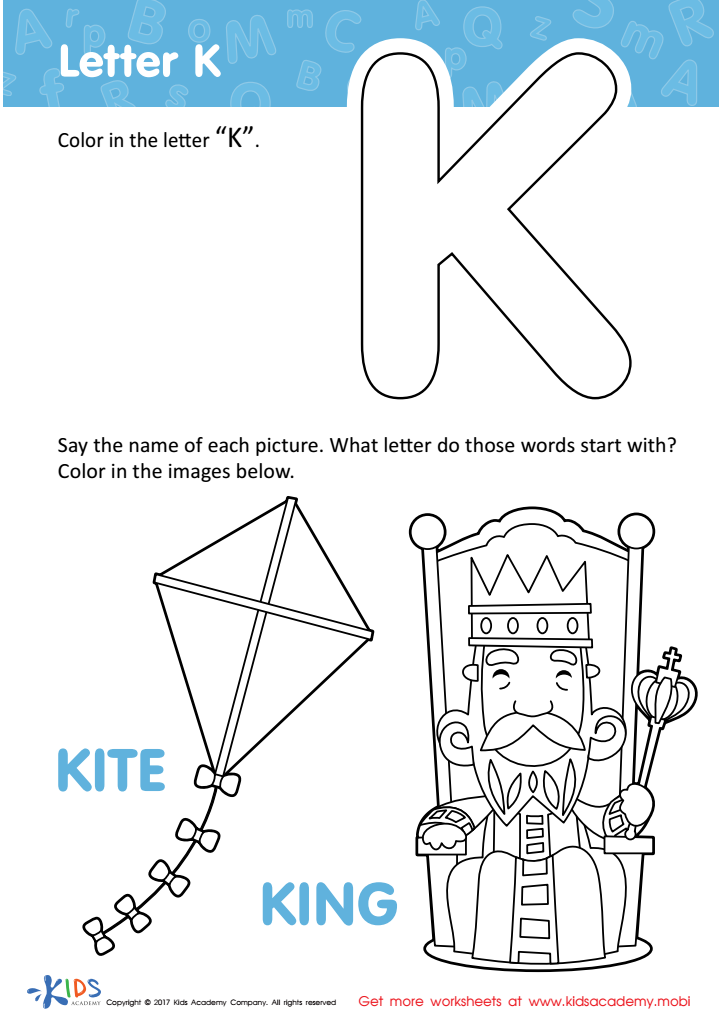
Letter K Coloring Sheet
Assign to My Students




Understanding alphabetical order is an important foundational skill for young children, especially those ages 4-7. For parents and teachers, teaching this concept can significantly boost a child’s literacy development and organizational skills.
Firstly, knowing the order of the alphabet enhances a child’s ability to recognize, organize, and locate words quickly. This is crucial as they begin to navigate through dictionaries, libraries, and educational resources. For instance, when children understand that “apple” comes before “banana” alphabetically, they can more efficiently find words in a dictionary or a list, fostering independence in learning.
Additionally, understanding alphabetical order helps improve spelling and reading skills. As children learn the sequence of letters, it advances their phonemic awareness— the ability to hear and manipulate individual sounds in words. This knowledge is essential for decoding new words, which is a key component of reading fluency.
Moreover, the ability to alphabetize encourages logical thinking and patterns recognition, which are foundational concepts in subjects like math and science. For young learners, mastering alphabetical order can thus serve as an entry point into the broader world of systematic learning and problem-solving.
In sum, understanding alphabetical order empowers children in the early stages of education by enhancing organizational skills, improving literacy, and fostering logical thinking. This builds a strong foundation for future academic success.