
Alphabetical order understanding Normal Letter Recognition Worksheets for Ages 5-6
3 filtered results
Difficulty Level
Grade
Age
-
From - To
Subject
Activity
Standards
Unlock your child's potential with our Alphabetical Order Understanding Normal Letter Recognition Worksheets, designed for ages 5-6. These engaging worksheets help young learners grasp the concept of alphabetical order while solidifying their letter recognition skills. Interactive activities, colorful illustrations, and hands-on tasks make learning enjoyable and effective. Foster early literacy, boost confidence, and pave the way for future reading success as your child masters the alphabet. Ideal for classroom or home use, our worksheets provide a solid foundation for lifelong learning. Discover the joy of learning with Kids Academy—where education meets fun!
Favorites
With answer key
Interactive

Letter G Tracing Page
Get ready to trace the letter "G" – with a big red spot as the starting point, trace the lines and watch the letter appear. Uppercase and lowercase letters are both easy and fun to write. Give it a go and finish the word "go". Play the guitar and say "hello" to a funny ghost!
Letter G Tracing Page
Worksheet

Letter J Coloring Sheet
Practice the letter 'J' with your little one with this fun coloring page! Pictures of jar, juice, jam and jelly make it an enjoyable experience for kids. Learning the letter and coloring is fun for even the youngest learners.
Download (PDF)
 Assign to My Students
Assign to My Students
Letter J Coloring Sheet
Worksheet
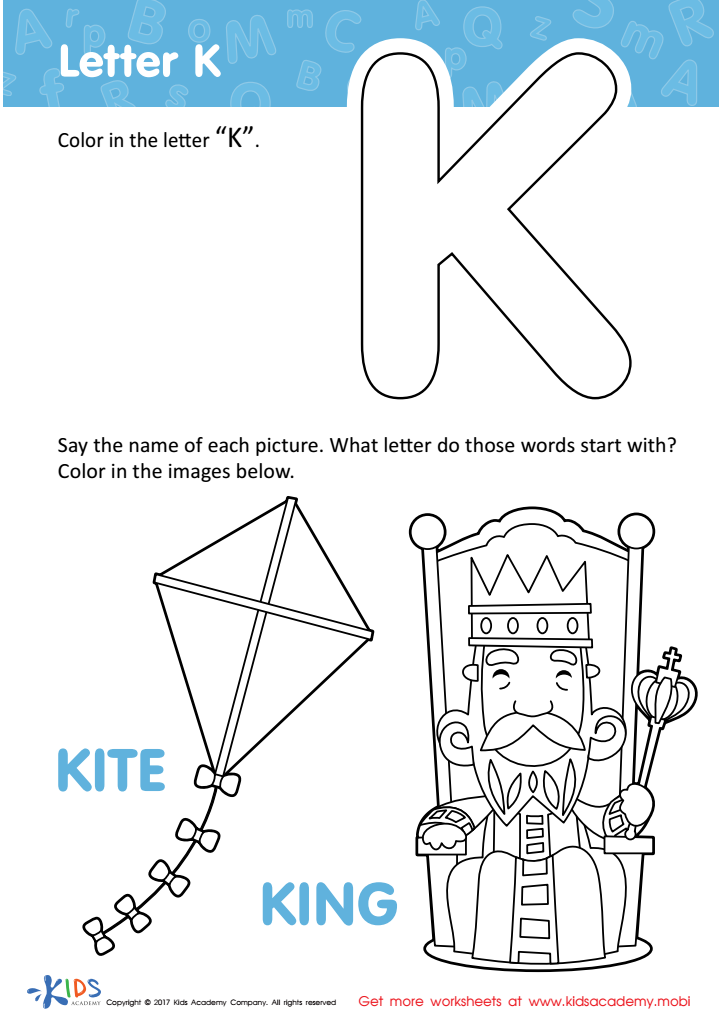
Letter K Coloring Sheet
This letter K coloring page captivates your child's creativity while learning the letter! Showcasing a king and kite, common words for their age group, it's sure to spark their imagination.
Download (PDF)
Assign to My Students
Assign to My Students
Letter K Coloring Sheet
Worksheet
Join Kids Academy for Free
Who is primarily going to use this learning content?








Understanding alphabetical order is vital for young children aged 5-6 as it forms a fundamental step in literacy development. While normal letter recognition—knowing the name and shape of each letter—is crucial, grasping the sequence of the alphabet offers additional educational benefits.
First, it aids in the organization and retrieval of information, essential skills for academic success. For example, understanding alphabetical order helps children use dictionaries, indexes, and libraries more effectively in later years. It furnishes them with a systematic way to categorize and access knowledge.
Second, learning alphabetical order enhances cognitive development. This practice sharpens memory and early problem-solving skills as children are required to hold sequences in their minds and recall them quickly. Activities like singing the alphabet song or simple sorting games engage their brains in beneficial looping patterns.
Moreover, sequencing skills gleaned from alphabet activities also pave the way for mathematical skills. Recognizing patterns and order lays a conceptual foundation useful in understanding numbers and mathematical principles, establishing an early affinity for STEM.
Lastly, grasping alphabetical order enriches literacy-based activities. It promotes early reading and writing proficiency, assisting children in understanding how to arrange letters to form words and eventually sentences, igniting a lifelong love for lifelong learning literacy.
In summary, understanding the alphabetical order transcends basic letter recognition, offering multifaceted developmental gains essential for successful early learning journeys.








