
Basic Math Skills Normal Word Problems Worksheets for Ages 5-6
3 filtered results
Difficulty Level
Grade
Age
-
From - To
Subject
Activity
Standards
Enhance your child's math journey with our Basic Math Skills Normal Word Problems Worksheets, designed specifically for ages 5-6. These engaging worksheets focus on developing essential math skills, fostering critical thinking and problem-solving abilities in a fun and interactive way. Each worksheet presents relatable scenarios that help young learners add and subtract through real-world context, encouraging them to apply their mathematical understanding. With vibrant illustrations and age-appropriate challenges, our resources aim to build confidence and a solid foundation in math for early learners. Unlock the joy of learning math with our thoughtfully crafted word problems worksheets today!
Favorites
With answer key
Interactive
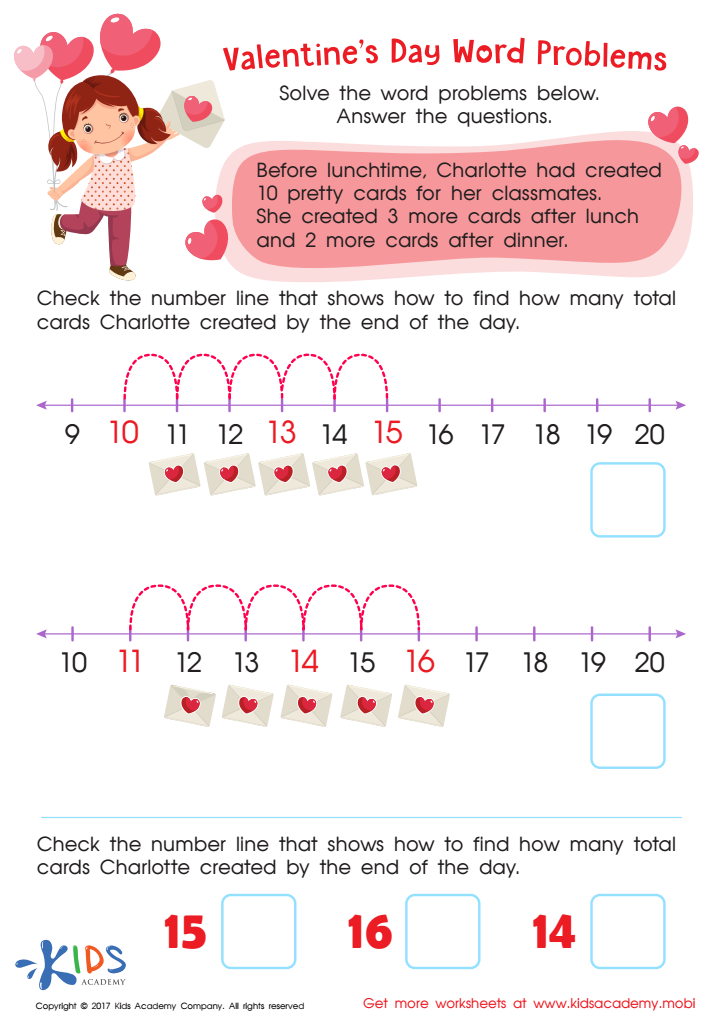
Valentines Day Word Problem Worksheet
This Valentine's Day worksheet will help your child practice using a number line to solve an addition problem. It's a great way to boost confidence and make solving word problems a breeze.
 Assign to My Students
Valentines Day Word Problem Worksheet
Worksheet
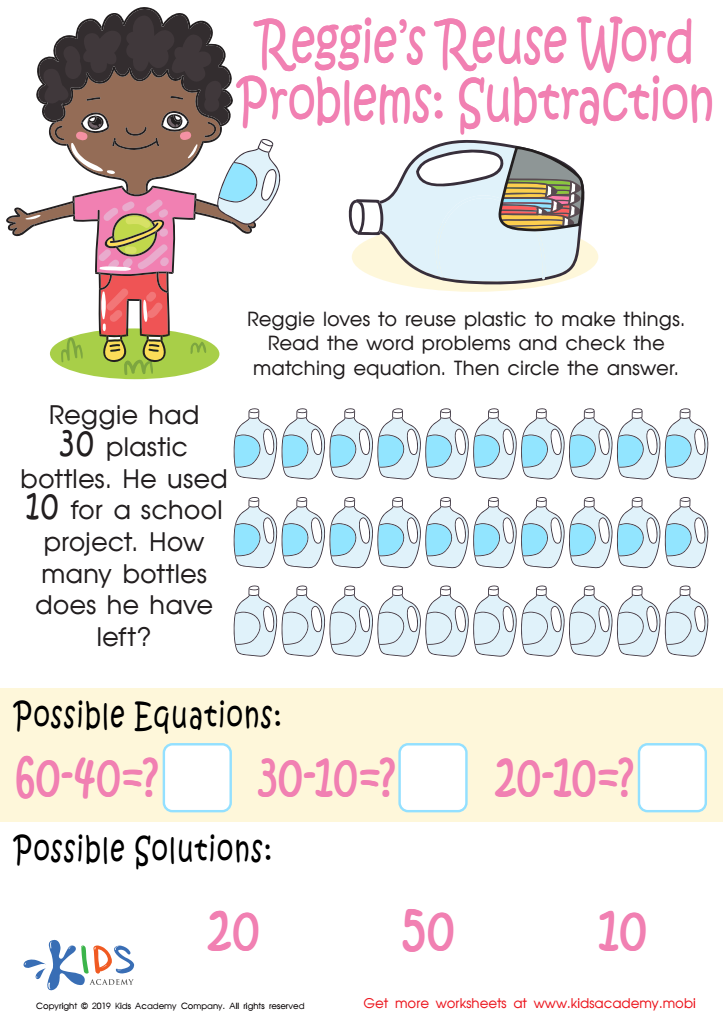
Reggie's Reuse Word Problems: Subtraction Worksheet
Kids can help pal Reggie become an eco-friendly friend! This PDF teaches kids subtraction and one-to-one number representation. They'll use pictures to solve word problems and find out how many plastic bottles Reggie can reuse. They'll also match number equations and solutions to get the right answer.
Reggie's Reuse Word Problems: Subtraction Worksheet
Worksheet
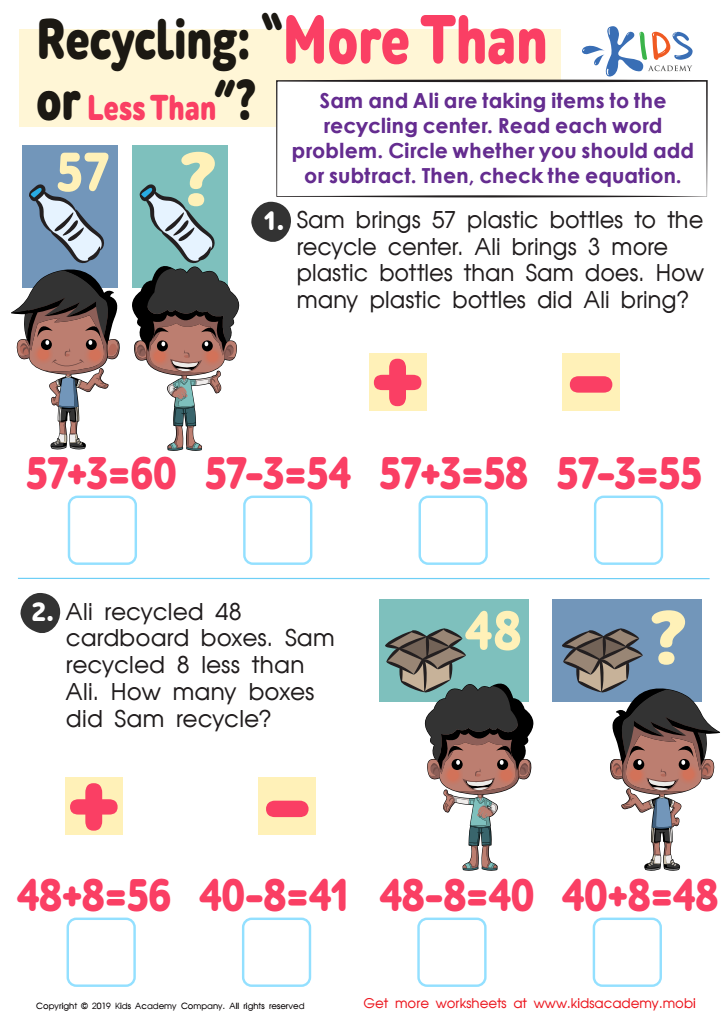
Recycling - More or Less Worksheet
Your child can compare numbers and solve word problems with this free worksheet. Help them understand what's being asked as Sam and Ali take items to the recycling center. They can choose the correct equation to match the word problem and apply their skills in reading and pulling out the appropriate information.
Recycling - More or Less Worksheet
Worksheet
Join Kids Academy for Free
Who is primarily going to use this learning content?







Basic math skills, particularly word problems, are essential for children aged 5-6 for several compelling reasons. Firstly, this age marks a critical period for cognitive development, where foundational math understanding fosters logical thinking and problem-solving skills. Engaging with word problems encourages children to interpret information contextually, enhancing their comprehension abilities.
Moreover, word problems connect math to real-life scenarios, cultivating an understanding of its relevance and applicability. For instance, when a child solves a problem involving sharing candies among friends, they not only practice addition or subtraction but also grasp the concepts of fairness and resource distribution.
Teachers and parents should also recognize that solving word problems promotes language development. Children learn to articulate mathematical thoughts, translating numbers into words and enhancing their vocabulary in the process. Furthermore, this skill fortifies social skills, as children often collaborate on problems, sharing strategies and insights with peers.
Ultimately, by prioritizing basic math skills and word problems, adults can equip young learners with confidence and competence in both mathematics and critical thinking, laying a strong foundation for their future academic endeavors. This early engagement sets the stage for lifelong mathematical literacy and a more profound appreciation for learning overall.








