
Spatial awareness Normal Reading Worksheets for Ages 5-6
3 filtered results
Difficulty Level
Grade
Age
-
From - To
Subject
Activity
Standards
Enhance your child's reading skills with our Spatial Awareness Normal Reading Worksheets, perfect for ages 5-6. These engaging worksheets are designed to develop young learners' spatial awareness, a critical foundational skill for effective reading and comprehension. Through fun and interactive activities, children explore concepts such as position, direction, and distance, helping them to understand and interpret text better. Each worksheet combines colorful graphics and intriguing tasks to make learning enjoyable and effective. Give your child the tools they need to succeed in their reading journey and beyond with our expertly crafted spatial awareness resources. Start today!
Favorites
With answer key
Interactive
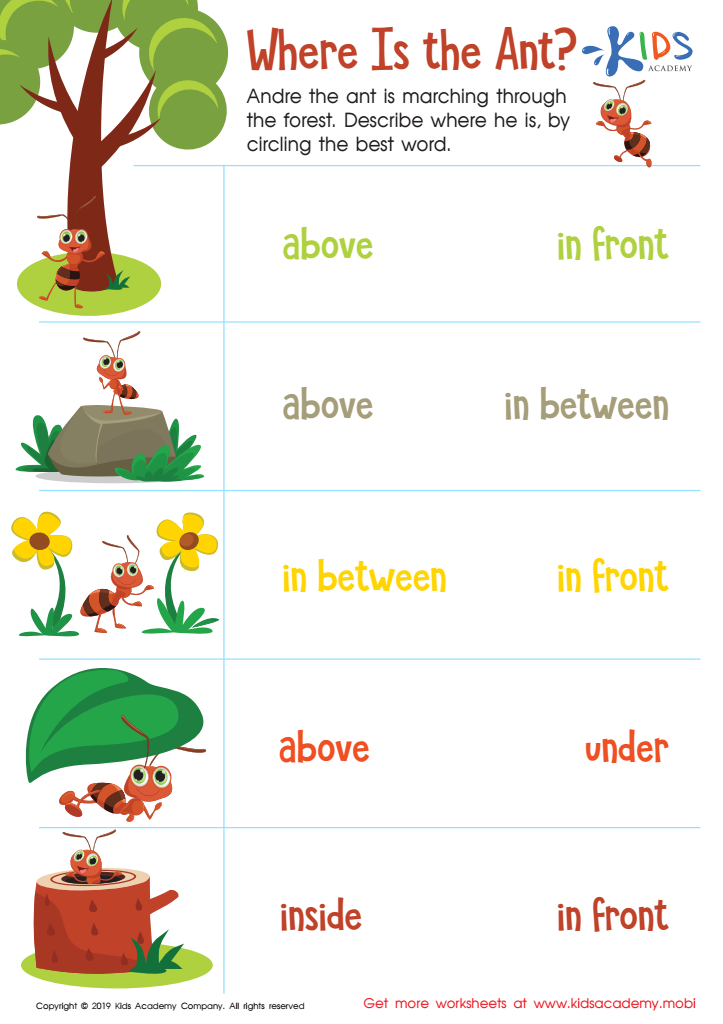
Where Is the Ant? Worksheet
Kids are captivated by ants. Andre is a busy ant, marching through the forest. Help your child circle the best word that best describes what he's doing in each picture. This colorful printout will show them the way.
 Assign to My Students
Where Is the Ant? Worksheet
Worksheet
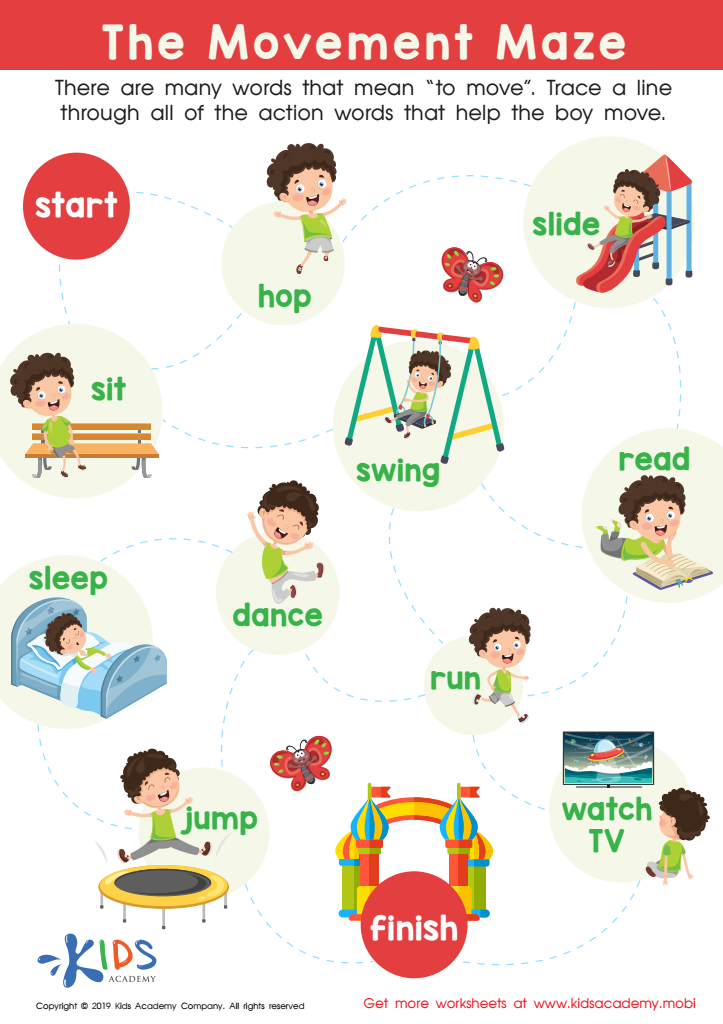
The Movement Maze Worksheet
Let your child have fun with this interactive PDF download. Kids will learn movement words with cute pictures, plus practice fine motor skills as they trace. A fun way to reinforce vocabulary. Jump, hop and sit – it's all here!
The Movement Maze Worksheet
Worksheet
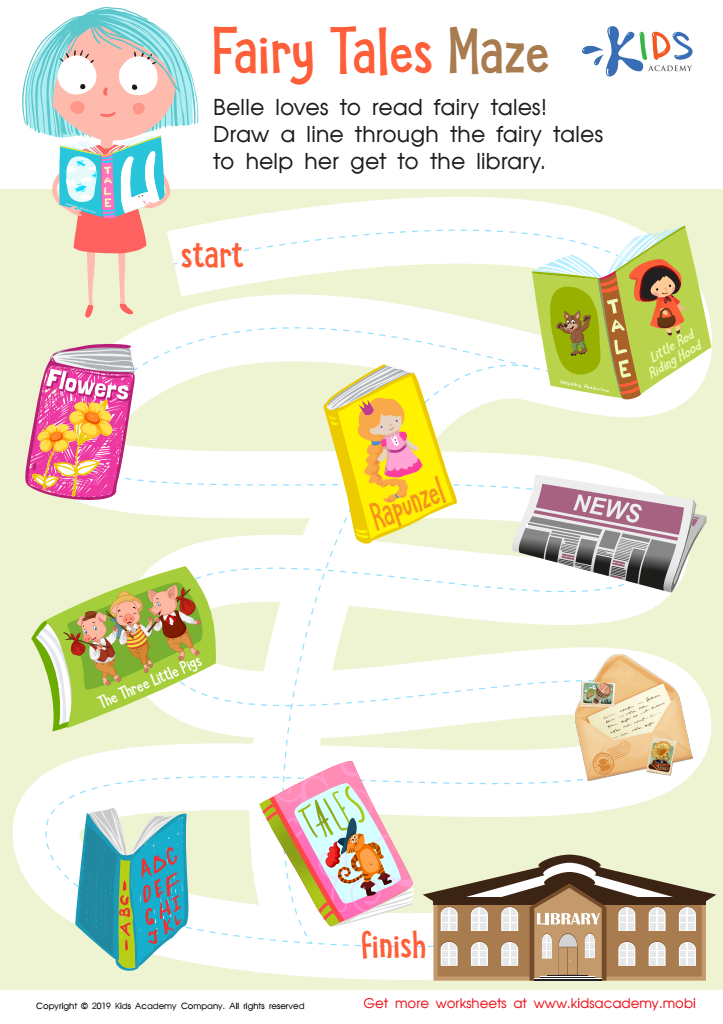
Fairy Tales Maze Worksheet
Kids love mazes and fairy tales, so this free worksheet is a great way to help teach young readers about familiar topics. They'll join Bella and use the traceable lines to travel through different reading genres, and find their way to the library for a nice reward!
Fairy Tales Maze Worksheet
Worksheet
Join Kids Academy for Free
Who is primarily going to use this learning content?


.jpg)


.jpg)
Spatial awareness—understanding the positions and relationships of objects in space—is crucial in early childhood development for many reasons, notably in the realm of reading. For children aged 5-6, developing strong spatial awareness significantly impacts their reading skills, which in turn affects overall academic success.
First, spatial awareness helps kids interpret the structure of written text. Children become more adept at recognizing how letters combine to form words and how words fit together in sentences, understanding concepts like left-to-right progression and top-to-bottom reading order. This awareness also aids in distinguishing between visually similar letters, like 'b' and 'd' or 'p' and 'q,' which can cause confusion and frustration if not properly understood.
Furthermore, spatial skills are tied to early math abilities, including recognizing patterns, shapes, and sizes, enhancing overall cognitive development. These skills strengthen a child’s capacity to visualize problems and comprehend multi-step instructions, directly impacting their ability to decode words and sentences effectively.
Parents and teachers should foster spatial awareness by engaging children in activities such as puzzles, building blocks, drawing, and playing with maps. By embedding spatial learning into everyday experiences, they set a solid foundation for higher-level thinking and reading proficiency, building confidence and positioning children for both academic and personal success.








