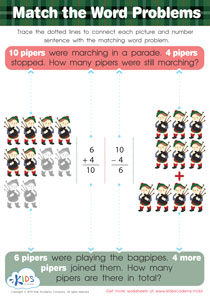
Subtraction practice Normal Addition Worksheets for Ages 7-8
3 filtered results
Difficulty Level
Grade
Age
-
From - To
Subject
Activity
Standards
Boost your child's math skills with our Subtraction Practice Normal Addition Worksheets designed specifically for ages 7-8. These engaging worksheets provide a structured way for young learners to strengthen their subtraction abilities while reinforcing their understanding of addition. Featuring a variety of problems that encourage critical thinking and problem-solving, our resources help children build confidence in math. Each worksheet is crafted to challenge students at their level, ensuring a fun and effective learning experience. Perfect for at-home practice or classroom use, these worksheets make mastering foundational arithmetic enjoyable and accessible. Help your child excel in math today!
Favorites
With answer key
Interactive
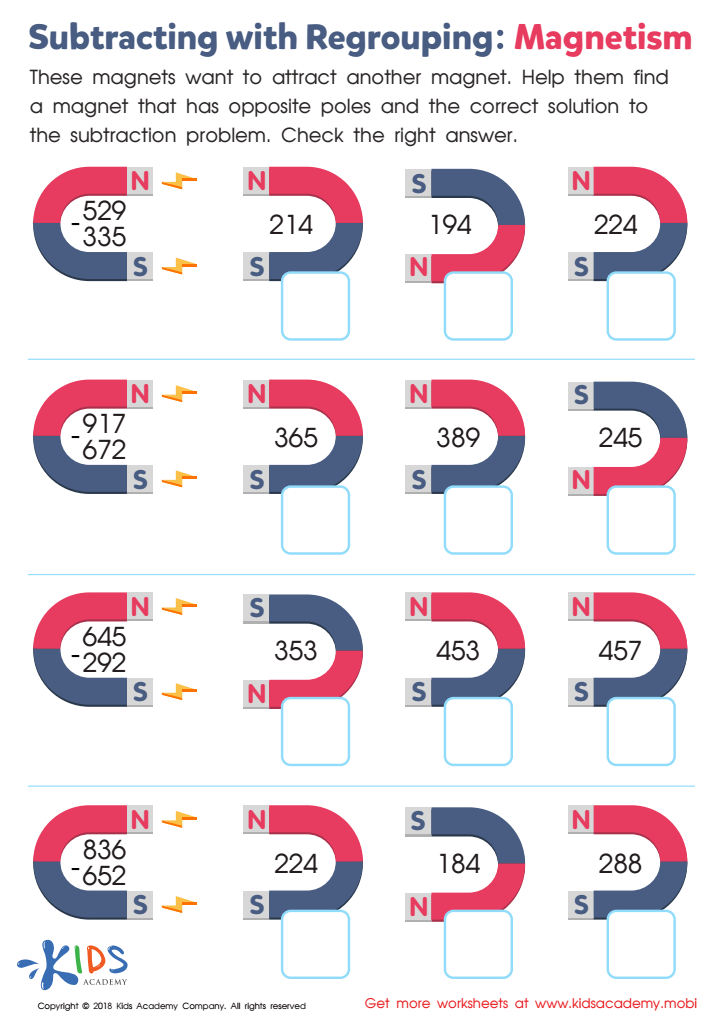
Subtracting with Regrouping: Magnetism Worksheet
Download Kids Academy's worksheet for a fun way to review science and math! Look at the magnet and remember opposites attract. Find another with opposite poles, then solve the problem on the left and check the solution against the magnet. Check the box next to the correct answer to complete this page.
 Assign to My Students
Subtracting with Regrouping: Magnetism Worksheet
Worksheet
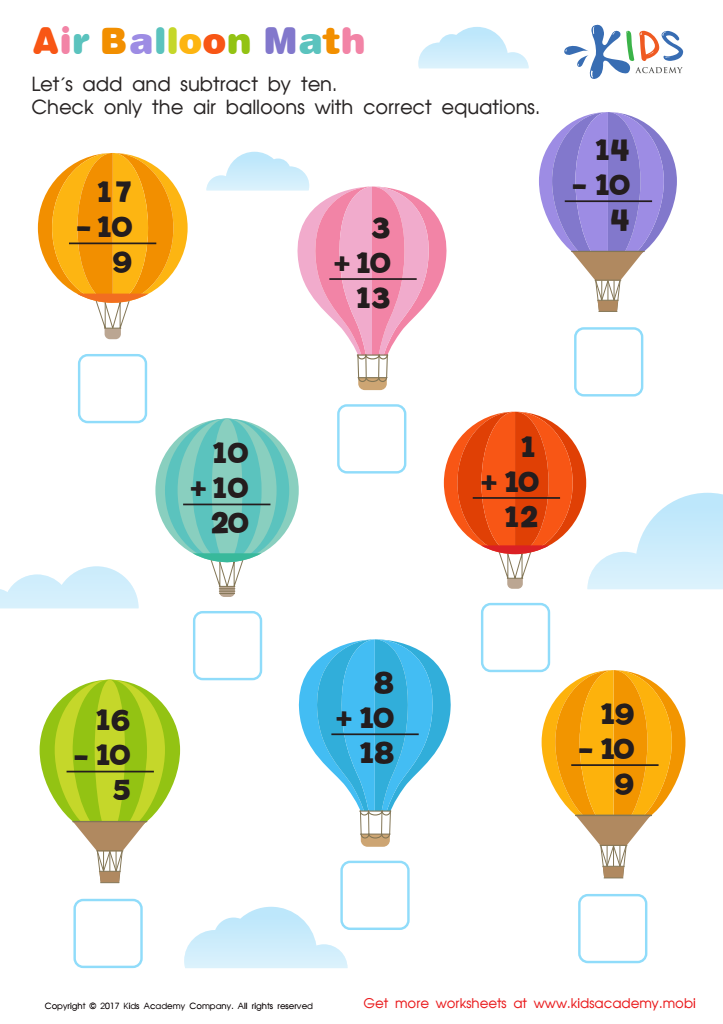
Air Balloon Math Worksheet
Revised:
Review your child's addition and subtraction skills with this fun worksheet. Featuring hot air balloons filled with math equations, help your child add or subtract by ten before ticking the boxes with the right answers. Working through the equations one-by-one is a great way to make math practice enjoyable!
Air Balloon Math Worksheet
Worksheet
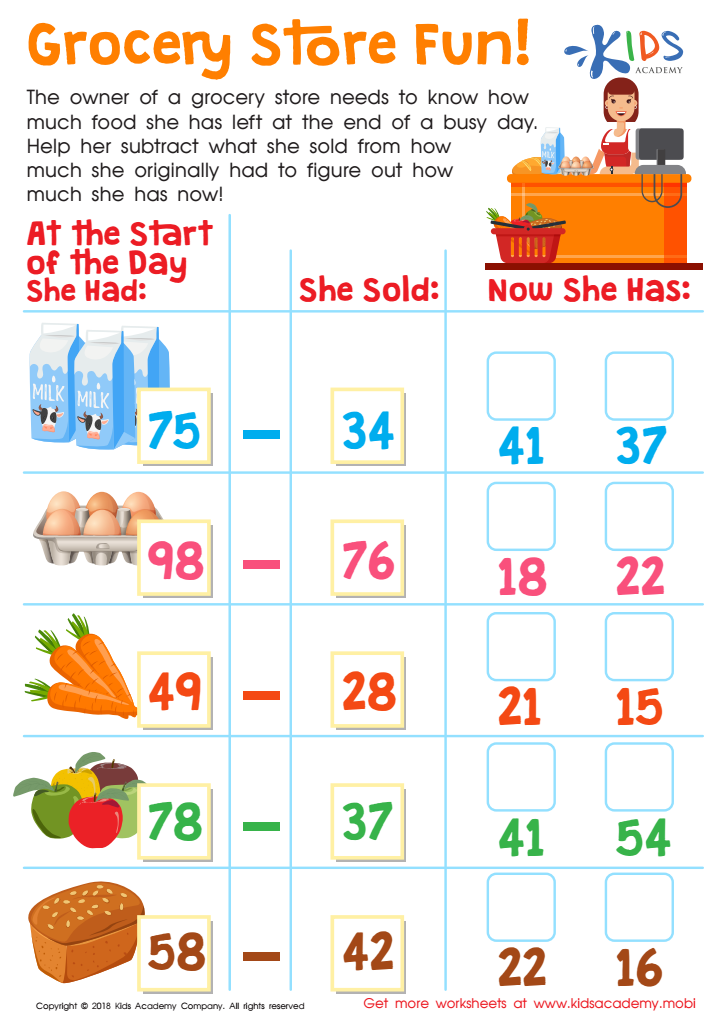
Grocery Store Fun! Worksheet
Let your kids have fun with this store worksheet. It requires them to help the owner by subtracting what she has sold from the original amount to figure out how much is left. Have them read and solve the equations in the printout to give the store owner the answer.
Grocery Store Fun! Worksheet
Worksheet
Join Kids Academy for Free
Who is primarily going to use this learning content?








Subtraction practice, alongside normal addition, is crucial for children aged 7-8 as it lays the foundation for more complex mathematical skills. At this developmental stage, children are transitioning from basic arithmetic to problem-solving and critical thinking. Regular practice of subtraction helps them understand mathematical concepts such as number relationships and computing differences, which are integral for daily activities and future academic success.
Furthermore, mastery of subtraction enhances overall number sense, boosting confidence and reducing math anxiety. When children understand subtraction, they can tackle word problems and real-world scenarios more effectively, promoting a positive attitude towards math. This age is also when children begin to encounter challenges like regrouping, which supports higher cognitive functions and analytical abilities.
Moreover, subtraction practice fosters perseverance and resilience. As children work through problems, they learn to approach difficulties methodically, encouraging a growth mindset. Teachers and parents should take an active role in guiding children through both addition and subtraction practice, recognizing its impact on their cognitive development and academic trajectory. Collaborating to reinforce these skills at home and in school creates a supportive learning environment, ultimately preparing children for higher-level mathematics and instilling lifelong problem-solving abilities.