
Handwriting Skills Normal Letter Recognition Worksheets for 7-Year-Olds
5 filtered results
Difficulty Level
Grade
Age
-
From - To
Subject
Activity
Standards
Enhance your 7-year-old’s handwriting and letter recognition with our engaging worksheets designed specifically for young learners. Our "Handwriting Skills Normal Letter Recognition Worksheets" provide a fun and interactive way to practice the alphabet. Each worksheet encompasses tracing activities, allowing children to improve their fine motor skills while reinforcing their understanding of letter shapes and sounds. Ideal for classroom and home settings, these resources promote confidence in writing and literacy. Explore our collection to foster essential skills that lay the foundation for academic success. Download and watch your child thrive as they enjoy the process of learning!
Favorites
With answer key
Interactive
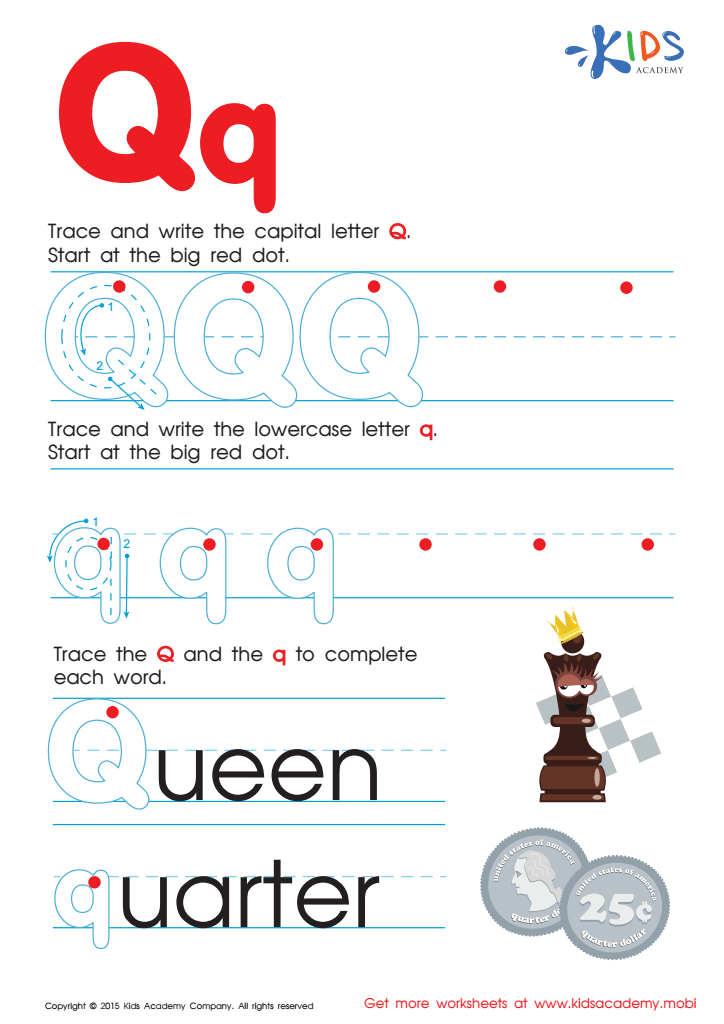
Letter Q Tracing Page
Learn the letter "Q"! Trace and write it a few times in upper and lowercase. Then help the Queen by writing her initial letter. Finally, write "quarters" and practice with more alphabet worksheets.
 Assign to My Students
Letter Q Tracing Page
Worksheet
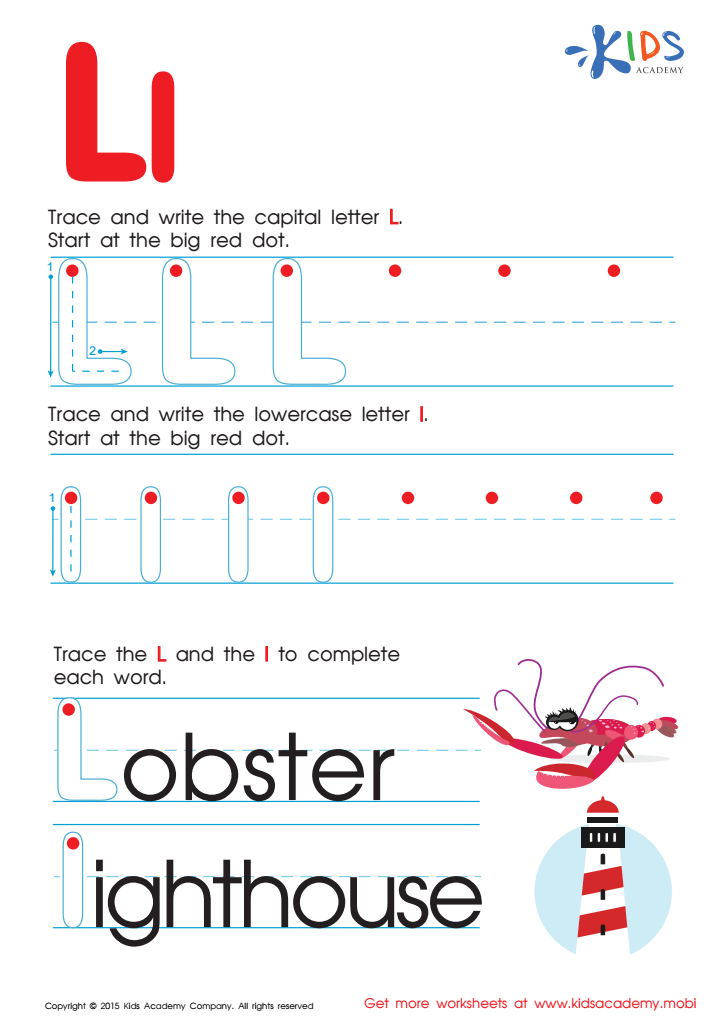
Letter L Tracing Page
Trace uppercase and lowercase letters to practice writing. Pay attention to the lowercase letters, like the "L", that are not as tall as an uppercase "I" or as short as a lowercase "i". Words like "lobster" and "lighthouse" are waiting to be completed. Enjoy!
Letter L Tracing Page
Worksheet

Letter E Tracing Page
Trace and write the uppercase and lowercase "E" starting at the big red dot. Complete words to perfect letter writing. Egg and Elephant must be written carefully. More alphabet worksheets for kindergarten are available for download to spend more time with your children learning.
Letter E Tracing Page
Worksheet
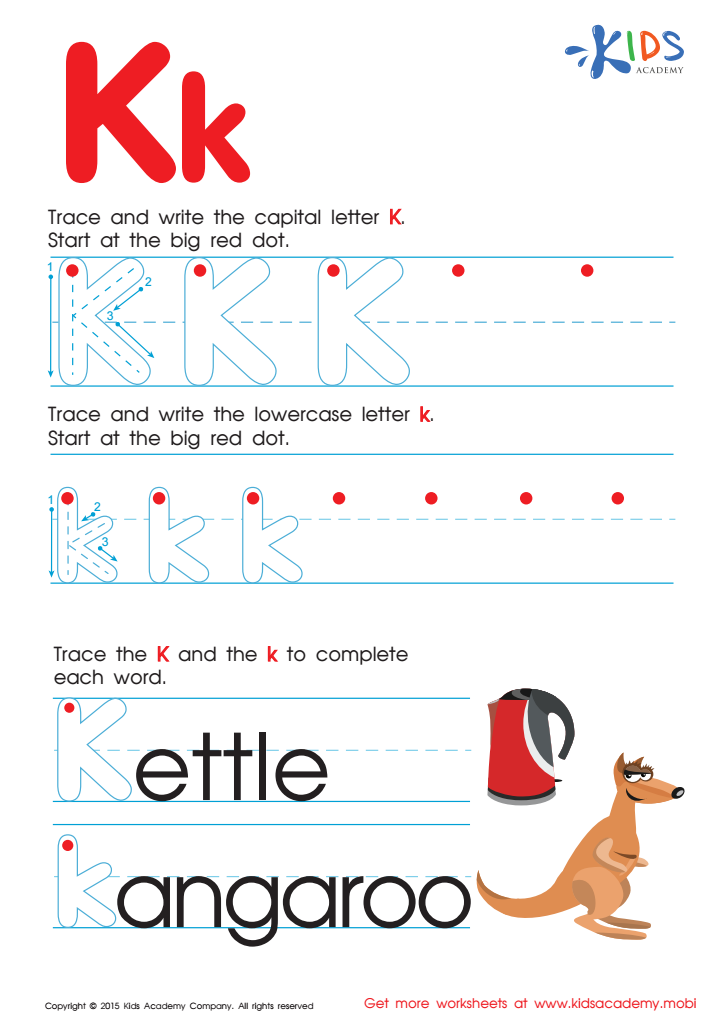
Letter K Tracing Page
Trace and write the letter K; start at the big red dot. Use it to complete words like "Kettle" and "Kangaroo". Visit Kids Academy for more free alphabet worksheets for kindergarten.
Letter K Tracing Page
Worksheet

Letter F Tracing Page
Trace "F" with your pencil! Start at the red dot and draw lines — it's fun! Check it out — it looks great! Keep practicing to make it even better. Then, try completing words. Help out the broken fan and funny frog! Get free alphabet worksheets and activities for your kids. Come see our new tracing pages!
Letter F Tracing Page
Worksheet
Join Kids Academy for Free
Who is primarily going to use this learning content?








Handwriting skills and letter recognition are foundational elements for a child's literacy development, particularly for 7-year-olds who are typically in second grade. At this age, children transition from learning to read and write to more advanced literacy tasks. Proficient handwriting not only enhances communication but also boosts a child's self-esteem. School assignments often require legible writing, and struggling with this can hinder academic progression and diminish motivation.
Furthermore, normal letter recognition is critical for fluent reading. When children can readily identify letters, they are better equipped to understand words and sentences, facilitating comprehension. These skills support broader literacy, helping children express their thoughts and emotions effectively.
Teachers and parents should also recognize that handwriting is linked to cognitive development. Engaging in fine motor skill activities builds neural pathways that enhance overall learning. In a digital world where typing is prevalent, caring about handwriting helps preserve the connection between manual dexterity and cognitive function, reinforcing learning experiences.
By prioritizing handwriting and letter recognition, parents and teachers can foster stronger readers and writers, setting a pattern for lifelong learning and enhancing a child's ability to participate fully in educational settings and beyond.








