Mathematical reasoning Normal Grade 1 Addition & Subtraction Worksheets
5 filtered results
Difficulty Level
Grade
Age
-
From - To
Subject
Activity
Standards
Boost your first grader's math skills with our "Mathematical Reasoning Normal Grade 1 Addition & Subtraction Worksheets." Carefully designed to foster critical thinking, these worksheets focus on developing fundamental math concepts. Through engaging exercises and fun activities, children explore addition and subtraction, enhancing their problem-solving abilities. Aligned with educational standards, these printables not only teach arithmetic but also build a strong foundation for mathematical reasoning. Ideal for classroom and at-home practice, our worksheets make learning interactive and enjoyable. Equip your child with the necessary skills to excel in math while nurturing their love for learning.
Favorites
With answer key
Interactive
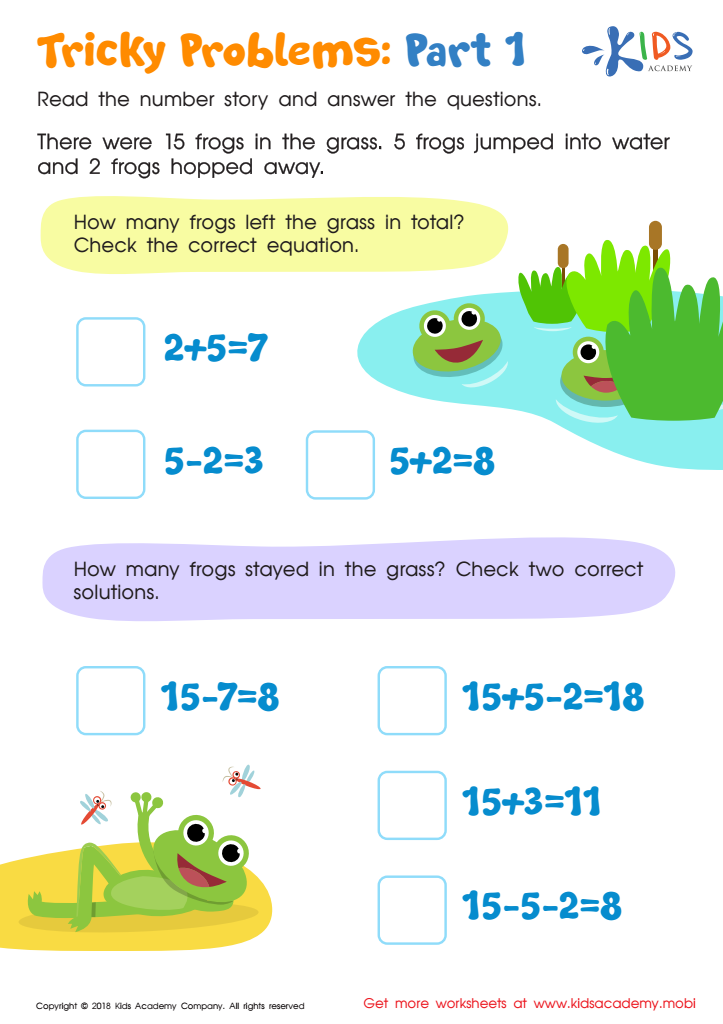
Tricky Problems Worksheet: Part 1
Visualizing word problems can help students solve them. This fun PDF worksheet encourages students to create mental images using math facts, then check boxes to match the equations for basic addition problems. It's a great way to build confidence in solving math.
 Assign to My Students
Tricky Problems Worksheet: Part 1
Worksheet
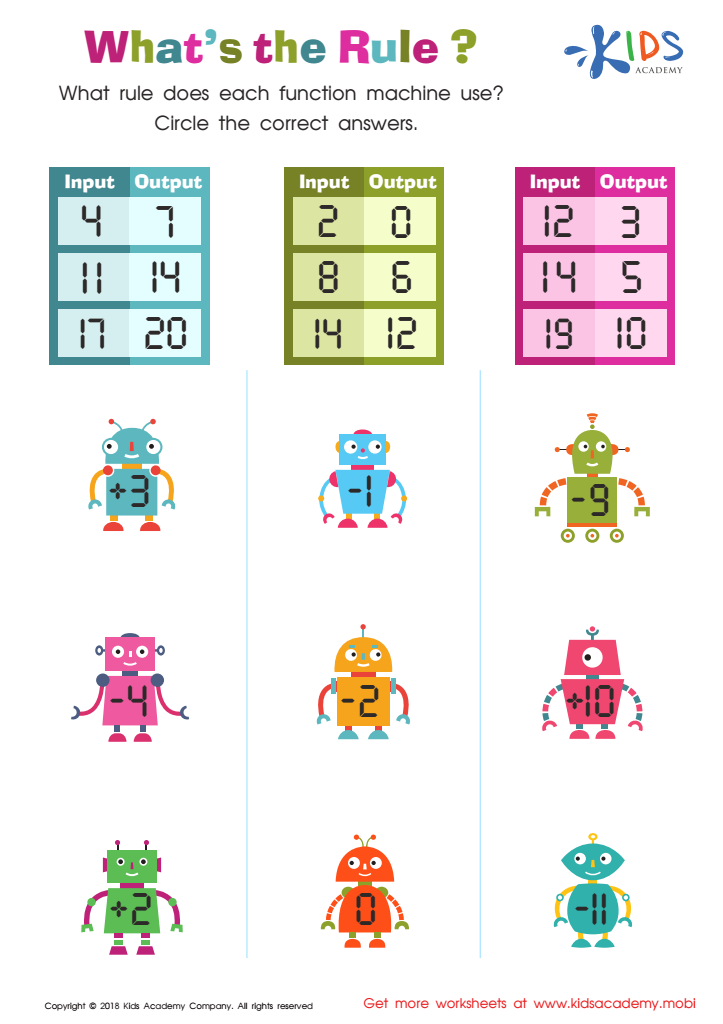
What's the Rule Worksheet
Robots are here to help your child find the relationship between each set of numbers! Adorably illustrated worksheets use vivid pictures that each contain a rule. Look at each function machine and find the pattern or relationship between the input and output. Then, complete the sheet by circling the correct answer!
What's the Rule Worksheet
Worksheet
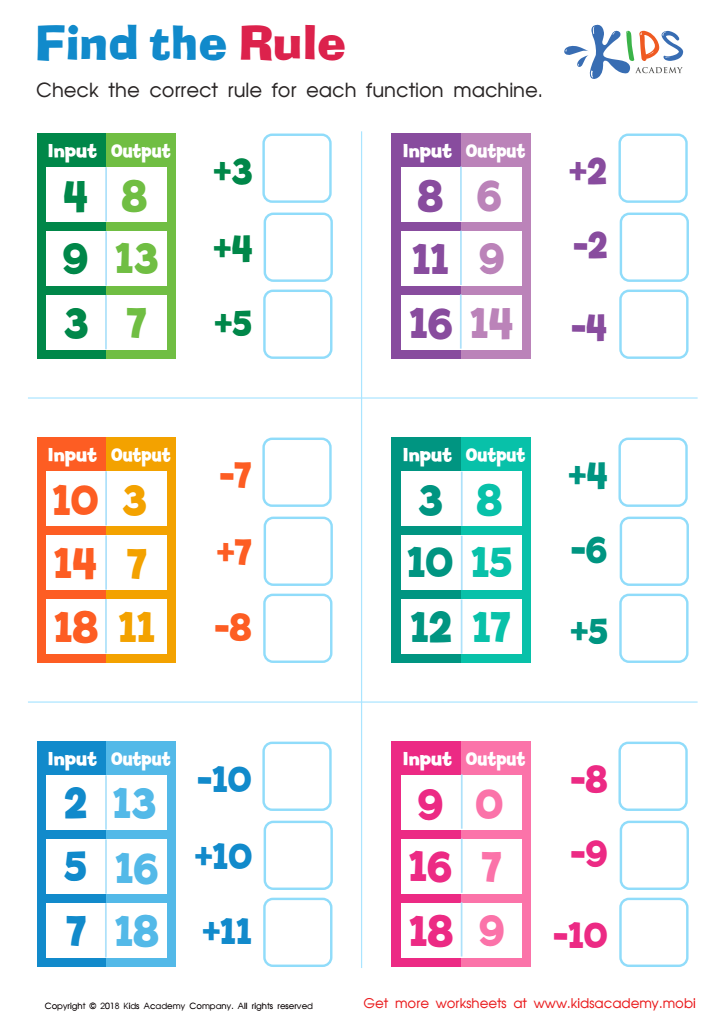
Find the Rule Worksheet
A function machine is an elementary math tool used to find an output by applying a rule, like addition or subtraction, to an input. Children use the diagram to understand the relationship between each input and output, with this worksheet helping them to analyze the machine and find the rule being used.
Find the Rule Worksheet
Worksheet
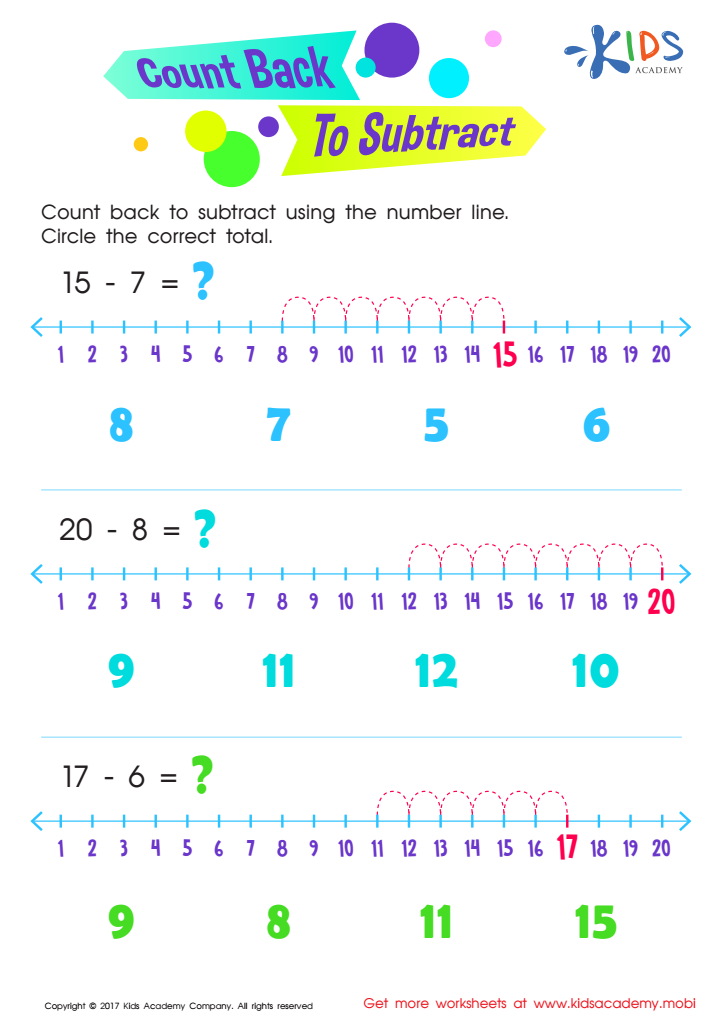
Count Back to Subtract Substraction Worksheet
With this worksheet, your child can visually see and count each number they’re subtracting.
This worksheet provides a number line to help your child master subtraction visually. Counting back on the line will give them a deeper understanding of the concept. It's a great way to teach subtraction and help children gain confidence with the subject.
Count Back to Subtract Substraction Worksheet
Worksheet
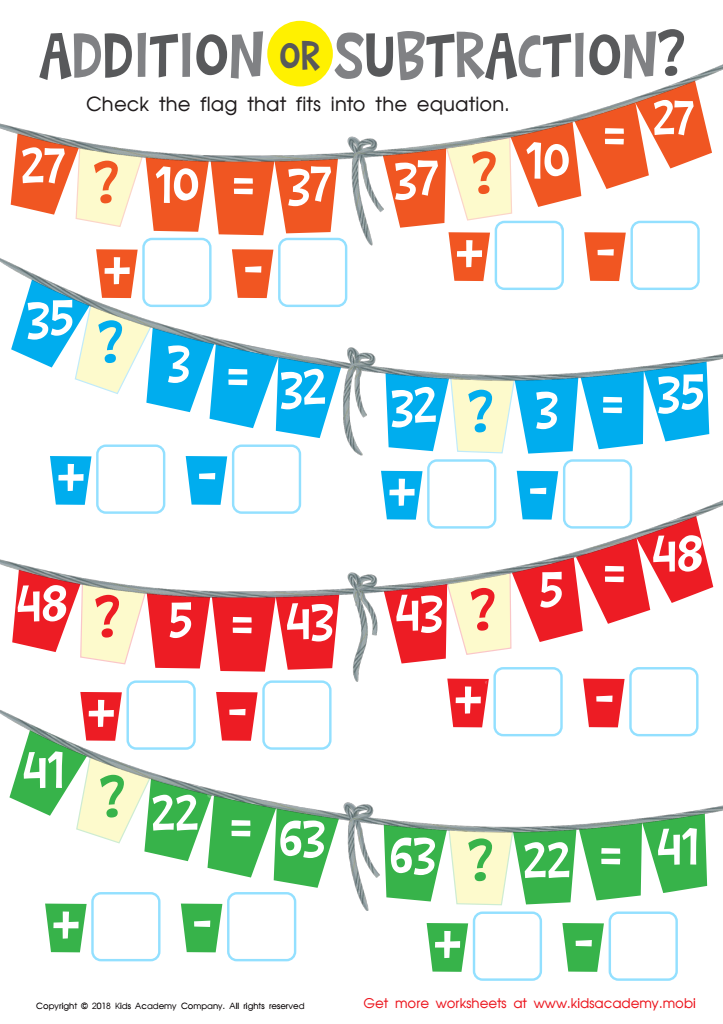
Addition or Subtraction? Worksheet
Help your math whiz's number skills advance with these colorful flag equations! With the free PDF, they'll learn to solve addition and subtraction facts by following the correct orders of operation. And the best part? They'll develop a deeper understanding of how the different operations work together within equations. Give it a try and watch their skills soar!
Addition or Subtraction? Worksheet
Worksheet
Join Kids Academy for Free
Who is primarily going to use this learning content?








Mathematical reasoning plays a crucial role in a child's cognitive development, especially during early education years, such as Grade 1. Fostering strong addition and subtraction skills lays the foundation for future mathematical learning and critical thinking. Both parents and teachers should prioritize this for several reasons.
Firstly, addition and subtraction are foundational skills upon which more complex mathematical concepts are built, including multiplication, division, fractions, and algebra. Mastery in these basic operations can make the transition to advanced topics smoother and less intimidating for young learners.
Secondly, cultivating mathematical reasoning at an early age enhances problem-solving skills. When children understand the 'why' and 'how' behind their calculations, they develop the ability to apply logic to real-world situations, thereby improving their overall decision-making skills and academic performance in other subjects.
Moreover, providing support in these early stages can build a child's confidence. Feeling competent in addition and subtraction boosts self-esteem, encouraging a positive attitude towards learning and reducing math anxiety, which is common among students.
Lastly, involving parents in a child's learning journey through activities and practice at home reinforces classroom teachings and ensures a holistic learning environment. Recognizing this critical period and emphasizing addition and subtraction can thus bring lifelong benefits to a child's education and day-to-day reasoning skills.