
Rhyming worksheets activities for Ages 4-6
1 filtered results
Difficulty Level
Grade
Age
-
From - To
Subject
Activity
Standards
Introducing our captivating Rhyming Worksheets Activities, designed to engage and educate young minds! These thoughtfully crafted worksheets are the ideal tool for children to explore the enchanting world of rhymes, enhancing their phonemic awareness and reading skills. Perfect for classroom use or at-home learning, our activities offer a blend of fun and challenge, keeping learners motivated and excited about mastering rhymes. From beginners to more advanced learners, our Rhyming Worksheets Activities are tailored to support and inspire students of all levels. Dive into our collection and watch your child's love for language and rhythm flourish!
Favorites
With answer key
Interactive
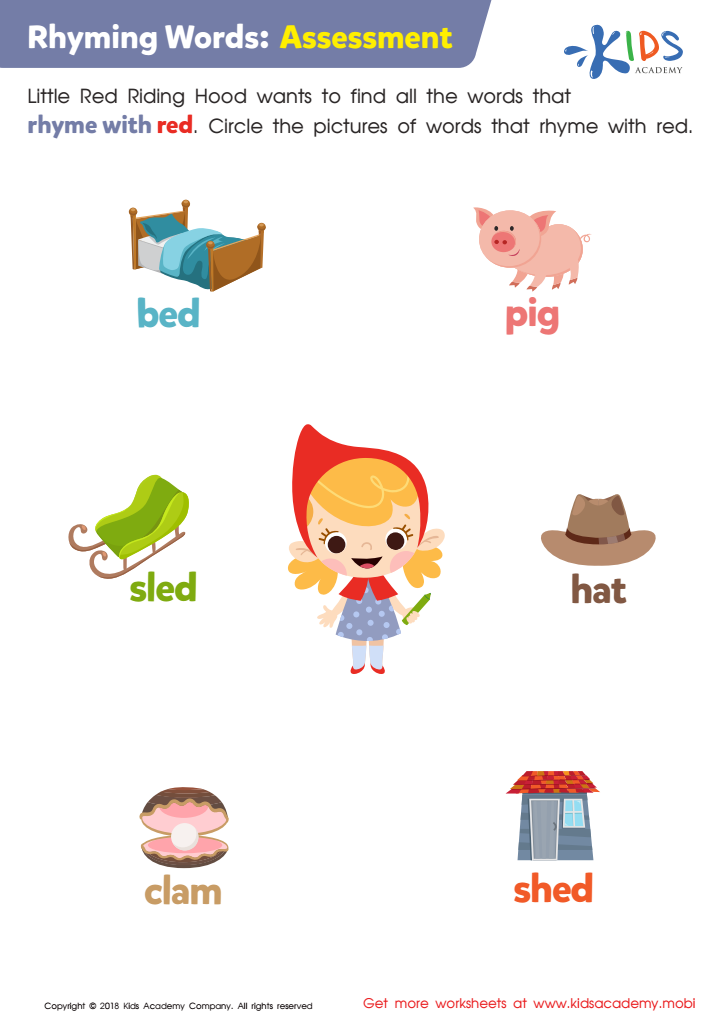
Rhyming Words: Assessment Worksheet
Help Little Red Riding Hood find rhyming words with "red". Download and print this worksheet. Have your child circle the rhyming words and pictures. Get them to say each word out loud and compare it to the word "red". When they're done, review the answers and talk about any words that don't rhyme.
 Assign to My Students
Rhyming Words: Assessment Worksheet
Worksheet
Learning Skills
Join Kids Academy for Free
Who is primarily going to use this learning content?







Rhyming worksheets activities are an invaluable tool for early learning, offering a plethora of benefits that extend far beyond simply recognizing similar sounding words. These activities serve as a foundational element in the development of phonemic awareness, a critical skill in the journey towards becoming proficient in reading and writing. Let’s delve into why rhyming worksheets activities are so beneficial.
First and foremost, rhyming worksheets activities foster an understanding and appreciation of language sounds. Through engaging with rhymes, children begin to discern patterns in word endings, which is a key step in the development of phonological awareness. This skill is vital as it underpins the ability to decode words, an essential component of reading fluently.
Moreover, these activities enhance vocabulary. As children encounter rhymes, they are exposed to a vast array of words, some of which may be new to them. This exposure naturally expands their linguistic repertoire, enabling them to express themselves more richly and understand a broader range of spoken and written language.
Rhyming worksheets activities also bolster memory and cognitive development. The repetitive nature of rhymes makes them easier to remember, encouraging children to recall and store information more effectively. This skill is not only useful in language learning but across all areas of education and everyday life.
Additionally, these activities can be a source of enjoyment and creativity. Rhyming encourages children to play with language, exploring how words can be manipulated and combined in entertaining and inventive ways. This not only makes learning more enjoyable but also stimulates creative thinking skills.
In conclusion, rhyming worksheets activities are far more than a simple language exercise. They are a comprehensive educational tool that supports linguistic, cognitive, and creative development. By incorporating these activities into early education, we can provide children with a solid foundation for their future learning journeys.








