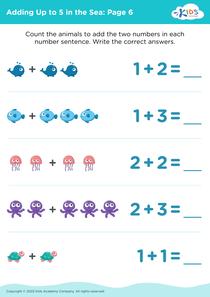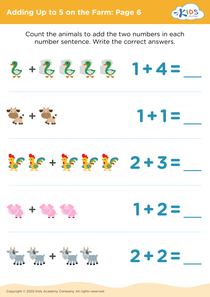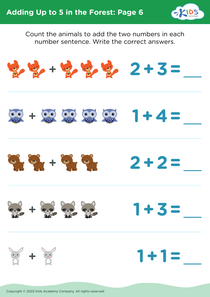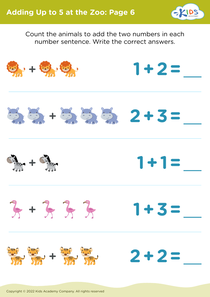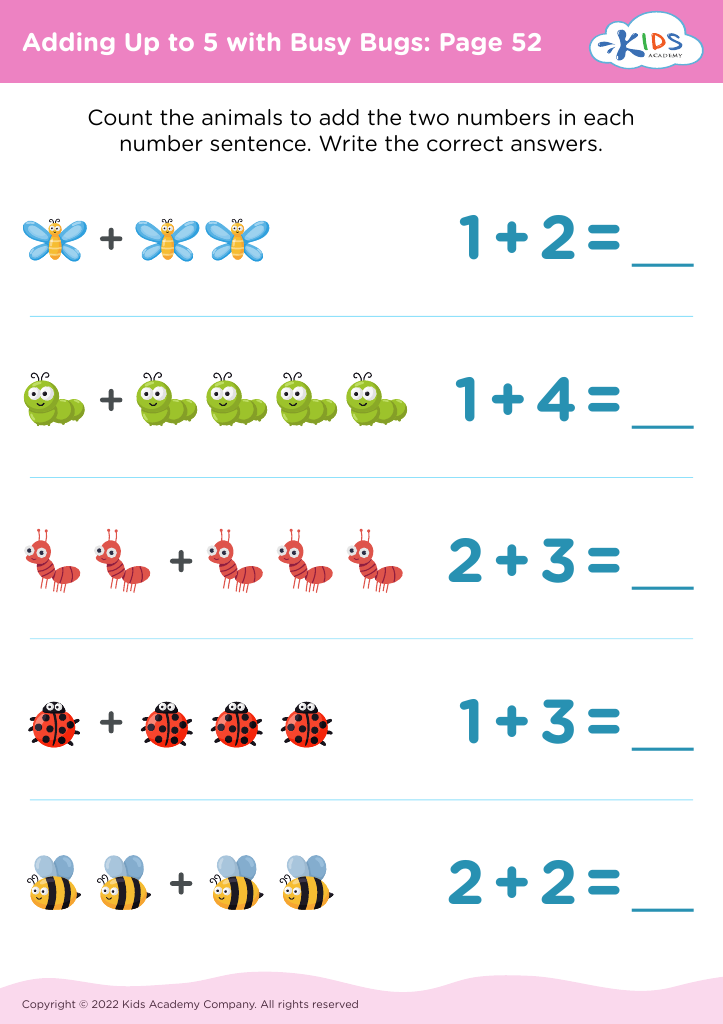


Counting practice and early addition skills are fundamental building blocks for young children's mathematical development. Introducing these concepts in a playful and engaging manner, such as with busy bugs, offers several benefits for preschoolers and reasons why parents and teachers should prioritize it.
First, counting practice helps children understand the concept of numbers and quantities. These early interactions with numbers lay the groundwork for more complex mathematical concepts. Preschool activities, especially those involving colorful and playful elements like busy bugs, make learning fun and can capture a child's attention more effectively than traditional methods.
Secondly, early addition practice encourages logical thinking and problem-solving skills. By starting with simple, tangible objects that children can see and count, like busy bugs, they can better grasp the concept of combining items to form a new total. This concrete understanding is crucial before moving on to abstract problem-solving.
Moreover, activities like counting and adding with busy bugs can promote fine motor skills as children manipulate small objects, and enhance social skills when they work in groups or pairs. These practices help children develop patience, turn-taking, and collaborative learning experiences.
Lastly, building a strong numerical foundation in a playful and engaging way fosters a positive attitude towards mathematics as children grow. Parents and teachers can support a lifelong love of learning by integrating fun, hands-on activities into early math education.