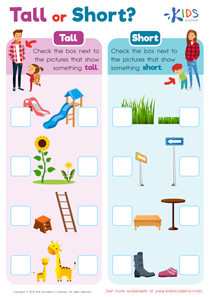
Comparing sizes Preschool Measurement Worksheets
3 filtered results
Difficulty Level
Grade
Age
-
From - To
Subject
Activity
Standards
Introduce your preschoolers to the fascinating world of measurements with our “Comparing Sizes Preschool Measurement Worksheets.” These engaging and educational worksheets are designed to help little ones grasp the concept of size differences through fun and interactive activities. Featuring colorful graphics and simple instructions, children will learn to compare and contrast items, enhancing their observational skills and early math understanding. Whether at home or in the classroom, these worksheets provide a solid foundation for future mathematical concepts. Perfect for curious minds eager to explore, our sheets make learning measurements a joyful and rewarding experience for young learners.
Favorites
With answer key
Interactive
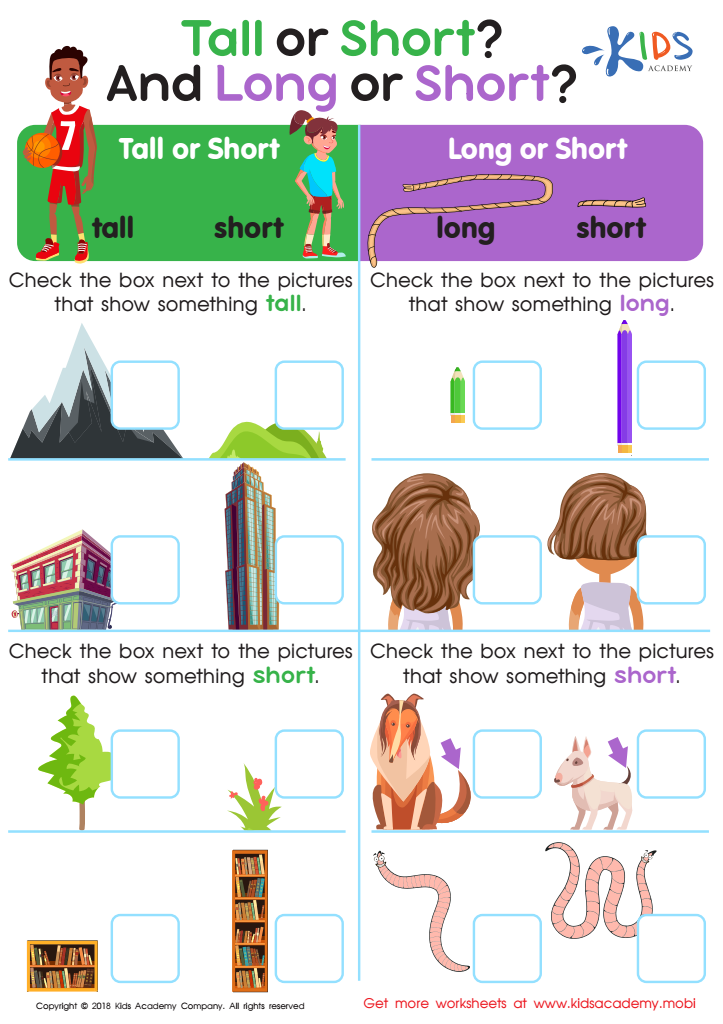
Tall or Short and Long or Short? Worksheet
This worksheet is fun and helpful for kids to understand the difference between height and length. With pictures of familiar objects, they can compare and choose the box with the right answer. This helps them gain skills and a better foundation for future measuring.
 Assign to My Students
Tall or Short and Long or Short? Worksheet
Worksheet
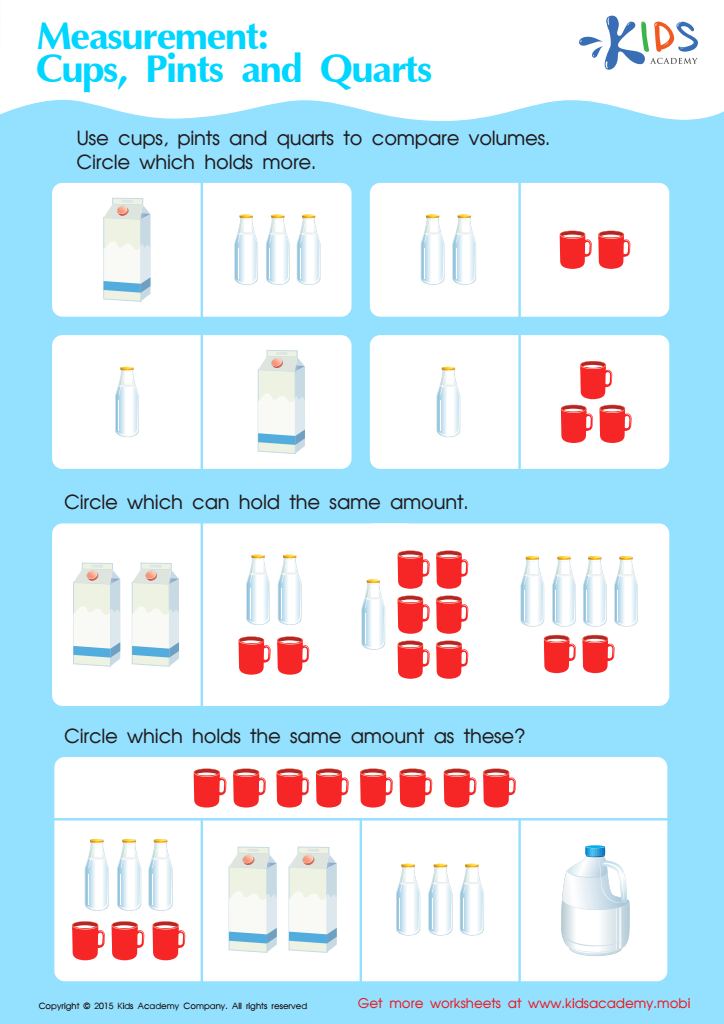
Measurement: Compare Volumes Worksheet
Compare volumes with Kids Academy and have fun! (80 words)
Practice measuring with Kids Academy and have fun! Compare volumes in pictures and circle which holds more. Keep learning with free math worksheets available on our website. Enjoy the process and have fun!
Measurement: Compare Volumes Worksheet
Worksheet
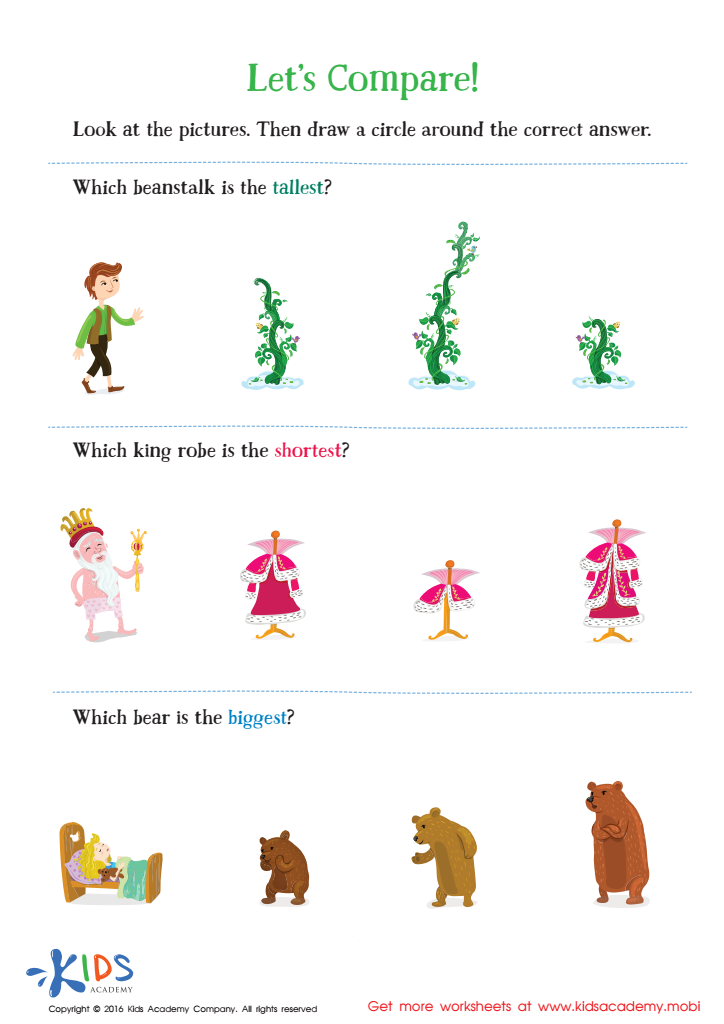
Fairy Tale Worksheet: Let's Compare
Preschoolers need to recognize different sizes of objects. This worksheet combines fun fairy tales with size practice, helping them read, problem solve, and sort through pictures. Your child will love the images and be eager to complete it. Enhance their learning by talking about the tales to build comprehension.
Fairy Tale Worksheet: Let's Compare
Worksheet
Join Kids Academy for Free
Who is primarily going to use this learning content?





Understanding and comparing sizes form an essential foundation for early math skills in preschoolers. When parents and teachers prioritize activities centered on comparing sizes, they are fostering critical cognitive development that will benefit children across numerous academic areas. By learning to observe and identify differences in sizes, preschoolers sharpen their observational skills and attention to detail. This practice also enhances their vocabulary as they learn various descriptive terms such as "big," "small," "tall," "short," "wide," and "narrow."
Furthermore, these early measurement activities directly support a child's ability to grasp more complex mathematical concepts later on, such as units of measurement, scaling, and spatial awareness. Such foundational knowledge creates a natural progression into understanding numbers, quantities, and eventually arithmetic operations. Daily activities like sorting toys by size, comparing the lengths of different objects, or describing the sizes of household items can stimulate problem-solving skills and logical thinking.
Emphasizing size comparison also brings about real-world relevance, enabling children to make sense of their environment. As they eagerly measure their own height against a wall or compare the length of their building blocks, they engage curiously and actively with the world, fostering a love for learning and discovery in the process. Through guided, thoughtful interactions focused on comparing sizes, parents and teachers can set children on a path toward academic confidence and success.