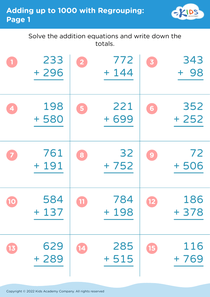
Basic Math Skills Grade 2 Adding up to 1000 Without Regrouping Worksheets
3 filtered results
-
From - To
Enhance your child's math proficiency with our engaging Basic Math Skills worksheets designed for Grade 2 students. Focusing on adding up to 1000 without regrouping, these printable resources promote foundational arithmetic skills and boost confidence in solving addition problems. Each worksheet features colorful visuals and age-appropriate exercises that captivate young learners, making math both fun and accessible. Encourage your child to practice critical thinking while honing their calculation abilities. Perfect for classroom activities or at-home learning, these worksheets support your child's academic growth in a structured and enjoyable manner. Foster a love for math with our interactive and educational resources!
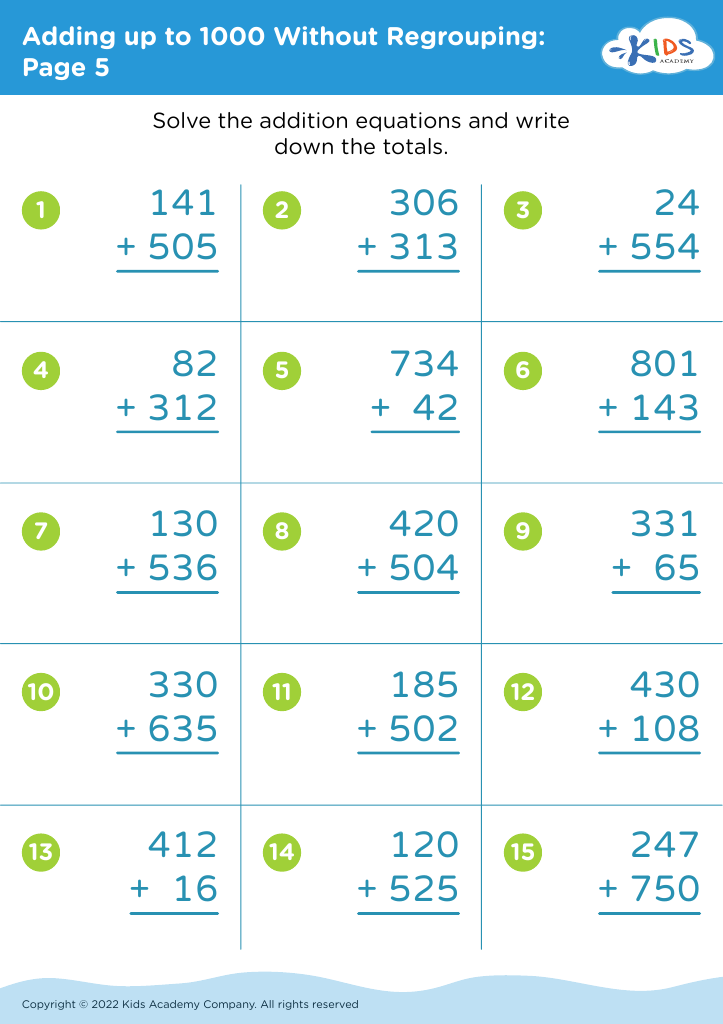
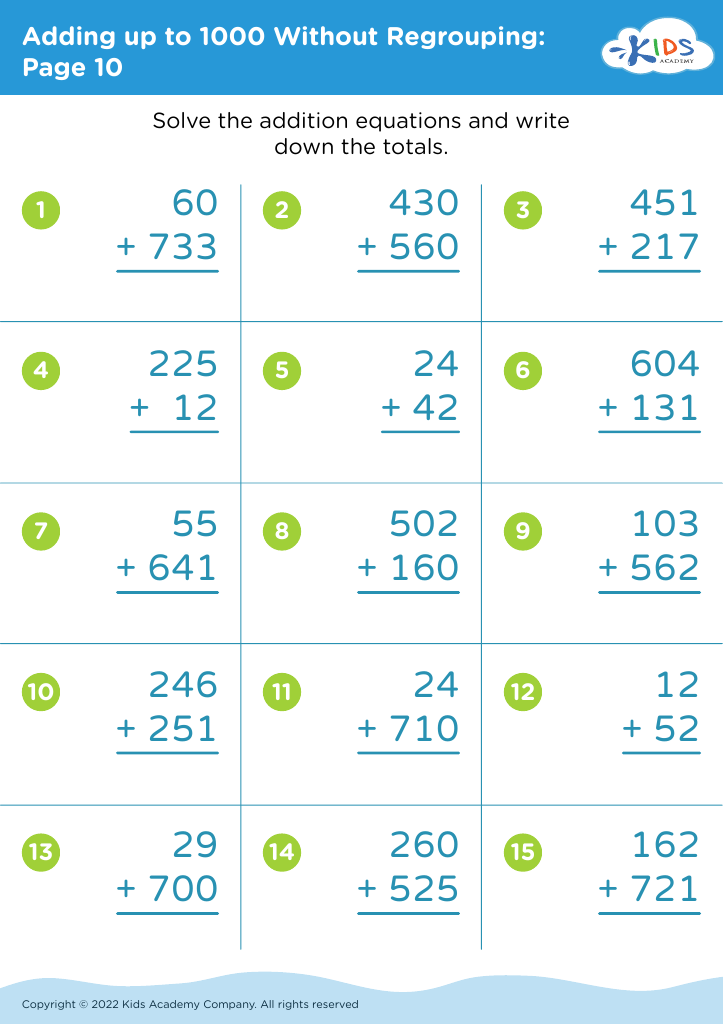
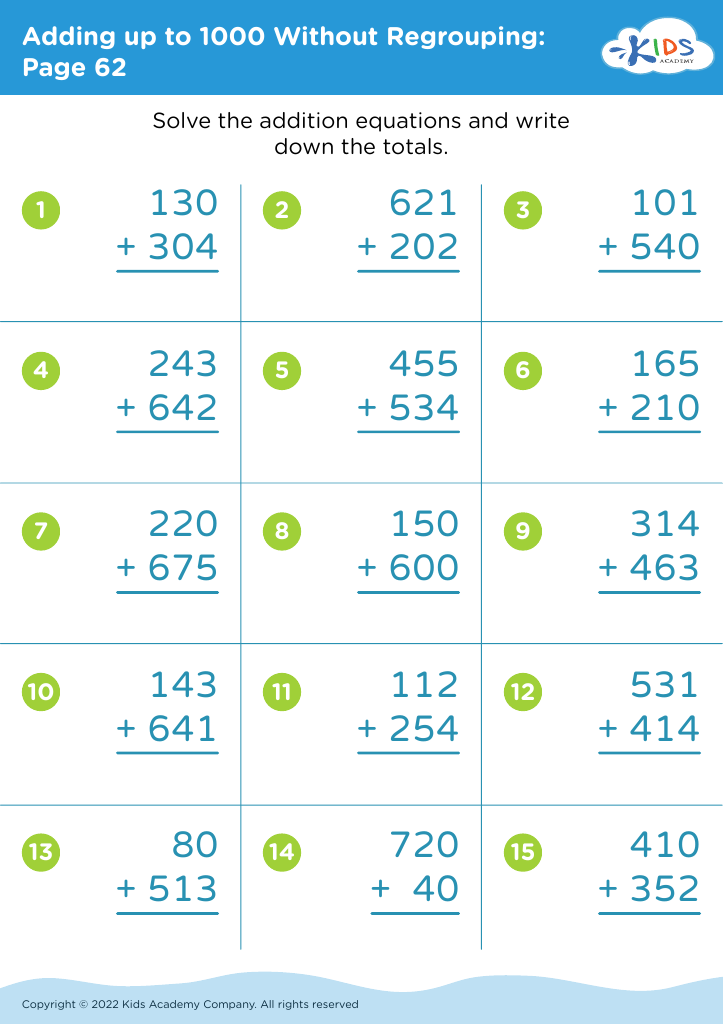


Basic math skills, especially mastery of addition up to 1,000 without regrouping, are crucial for second graders as they lay the foundation for more advanced mathematical concepts. At this age, students transition from concrete to more abstract problem-solving, and fluency in simple addition fosters confidence in their abilities.
Understanding how to add larger numbers builds number sense, enabling children to comprehend larger quantities and establish crucial relationships between numbers. This skill serves not only academic purposes but also practical applications in daily life, such as managing money or understanding time.
Moreover, the continuous practice of such basic math skills nurtures cognitive development, enhancing logical reasoning and critical thinking, which are applicable beyond math. It equips students with systematic reasoning and problem-solving strategies, which are vital throughout their educational journey.
For parents and teachers, emphasizing these skills reinforces a child's educational success, mitigating math anxiety as they progress. Genuinely engaging children with practical examples and enjoyable activities can create a supportive learning environment, ensuring that they feel competent and motivated to tackle future challenges in mathematics and other subjects. Thus, prioritizing basic math skills is an investment in children’s overall academic and personal growth.