Counting practice Grade 2 Adding up to 1000 Without Regrouping Worksheets
4 filtered results
-
From - To
Enhance your Grade 2 students' math skills with our engaging worksheets designed for counting practice and addition without regrouping, focusing on sums up to 1000. These fun and interactive worksheets encourage young learners to master essential addition techniques, fostering confidence and fluency in mathematics. Each worksheet features clear instructions and a variety of exercises to keep students motivated while learning. Perfect for classroom assignments or at-home practice, our resources help educators track student progress while reinforcing foundational math concepts. Dive into our extensive collection of counting practice worksheets today and empower your students to become proficient in addition!
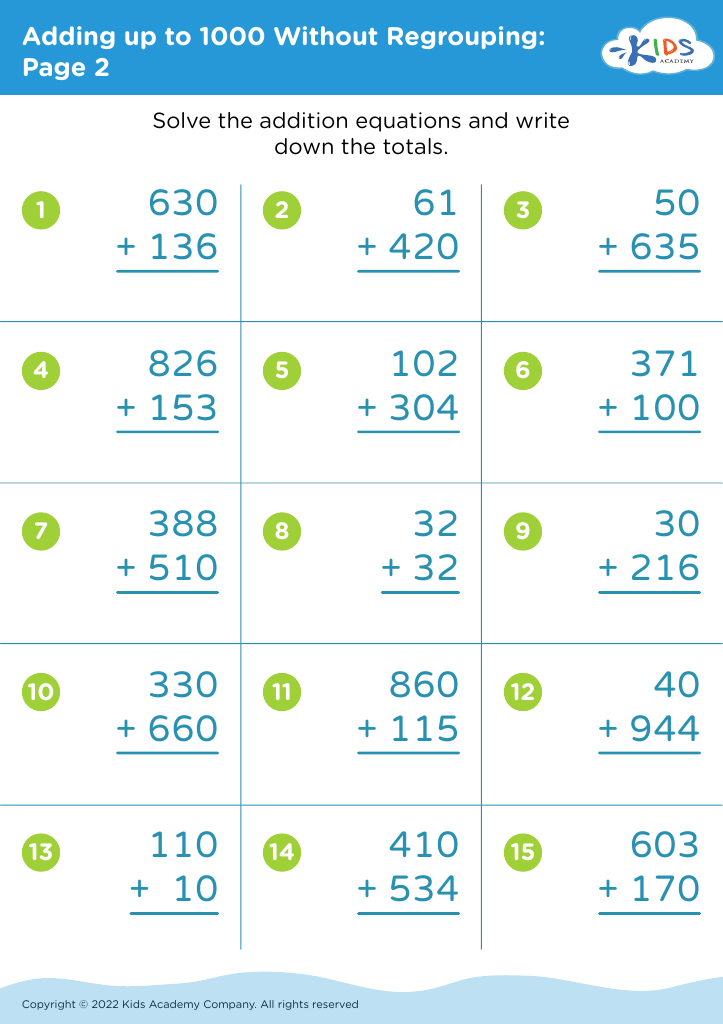
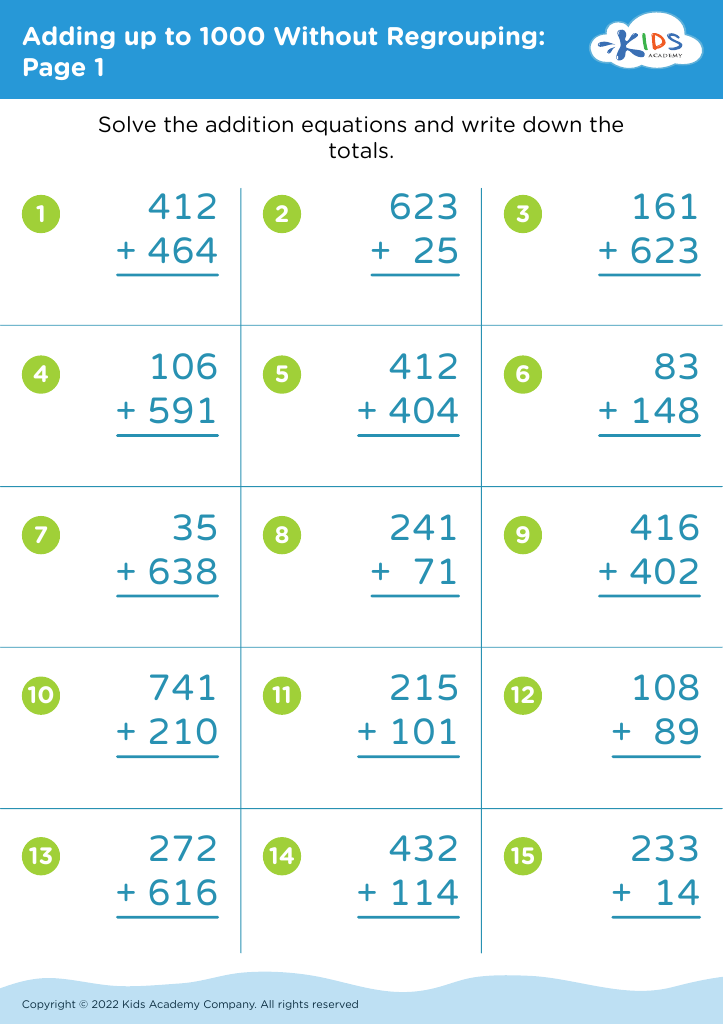
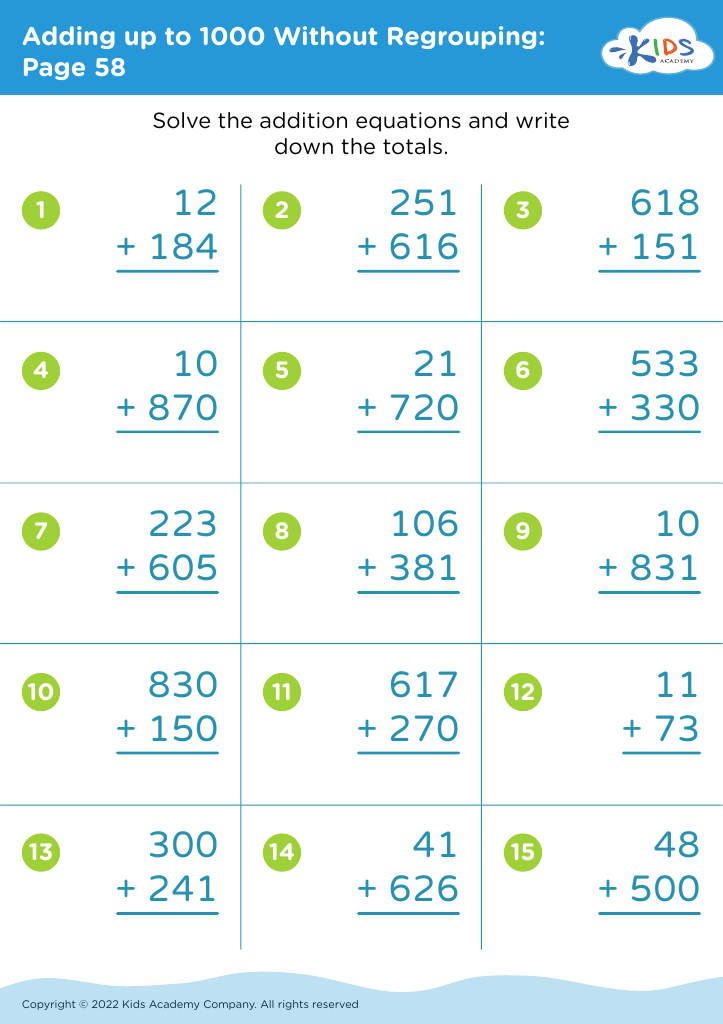
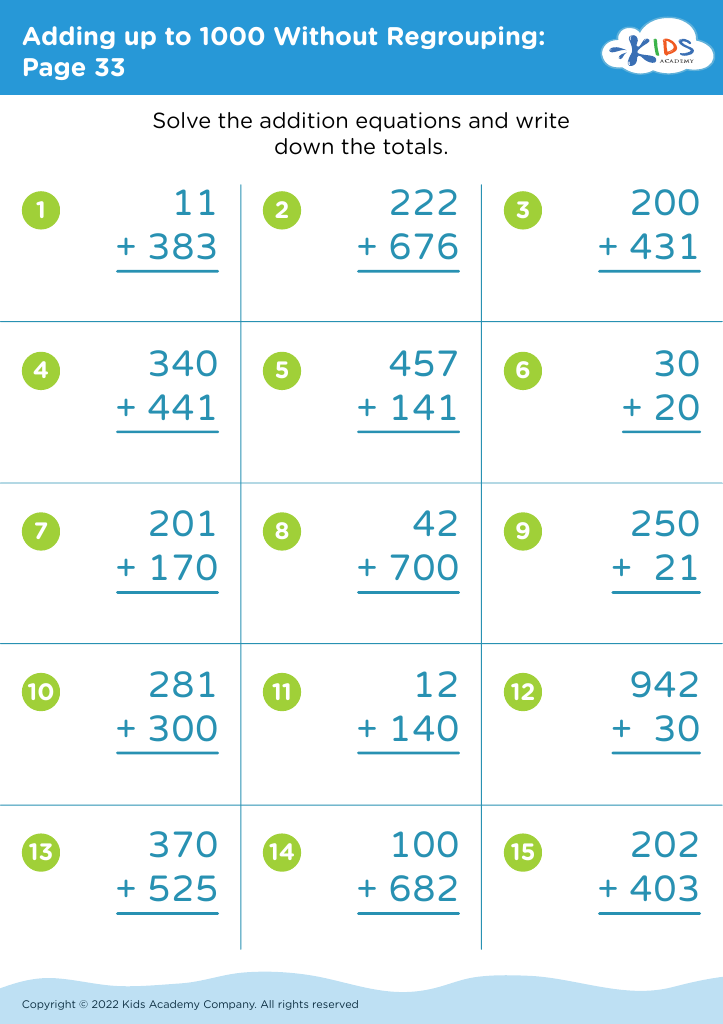


Counting practice in Grade 2, particularly focusing on adding up to 1000 without regrouping, is essential for foundational math skills. For parents and teachers, fostering proficiency in these skills is crucial for several reasons.
Firstly, mastering addition helps build confidence in young learners, setting a positive tone for future mathematical endeavors. When children can quickly and accurately add numbers up to 1000, they develop a solid grasp of numerical concepts and relationships, promoting a deeper understanding of arithmetic.
Additionally, learning to add without regrouping enables students to perform mental math more effectively. This ability encourages them to solve problems quickly and boosts their overall mathematical fluency, which is vital in everyday situations and future academic tasks.
Furthermore, this practice prepares students for more complex mathematical operations that involve regrouping and larger numbers as they progress in their education. It also reinforces important skills such as pattern recognition and problem-solving.
Encouraging counting practice helps parents and teachers identify areas where a child may struggle, allowing for timely intervention. Ultimately, nurturing strong foundational math skills in primary education forms the backbone of a child’s future learning and success in mathematics.