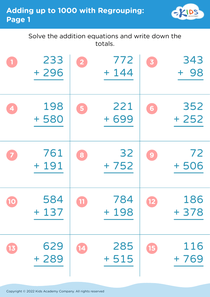
Improving math skills Grade 2 Adding up to 1000 Without Regrouping Worksheets
3 filtered results
-
From - To
Our "Improving Math Skills: Grade 2 Adding up to 1000 Without Regrouping Worksheets" are essential practice tools tailored to help young learners master addition up to 1000 efficiently and build a solid mathematical foundation. These carefully crafted worksheets provide a variety of addition problems that enhance numerical understanding and boost confidence in second graders. By focusing on addition without regrouping, students can develop stronger arithmetic skills, accuracy, and problem-solving abilities. Perfect for classroom use or home practice, these worksheets ensure a fun, engaging, and productive learning experience for every child, setting them up for continued success in math.
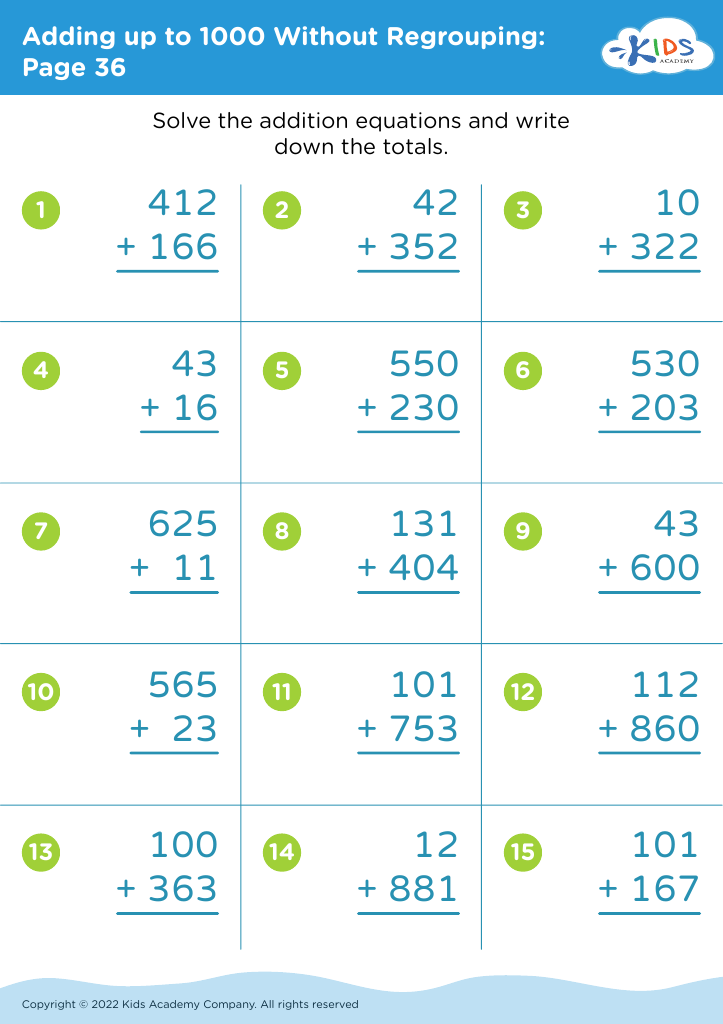
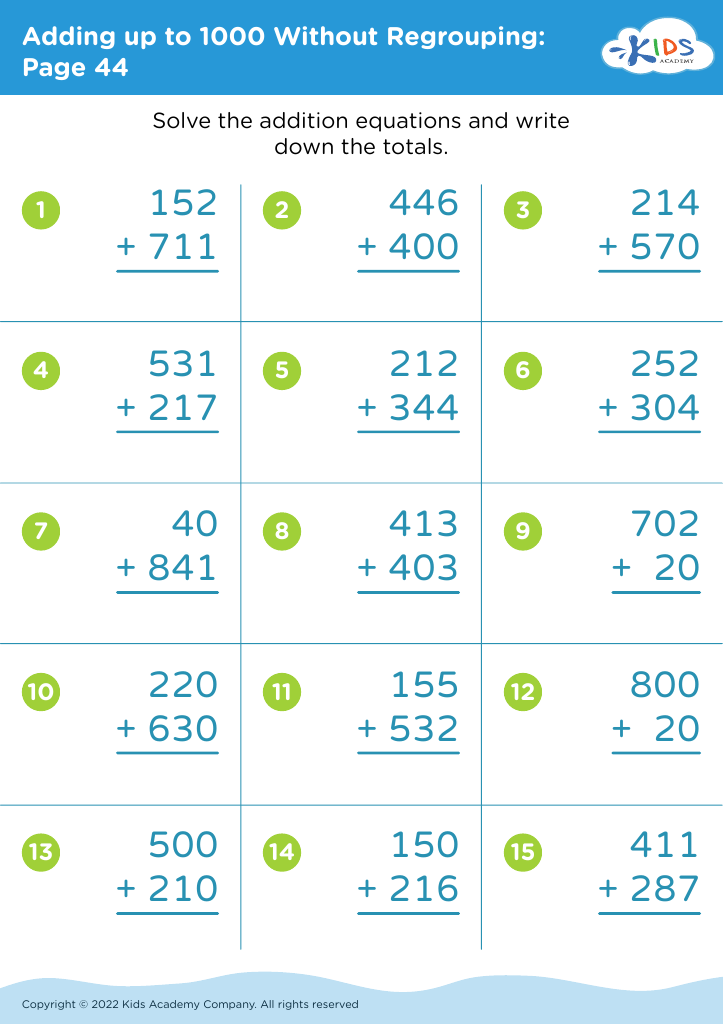
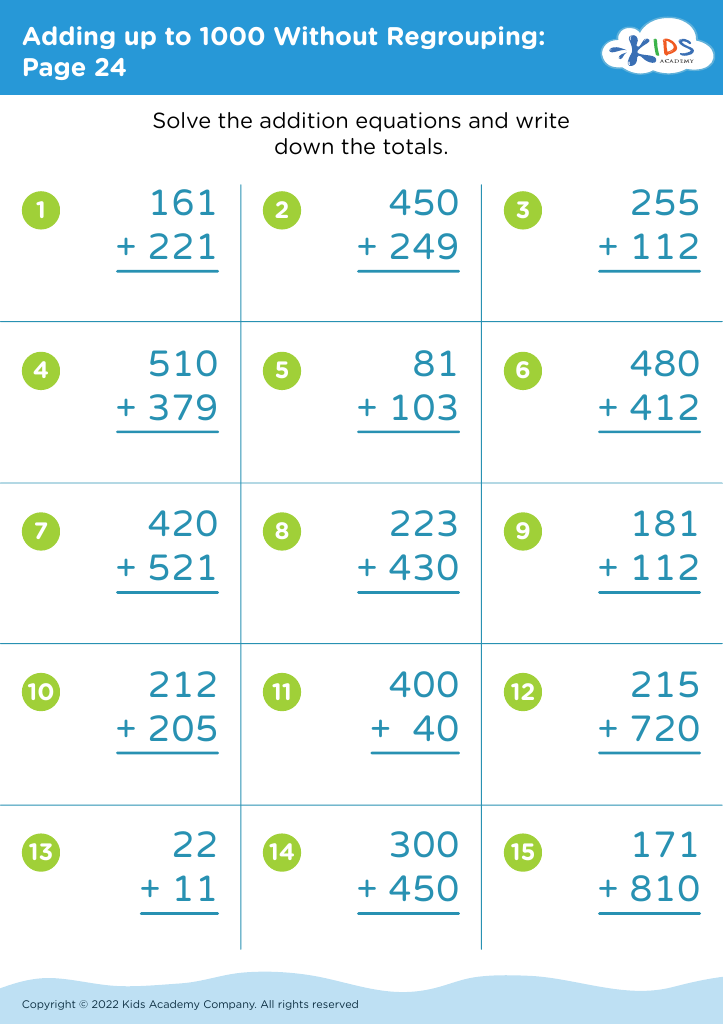


Improving math skills for second graders, especially in adding up to 1000 without regrouping, is paramount for several reasons. Firstly, these foundational math skills act as building blocks. Mastery in basic addition makes it significantly easier for children to grasp more complex math concepts they will encounter in later grades, such as multiplication, division, and fractions. Inadequate understanding can lead to gaps that hinder future learning and confidence in math.
Secondly, math skills develop critical thinking and problem-solving abilities essential in daily life. Elementary-grade math lays the groundwork for logical reasoning and the ability to tackle real-world problems, such as budgeting or measuring ingredients in a recipe.
Additionally, early success in math instills a growth mindset in children. It encourages perseverance and boosts self-esteem by showing students that they can overcome difficulties through practice and effort. This positive attitude can carry over to other subjects and aspects of life.
Moreover, mathematical competence is linked to better educational and career opportunities. Proficiency in early math opens doors to STEM (Science, Technology, Engineering, and Mathematics) fields, which are highly valued in today's job market.
Therefore, investing time and resources in improving math skills for second graders is crucial for fostering their overall academic growth and lifelong success.