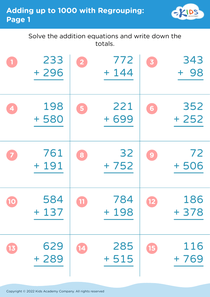
Recognize patterns Grade 2 Adding up to 1000 Without Regrouping Worksheets
3 filtered results
-
From - To
Help your second-grade students master addition with our "Recognize Patterns: Adding up to 1000 Without Regrouping" worksheets! Designed to enhance mathematical skills, these engaging and interactive activities focus on identifying patterns in addition. Your children will explore various number combinations that add up to 1000, reinforcing their understanding of number relationships while building confidence in their abilities. These worksheets foster critical thinking and problem-solving, providing ample opportunities for practice. Perfect for both classroom and home use, our materials ensure that learning math is not only educational but also fun! Download now and watch your students thrive in their addition skills!
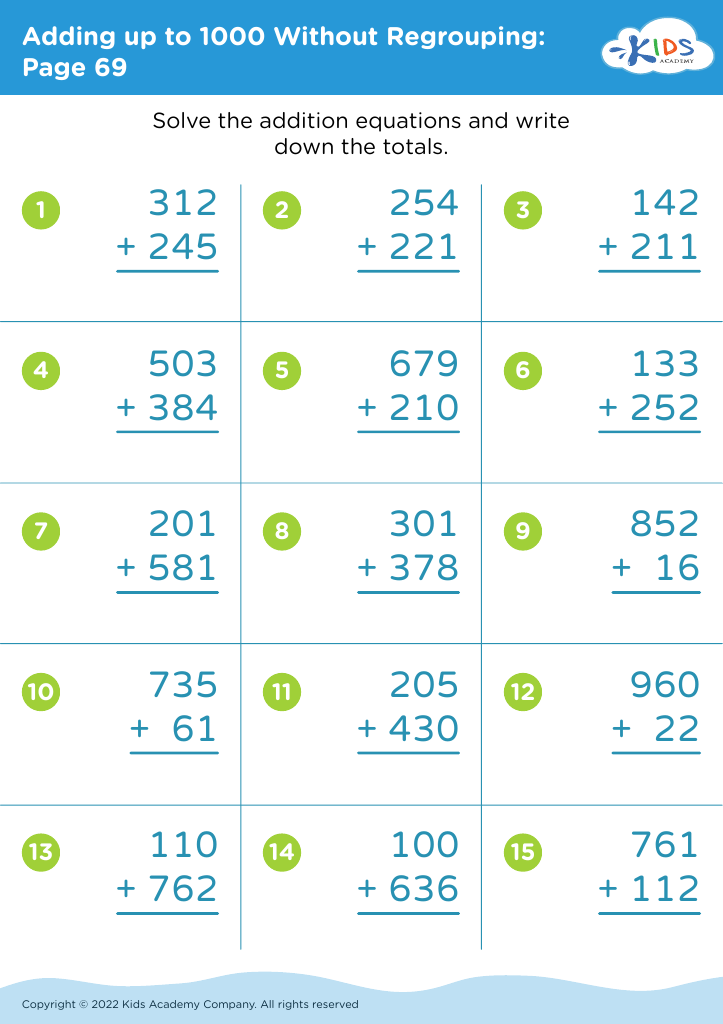
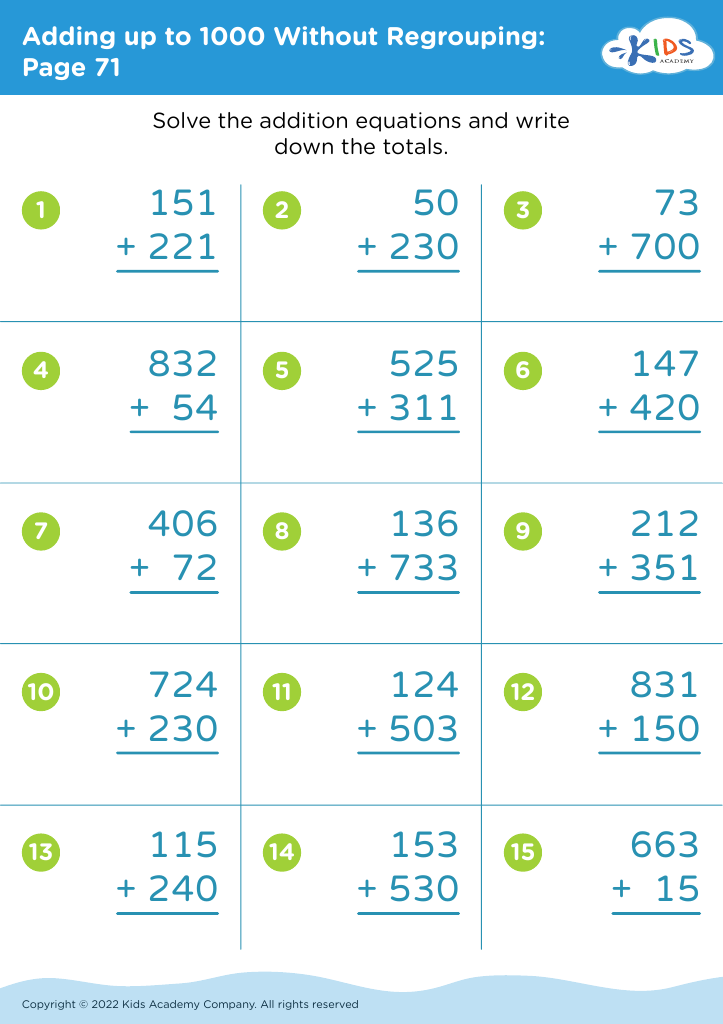
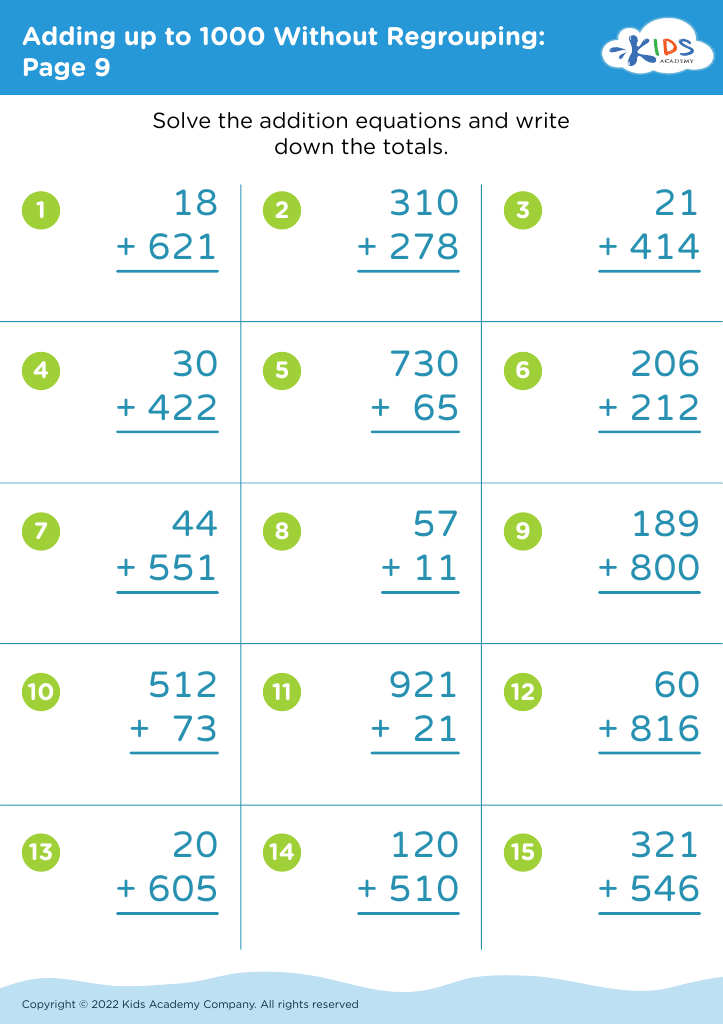


Recognizing patterns in mathematics is a crucial skill for second graders, especially when it involves adding numbers up to 1000 without regrouping. This skill fosters number sense, enabling students to see relationships and structures among numbers, making mental math calculations more accessible and efficient. When teachers and parents emphasize this skill, children develop a stronger foundation for future mathematical concepts, such as algorithms and place value, which are vital as they advance in their education.
Moreover, understanding patterns allows students to build confidence in their math abilities. By learning to recognize that certain combinations of numbers can sum to 1000, children can approach problem-solving with a more strategic mindset. This not only increases their engagement but also enhances critical thinking and analytical skills. Additionally, strong pattern recognition lays the groundwork for tackling more complex operations and word problems in later grades.
By supporting the recognition of these patterns, adults help children articulate their thought processes and become proficient in conveying their reasoning. Overall, valuing this mathematical skill sets the stage for success across academic disciplines and prepares students for real-world applications of math in daily life. Thus, it becomes essential for both parents and teachers to prioritize and nurture this understanding in budding mathematicians.