Number identification Grade 2 Adding up to 1000 Worksheets
3 filtered results
-
From - To
Discover our engaging "Number Identification Grade 2 Adding up to 1000 Worksheets" designed to support second graders in mastering number recognition and addition skills. These worksheets, crafted by educational experts, offer a variety of exercises to help students confidently identify and add numbers up to 1000. Ideal for classroom practice or at-home learning, these printables make math both fun and educational. With colorful illustrations and interactive challenges, kids will remain motivated as they build essential math foundations. Help your child succeed and develop essential numerical fluency with our Grade 2 number identification resources!
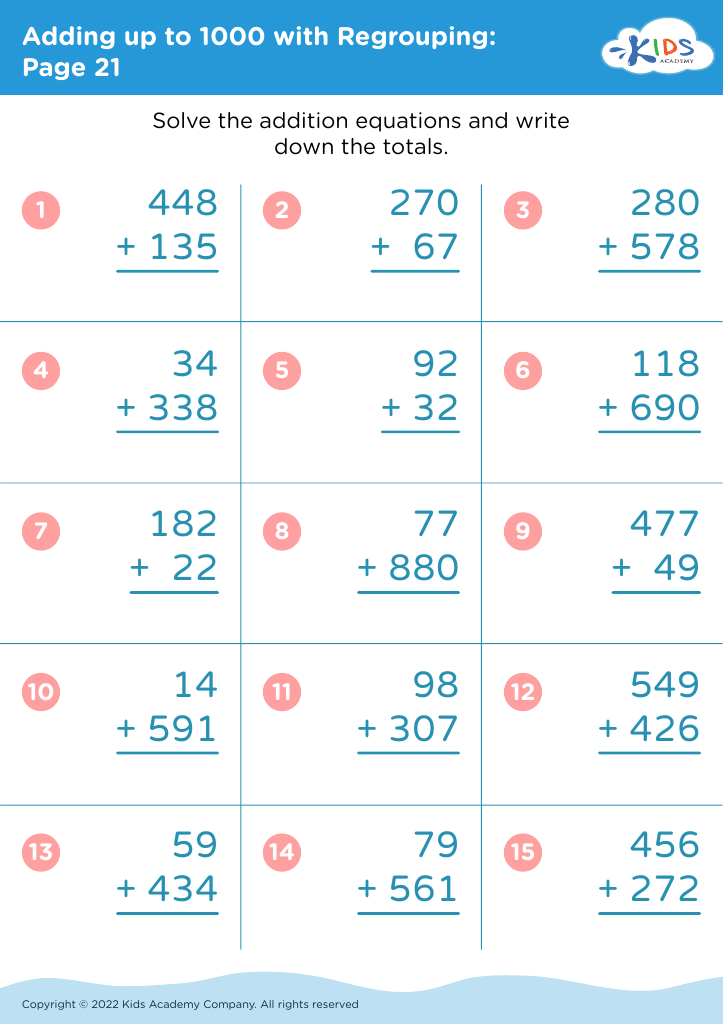
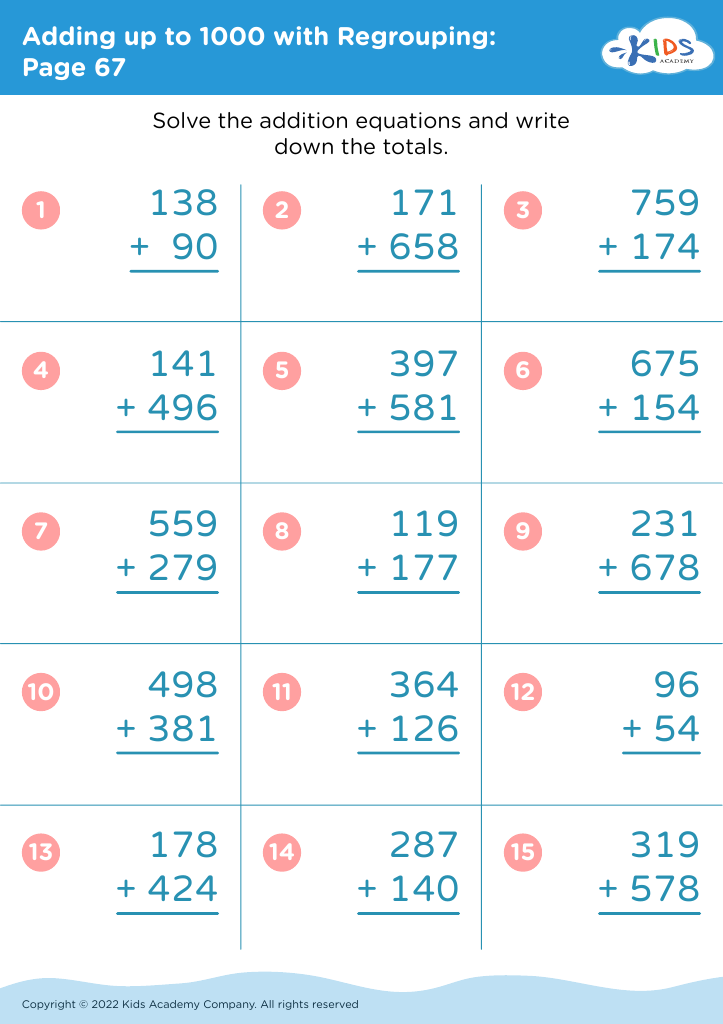
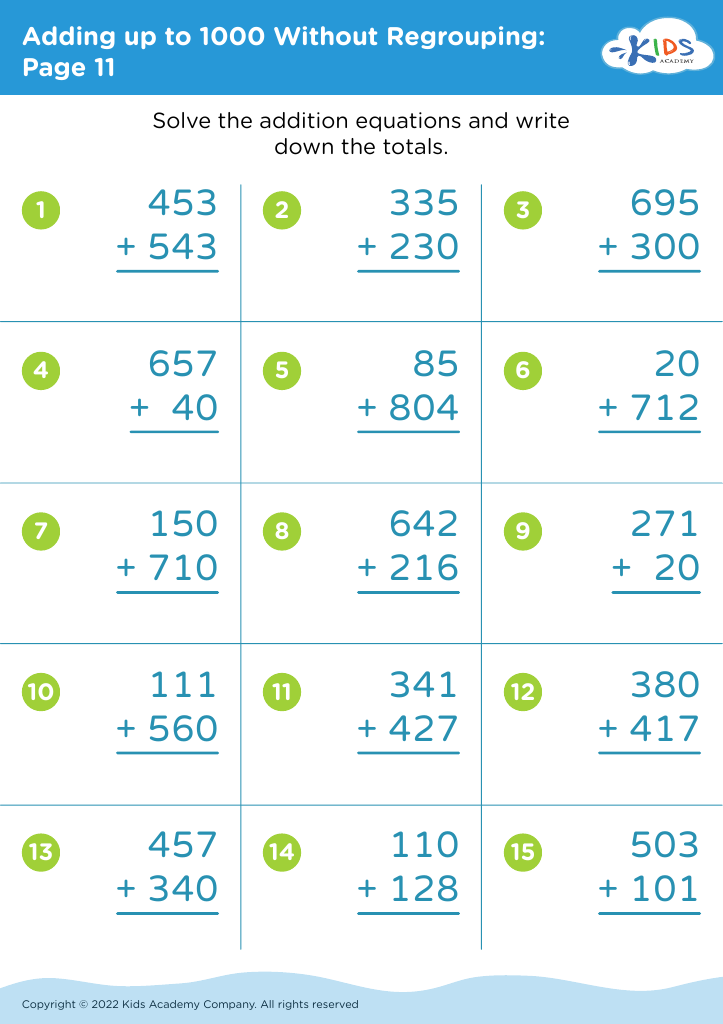



Number identification and the ability to add up to 1,000 are foundational skills crucial for second graders. Parents and teachers should prioritize these skills because they lay the groundwork for more advanced mathematical concepts. First and foremost, number identification helps children recognize and understand the value of digits, which is essential for later arithmetic, problem-solving, and algebraic thinking.
Being proficient in addition up to 1,000 not only enhances numeric fluency but also builds a child's confidence. When students can add large numbers, they develop a stronger sense of how smaller sums build into larger wholes, bolstering their comprehension of place value and the number system.
Moreover, these skills integrate into daily life. From calculating expenses during shopping to managing time and quantities in cooking, the ability to efficiently add and identify numbers is practically applicable. This real-world relevance motivates students, making learning meaningful and engaging.
Lastly, early mastery of these skills creates a solid base for future educational pursuits. It ensures students are well-prepared to tackle more complex mathematical challenges in higher grades, eliminating the struggle and frustration that can stem from foundational gaps. In summary, focusing on number identification and addition up to 1,000 in grade 2 nurtures confident, capable, and mathematically literate students.