Problem-solving practice Grade 2 Adding up to 1000 Worksheets
3 filtered results
-
From - To
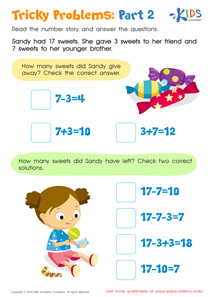
Enhance your child's math skills with our Grade 2 Adding Up to 1000 Worksheets. These problem-solving practice sheets are designed to challenge and engage young minds, helping them master addition up to 1000. Featuring diverse problem types, they encourage critical thinking and boost confidence in math. Each worksheet is crafted by educational experts and provides step-by-step instructions to aid understanding. Perfect for classroom or home use, these worksheets offer a blend of fun and learning to reinforce your child's arithmetic skills. Give your second grader the tools they need to excel in math with Kids Academy!
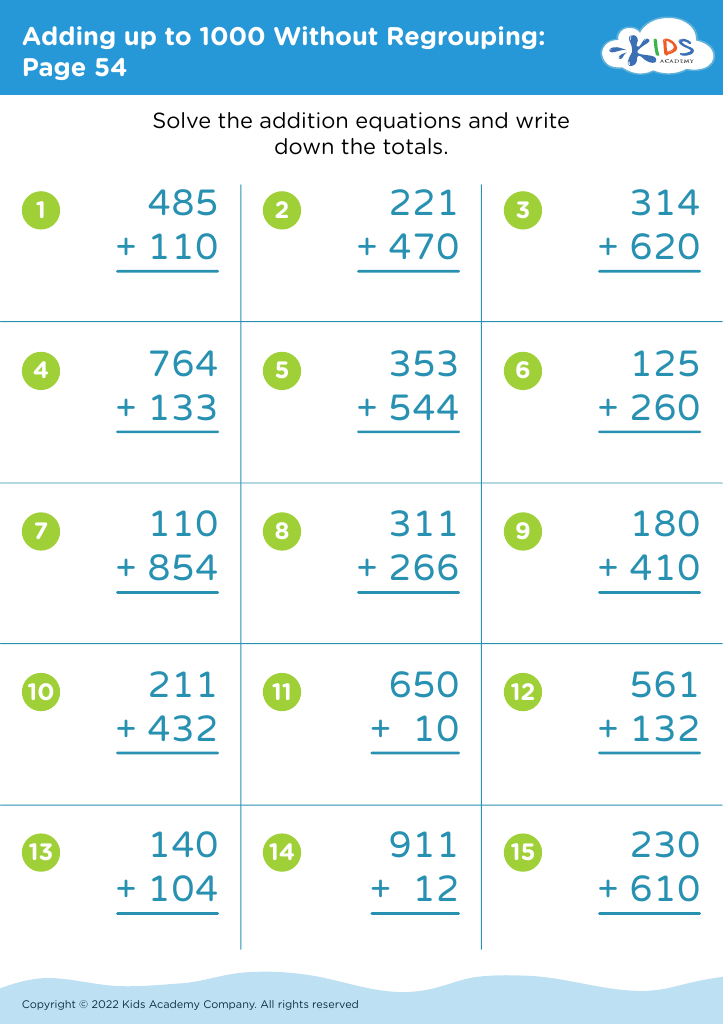
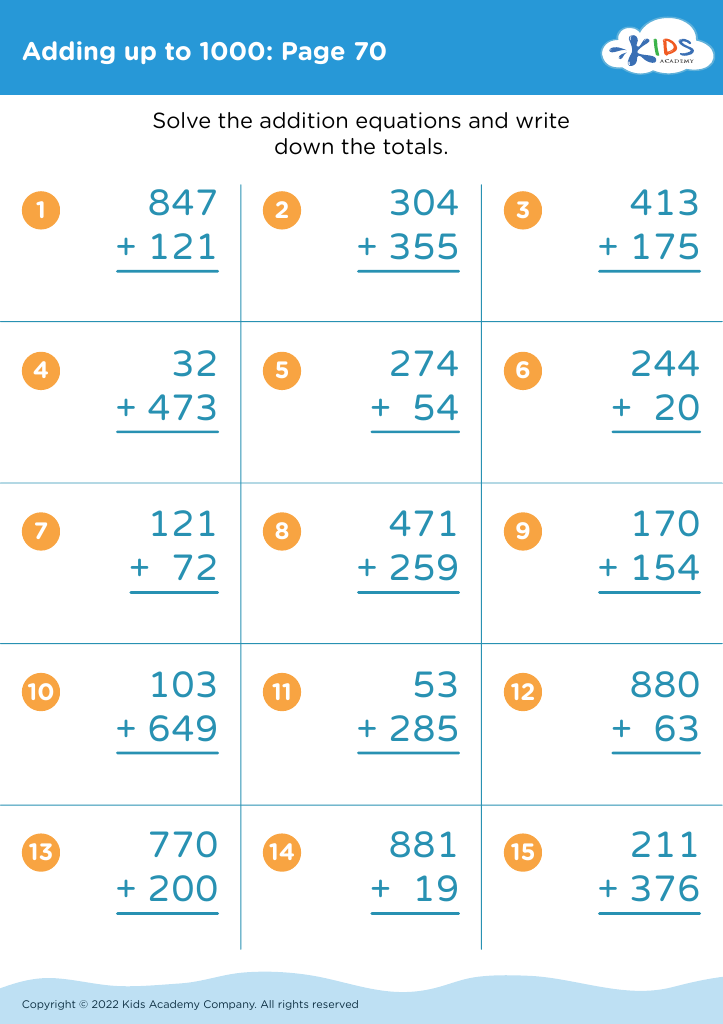
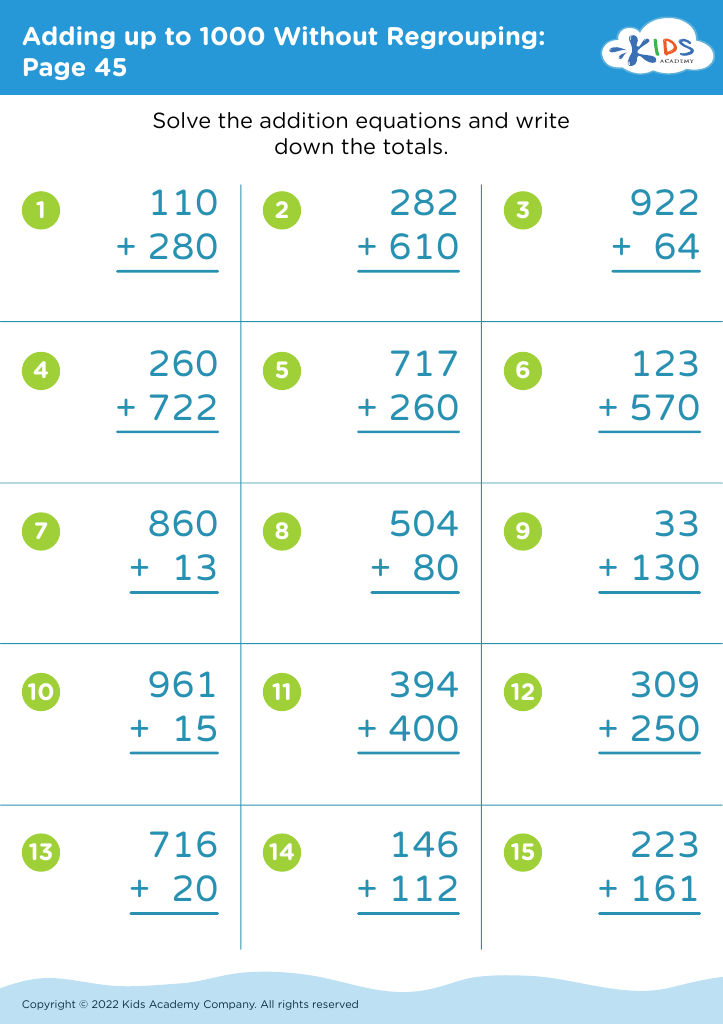



Parents and teachers should prioritize problem-solving practice focused on adding up to 1000 in Grade 2 because it creates a critical foundation for mathematical fluency and cognitive development. At this stage, children are building the fundamental skills required for more complex math in later grades. Mastering addition up to 1000 enhances their numerical understanding, improves their mental arithmetic abilities, and boosts their confidence in handling larger numbers. This practice is not just about learning to add; it also fosters logical thinking, pattern recognition, and strategic planning, which are essential skills both in academics and everyday life.
Engaging with addition problems up to 1000 encourages children to develop perseverance and a positive attitude toward challenges. It teaches them that taking on and solving complex tasks is achievable through practice and effort. Moreover, being proficient in these foundational skills is crucial for standardized testing and future academic success. When children see numbers as friendly and manageable, they're more likely to excel in other mathematical areas, such as subtraction, multiplication, and beyond.
Finally, it's about nurturing a growth mindset. By regularly practicing and succeeding in problem-solving activities, children learn the value of hard work, learn from mistakes, and embolden their natural curiosity and love for learning.