Visual interpretation Grade 2 Adding up to 1000 Worksheets
3 filtered results
-
From - To
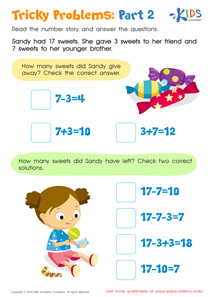
Welcome to our Visual Interpretation Grade 2 Adding Up to 1000 Worksheets! Designed to enhance your child’s mathematical skills, these worksheets help students understand addition through engaging visuals. At this level, children will learn to interpret and solve problems using pictures and graphics, making abstract concepts more concrete. Each worksheet encourages students to analyze visual representations and practice adding numbers up to 1000. Whether used in the classroom or at home, these resources support academic growth while making learning enjoyable. Empower your young learners with the skills they need to succeed in math with our thoughtfully crafted worksheets!
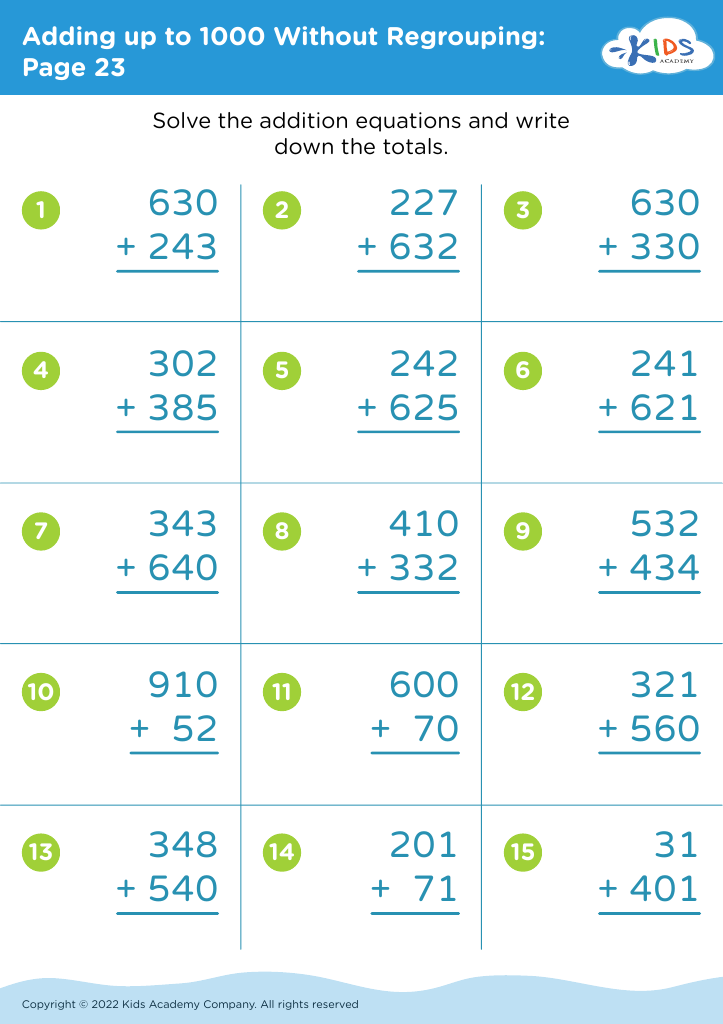
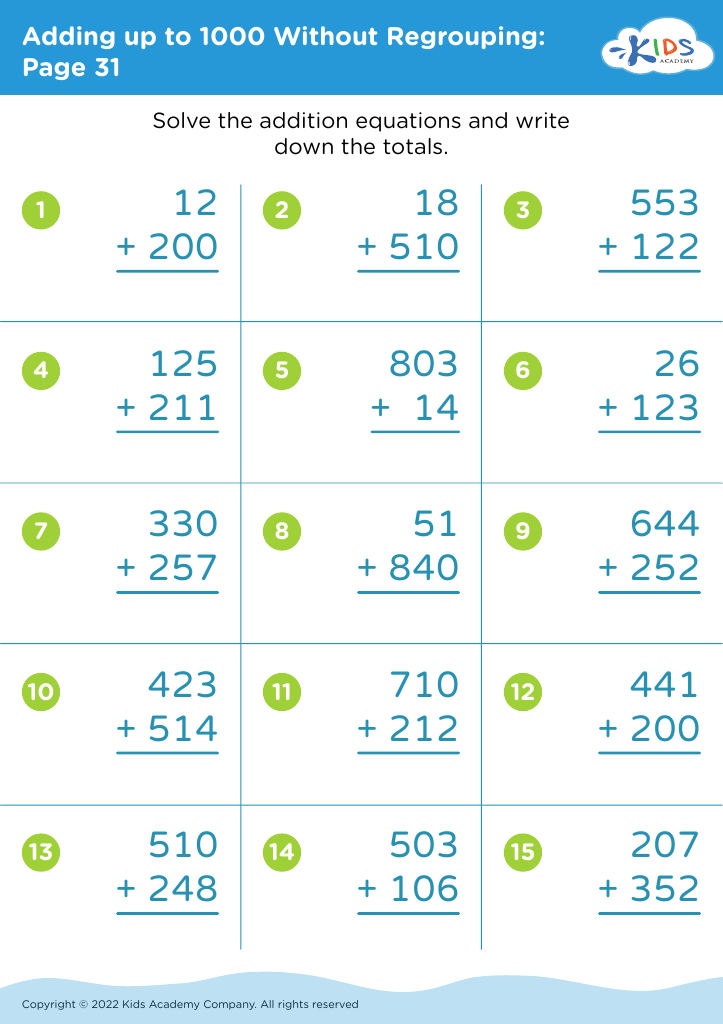
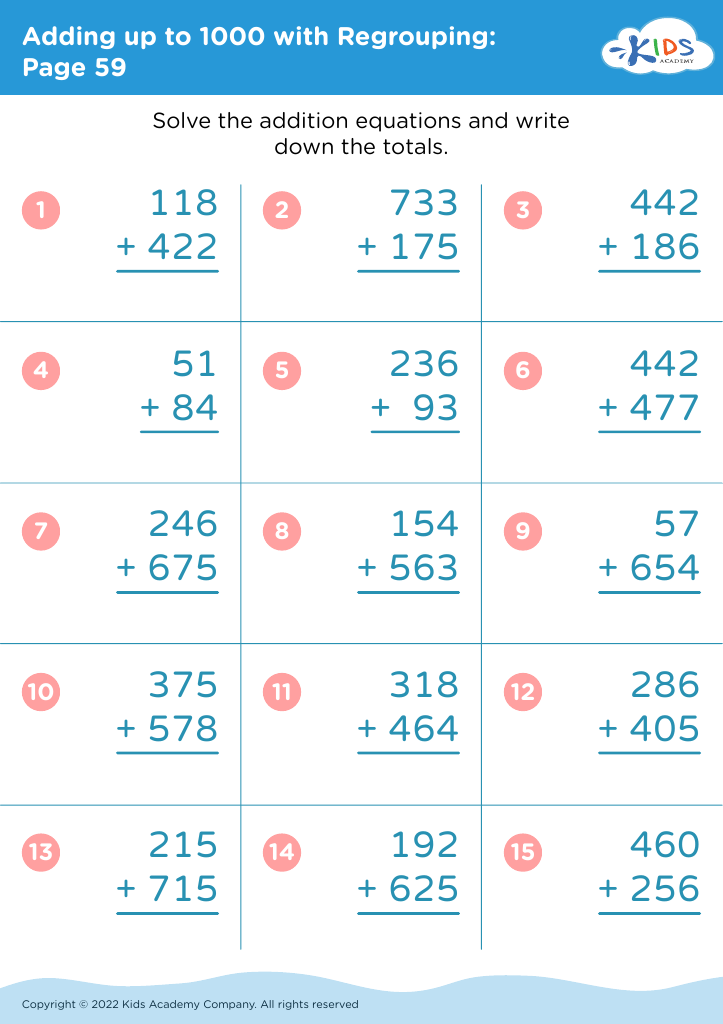



Visual interpretation in Grade 2, especially when it involves adding up to 1000, is crucial for children's cognitive and mathematical development. Understanding visual representation of numbers—through charts, number lines, or pictorial aids—helps young learners grasp abstract concepts more concretely. When parents and teachers emphasize this skill, they promote critical thinking and problem-solving abilities, enabling students to visualize math problems.
Moreover, visual interpretation aids in fostering number sense, which is essential for future math success. By seeing relationships between numbers and understanding how to represent them visually, students build a stronger foundation for arithmetic operations and develop confidence in tackling more complicated math tasks down the line.
Additionally, encouraging students to represent math visually can cater to various learning styles, particularly for those who may struggle with traditional methods. This inclusivity can enhance engagement, promote collaborative learning, and improve overall academic performance.
As Grade 2 students are becoming more independent thinkers, parental and teacher support in fostering visual interpretation not only aids in math understanding but also nurtures a love for learning. This foundational skill is a stepping stone toward their long-term educational growth and their ability to approach complex problems creatively.