Basic addition practice Grade 2 Adding up to 50 Without Regrouping Worksheets
3 filtered results
-
From - To
Engage your second graders with our "Basic Addition Practice Grade 2: Adding up to 50 Without Regrouping" worksheets. Designed to build essential math skills, these printable sheets challenge students to add numbers up to 50, reinforcing their understanding without the need for regrouping. Each worksheet offers a variety of problems that help kids develop accuracy and confidence in their math abilities. Perfect for classroom use or additional practice at home, these worksheets provide a solid foundation in addition principles. Browse now and support your child's arithmetic journey with fun, educational exercises that make learning math an enjoyable experience!
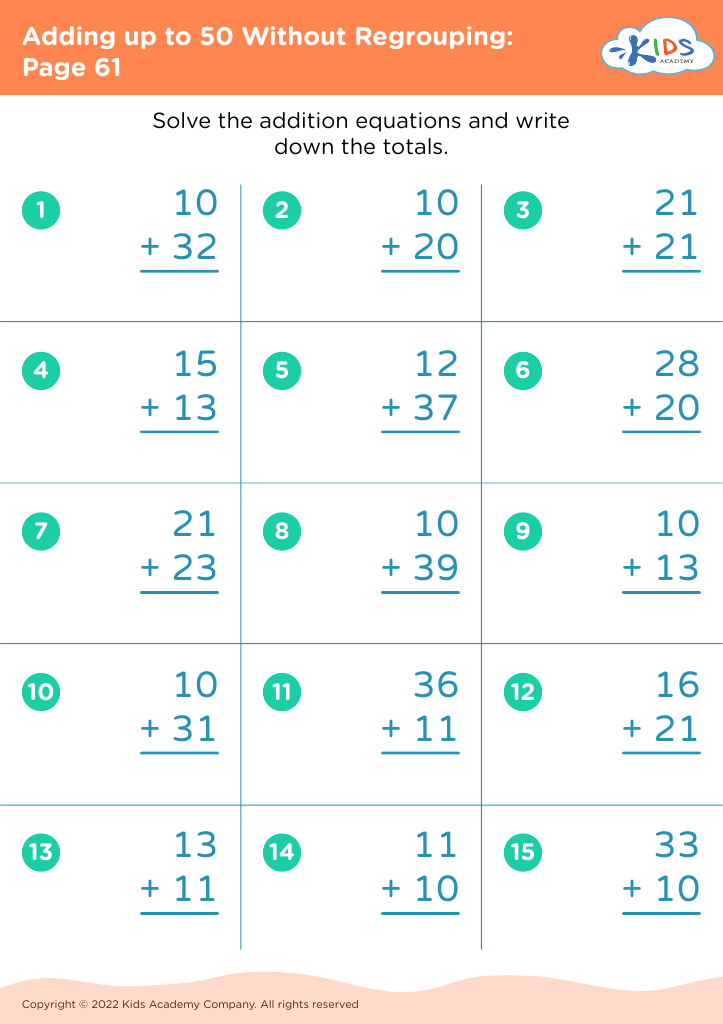
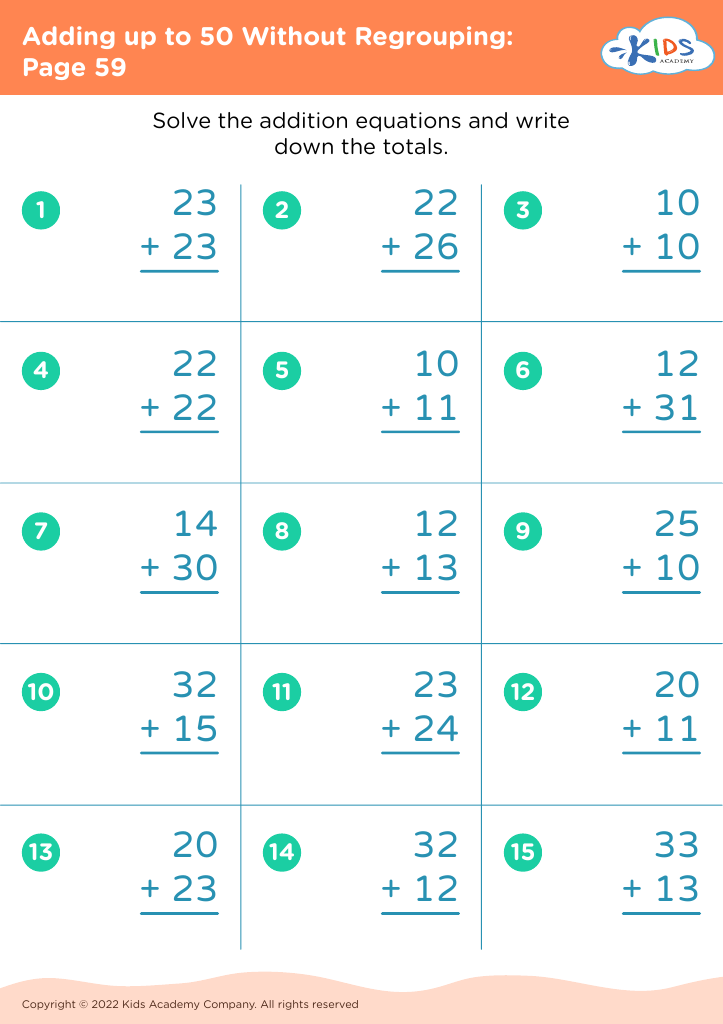
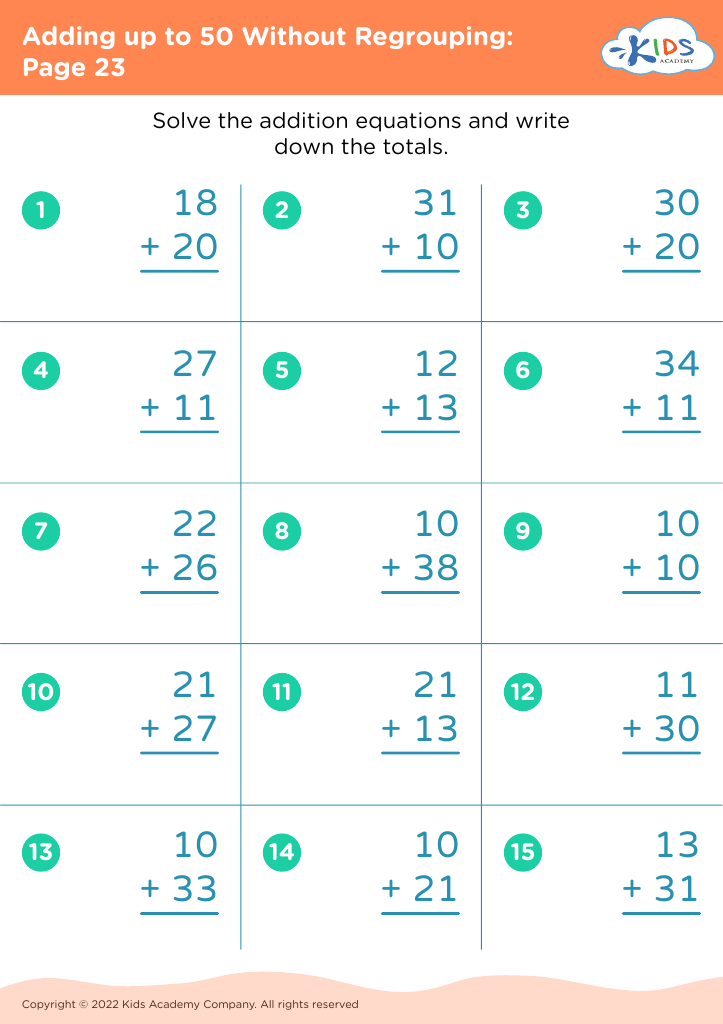


Parents and teachers should prioritize basic addition practice for second graders adding up to 50 without regrouping because it lays the groundwork for essential math skills. At this stage, children are transitioning from single-digit calculations to more complex problems, and mastering basic addition is crucial for their confidence and competence in mathematics.
Practice in this area enhances number sense, allowing children to understand the relationships between numbers and to see patterns, which are critical skills for future mathematical concepts. It also supports the development of problem-solving abilities, critical thinking, and logical reasoning. Moreover, frequent practice helps with memorization of addition facts, which aids in speed and fluency, making more challenging math operations, such as addition with regrouping and eventually subtraction, multiplication, and division, more manageable.
By ensuring children are comfortable with adding numbers up to 50 without regrouping, parents and teachers can prevent future struggles and build a robust foundation for all areas of mathematics. This fundamental skill will not only be useful academically but in everyday practical situations requiring quick and accurate calculations, fostering both academic success and practical life skills in young learners.