Recognizing equivalent fractions Grade 2 Adding up to 50 Worksheets
3 filtered results
-
From - To
Looking for a fun and engaging way to help your second graders recognize equivalent fractions while improving their addition skills? Our "Recognizing Equivalent Fractions Grade 2: Adding up to 50 Worksheets" are perfect for young learners! These expertly designed worksheets combine colorful visuals and interactive exercises to make learning fractions fun and accessible. Students will gain a solid grasp of equivalent fractions and improve their confidence in adding numbers up to 50. Great for classroom use or at-home practice, these worksheets provide a fantastic foundation for future math success. Download now to spark your child's interest in fractions and addition!
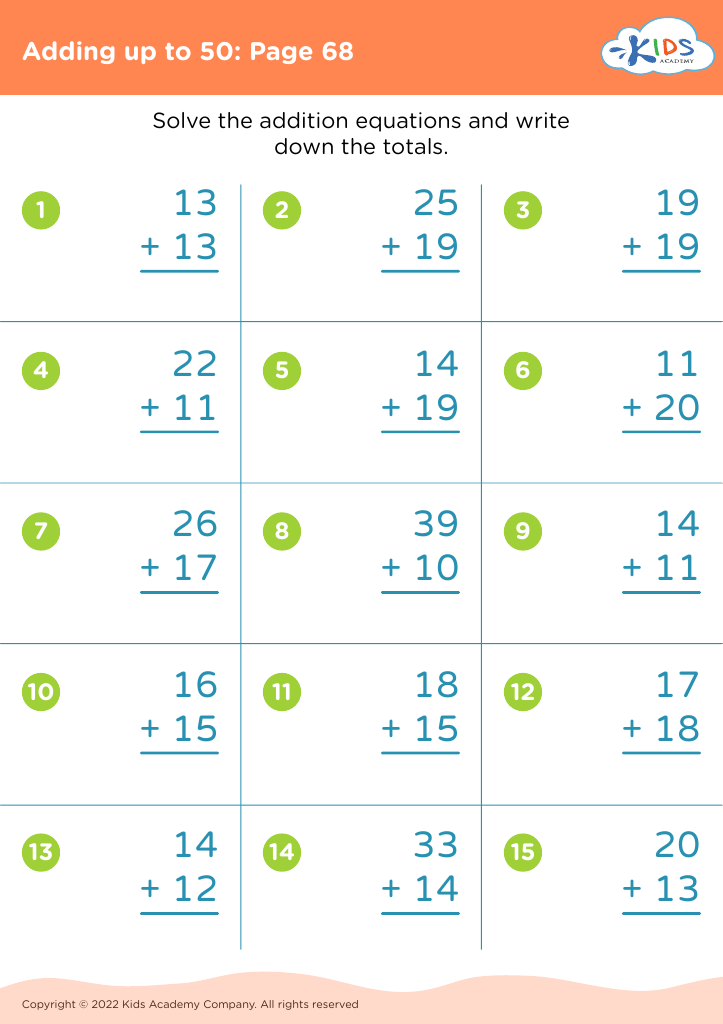
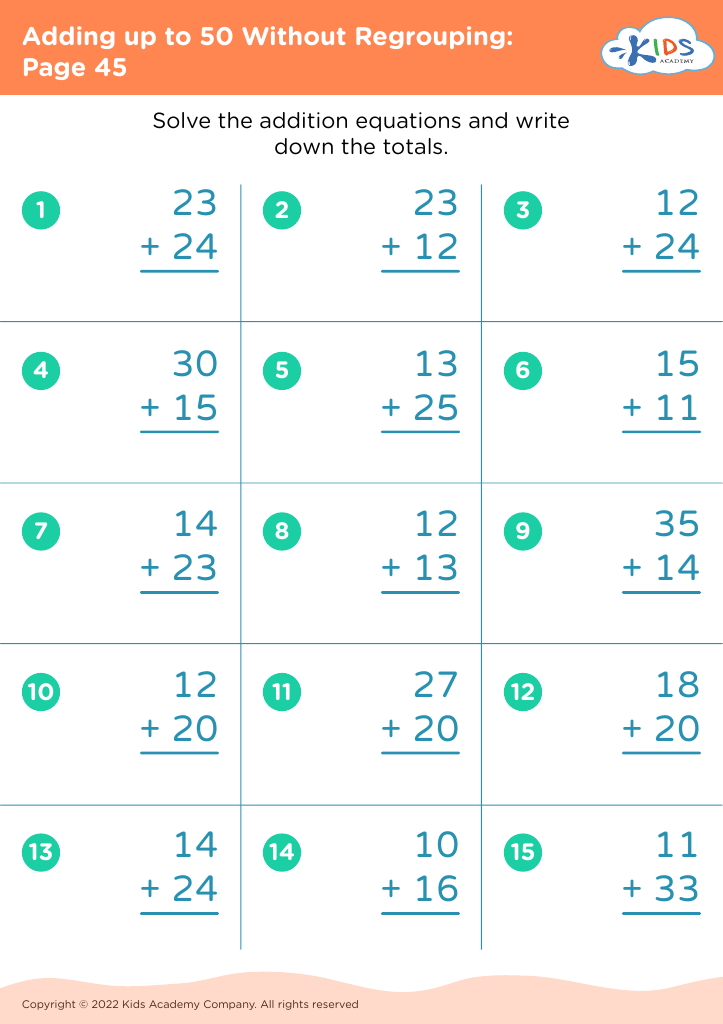
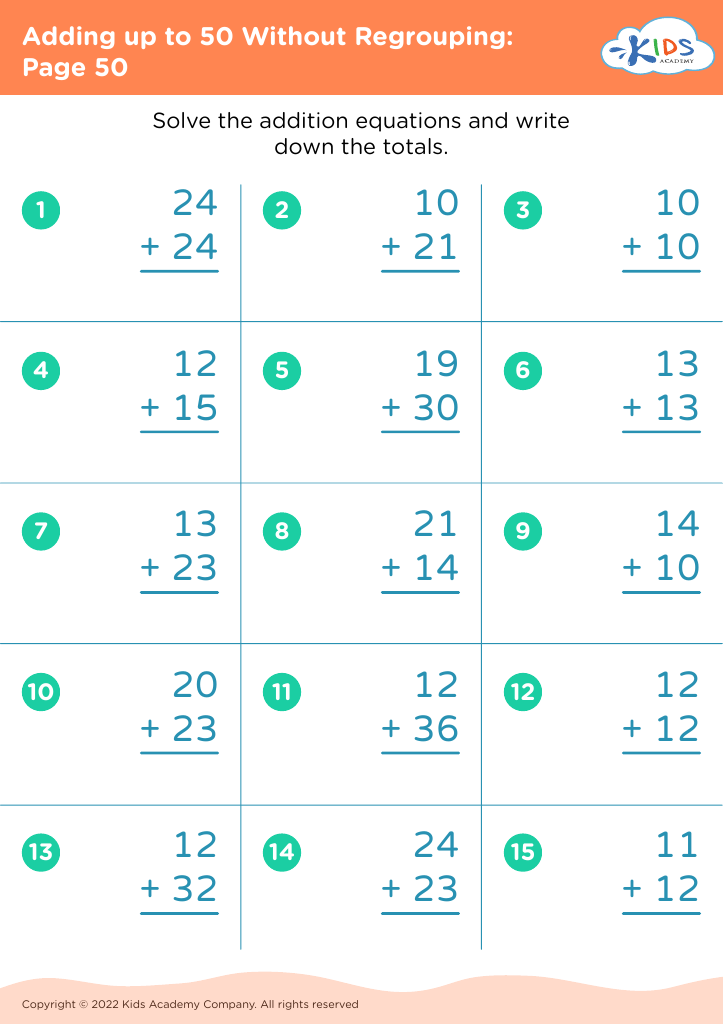


Recognizing equivalent fractions and mastering addition skills up to 50 in Grade 2 are crucial milestones that lay the foundation for a child's future success in mathematics and beyond. Firstly, understanding equivalent fractions fosters the development of a strong number sense. It helps children comprehend the concept of fractions and how different fractions can represent the same part of a whole, a skill essential for tackling more complex math problems later on.
In addition, the ability to recognize equivalent fractions early on aids in the simplification of mathematical problems, boosting a child's confidence and efficiency. This aptitude is not only valuable in academic settings but also in real-life scenarios, such as sharing food or dividing resources, where fair shares are split among groups.
Moreover, proficiency in adding numbers up to 50 strengthens basic arithmetic skills, a foundational competence. It enhances mental math abilities and speeds up problem-solving, making subsequent learning in higher grades easier and less stressful. This arithmetic competence forms the stepping stones to more advanced concepts in mathematics and other subjects, where calculation speed and accuracy are crucial.
Hence, parents and teachers should prioritize these skills to ensure that children build a robust mathematical foundation early on. This focus can foster a love for learning math and inspire confidence, setting students on a path of academic success.