Vocabulary expansion Grade 2 Adding up to 50 Worksheets
3 filtered results
-
From - To
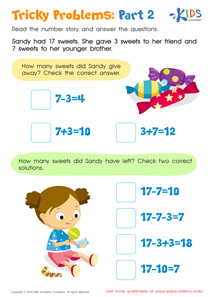
Enhance your Grade 2 students' vocabulary and math skills with our "Vocabulary Expansion: Adding Up to 50 Worksheets." Specifically designed for second graders, these engaging worksheets focus on key mathematical terms while reinforcing their addition skills. Students will learn essential vocabulary related to numbers, sums, and mathematical processes, empowering them to articulate their understanding of math concepts clearly. By incorporating fun illustrations and relatable examples, these worksheets make learning enjoyable and effective. Perfect for homework or classroom use, our resources support educational growth and foster a love for learning, laying a solid foundation for future math endeavours. Explore the activities today!
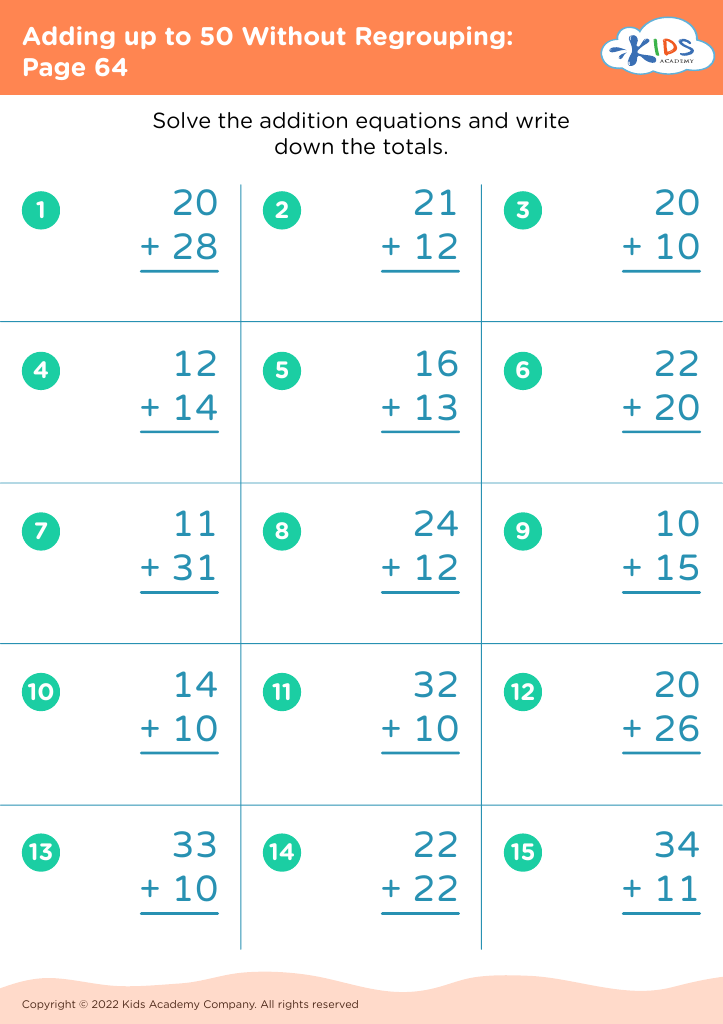
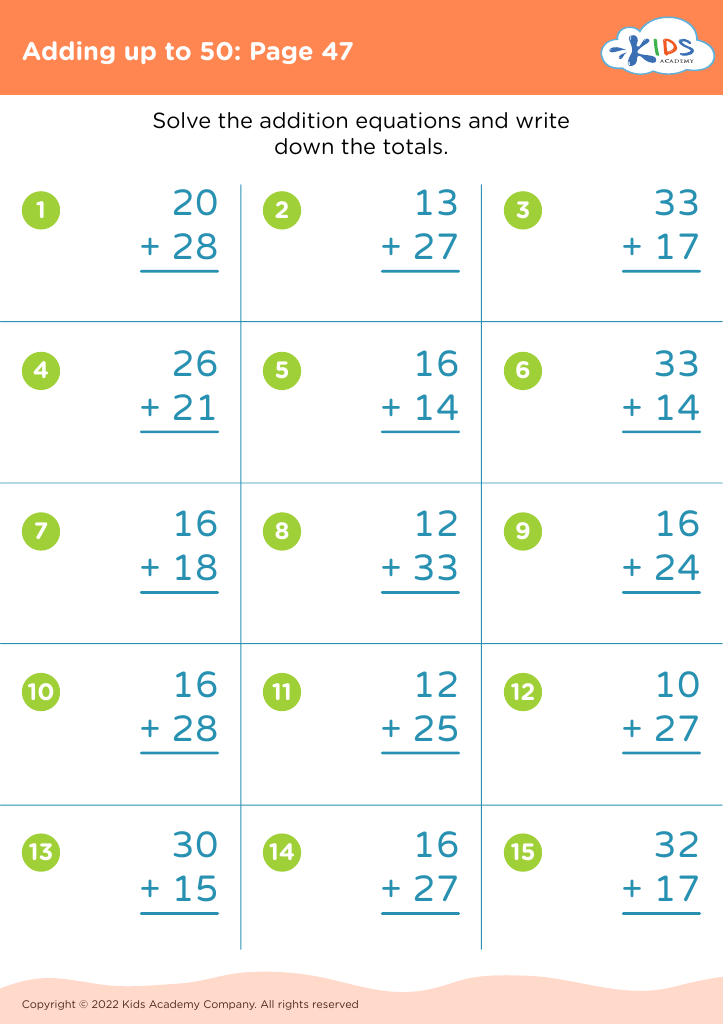
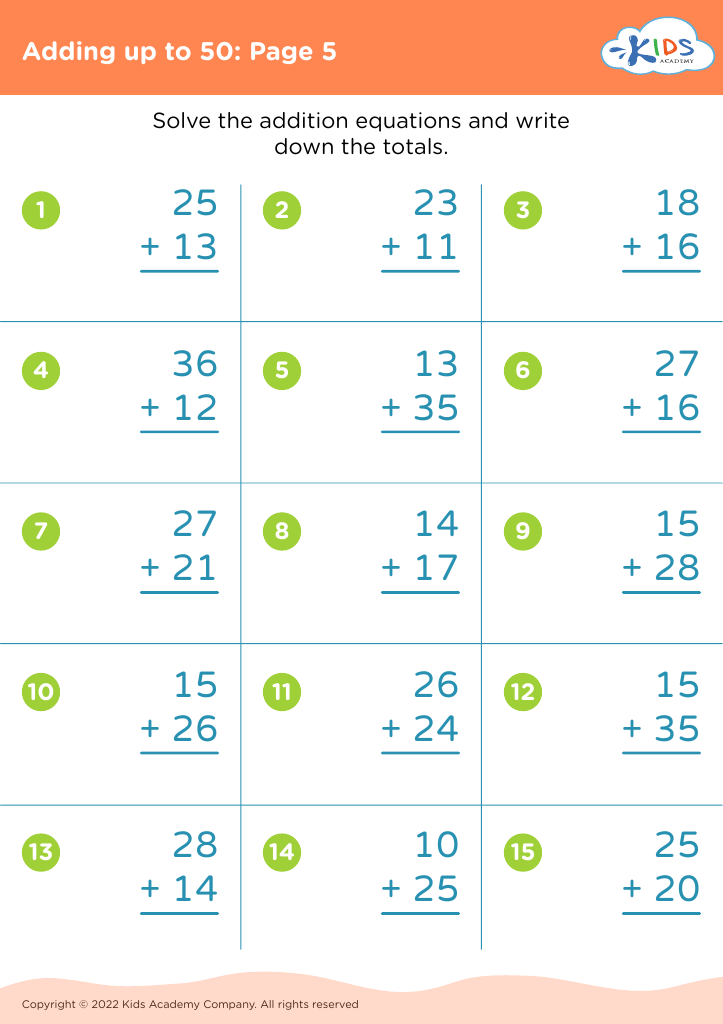


Vocabulary expansion in Grade 2 is crucial for several reasons, especially when it comes to subjects like mathematics, where students are learning to add numbers up to 50. When students develop a strong mathematical vocabulary, they gain a deeper understanding of mathematical concepts and the relationships between numbers. For instance, knowing terms such as "sum," "plus," "total," and "equals" not only helps them understand instructions but also streams their thought process during problem-solving.
Furthermore, a rich vocabulary aids in comprehension. When students encounter word problems involving addition, a robust vocabulary enables them to break down the problem accurately and identify necessary operations. It also builds confidence as students showcase their knowledge when articulating their reasoning and explaining their thought process.
Additionally, enhancing vocabulary at this grade level fosters overall language skills, providing students with tools to communicate effectively across disciplines. For parents and teachers, nurturing vocabulary growth transforms learning into an engaging social and cognitive experience. As students articulate their reasoning and experiences, they develop critical thinking skills essential for future academic success. Therefore, by prioritizing vocabulary expansion, parents and teachers are investing in the child’s holistic education, laying a foundation for lifelong learning.