Numerical reasoning Grade 2 Addition & Subtraction Worksheets
3 filtered results
-
From - To
Enhance your second grader's mathematical skills with our engaging Numerical Reasoning worksheets focused on addition and subtraction! Designed specifically for Grade 2 students, these interactive worksheets offer a variety of problems that improve critical thinking and problem-solving abilities. Children will practice their addition and subtraction skills in fun and challenging ways, promoting a deeper understanding of numerical concepts. Each worksheet is crafted to be age-appropriate, ensuring a perfect blend of challenge and support. Ideal for in-class activities or at-home practice, our resources will help young learners build confidence and proficiency in mathematics. Start your child’s math journey with us today!
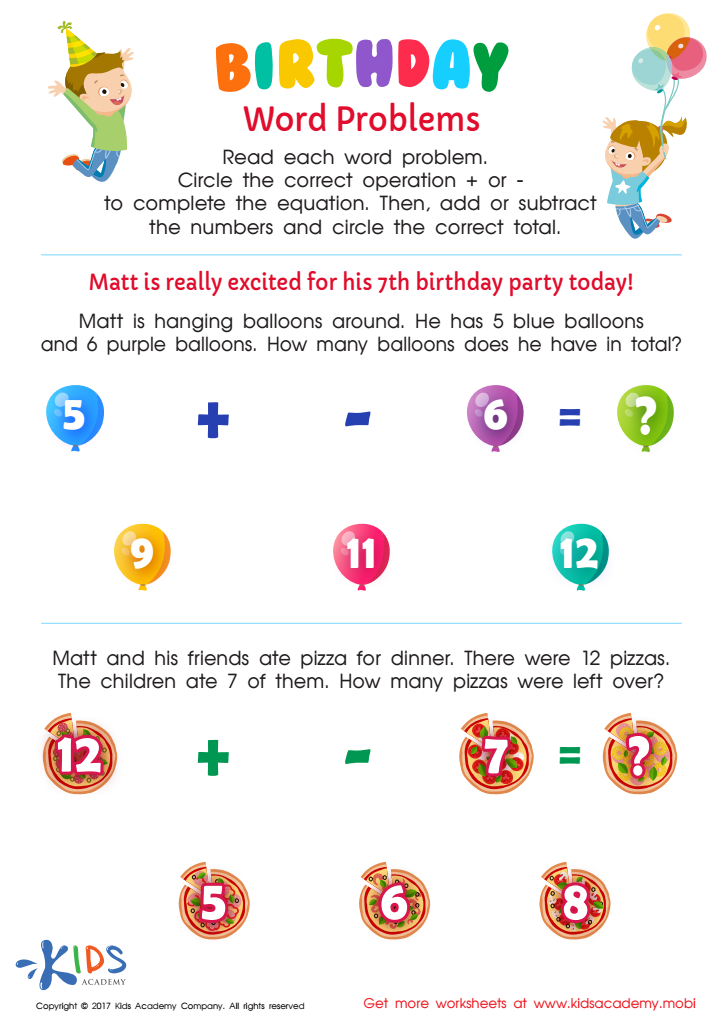
Birthday Word Problems Substraction Worksheet
 Assign to My Students








Parents and teachers should prioritize numerical reasoning, specifically Grade 2 addition and subtraction, because it lays the foundation for a child's mathematical understanding and problem-solving skills. At this critical stage, students not only learn to perform basic calculations but also develop the ability to think logically and make connections between numbers.
Introducing addition and subtraction concepts helps children grasp the idea of quantities, which is essential for everyday tasks like counting, measuring, and budgeting. These skills also support more complex mathematical concepts they will encounter in later grades, ensuring a smoother academic journey.
Moreover, proficiency in addition and subtraction builds confidence in young learners, making them more willing to engage with math. When children feel secure in their numerical abilities, they are more likely to develop a positive attitude toward mathematics overall.
Additionally, numerical reasoning enhances critical thinking and promotes skills used in real-life situations, such as problem-solving and decision-making. By fostering a strong foundation in mathematical fundamentals, parents and teachers can help students become not only adept at math but also enthusiastic and capable learners, equipping them for future academic challenges and life skills.