Fraction identification Grade 2 Math Worksheets
6 filtered results
-
From - To
Explore our engaging Grade 2 Math Worksheets focused on fraction identification! Designed to reinforce essential math skills, these worksheets help young learners understand the concept of fractions through fun exercises and activities. Students will practice identifying, comparing, and representing fractions, making math enjoyable and interactive. Our carefully crafted worksheets cater to different learning styles, ensuring that every child can grasp the basics of fractions. Perfect for classroom use or at-home practice, these resources aim to build confidence and proficiency in math. Discover a variety of worksheets that make learning fractions a delightful experience for your second grader!
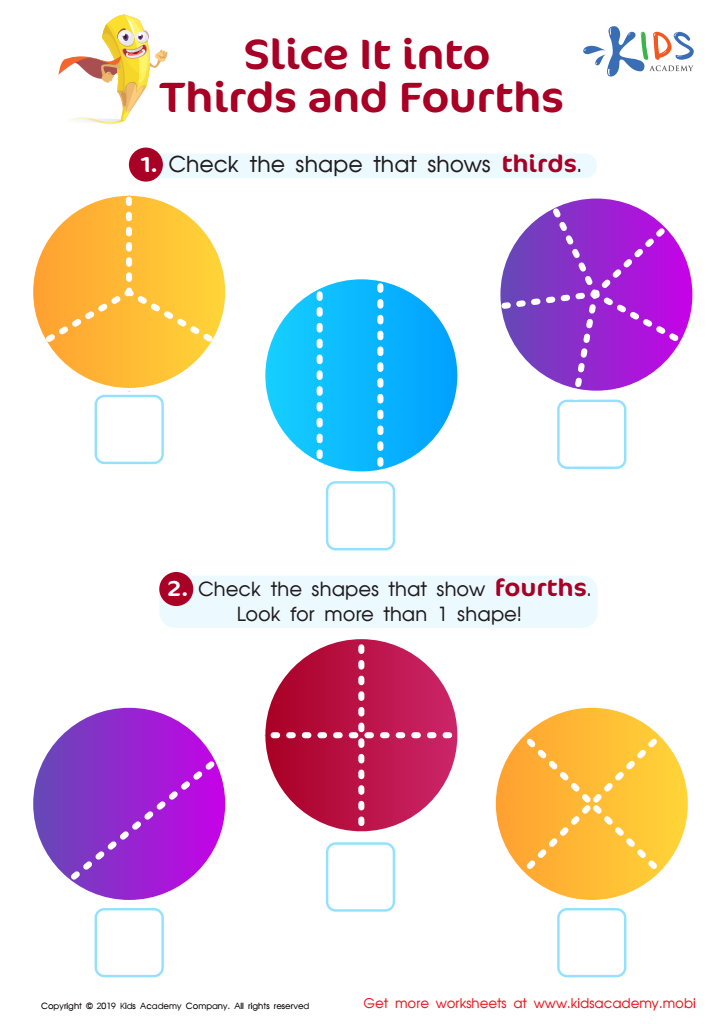
Slice in Thirds Fourths Worksheet
 Assign to My Students







Parents and teachers should care about fraction identification in Grade 2 math because it lays a crucial foundation for a child’s numerical literacy and overall mathematical understanding. At this stage, children begin to explore the concept of parts and wholes, which directly relates to their ability to recognize, compare, and operate with fractions in more advanced mathematical contexts.
Understanding fractions helps students make sense of everyday situations, such as sharing food, dividing objects, or measuring ingredients. These practical applications foster a sense of relevance and engagement, making math more relatable and enjoyable. Furthermore, fraction identification promotes critical thinking and problem-solving skills. As students learn to categorize and manipulate fractions, they develop their cognitive abilities and learn how to approach challenges systematically.
Moreover, early competency in fractions is vital as it sets the groundwork for more complex concepts in later grades, such as addition, subtraction, multiplication, and division of fractions. Early intervention can identify potential struggles and enable supportive strategies, ensuring students build confidence and competence in mathematics. When parents and teachers collaborate to emphasize the importance of fractional knowledge, they create a supportive environment that encourages curiosity and lifelong learning in mathematics.