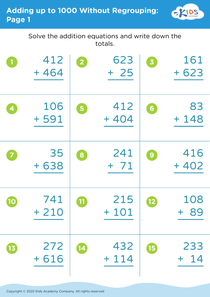
Mathematical reasoning Grade 3 Adding up to 1000 with Regrouping Worksheets
3 filtered results
-
From - To
Enhance your third grader's mathematical reasoning skills with our engaging "Adding up to 1000 with Regrouping Worksheets." These printable resources help students grasp the concept of regrouping, essential for mastering addition of larger numbers. With fun, colorful exercises, children can practice their addition skills in an interactive way, building confidence and fluency. Our worksheets reflect real-life scenarios to make learning meaningful and enjoyable. Ideal for classroom activities or at-home practice, these resources encourage critical thinking and problem-solving. Download our comprehensive worksheets today and support your child's journey toward numerical proficiency and mathematical understanding!
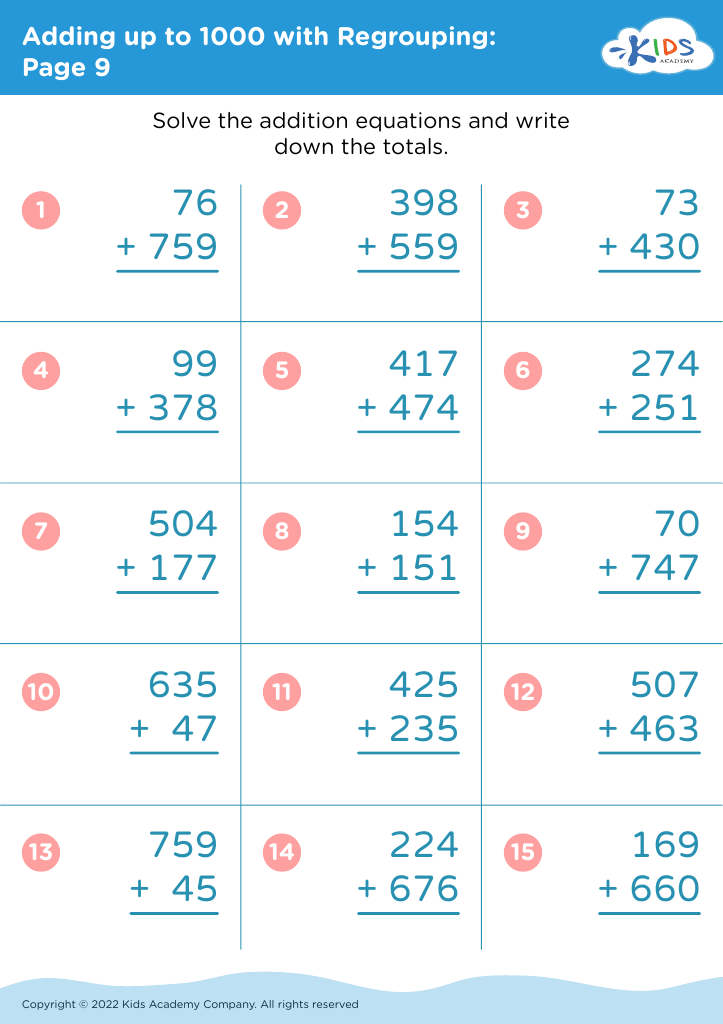
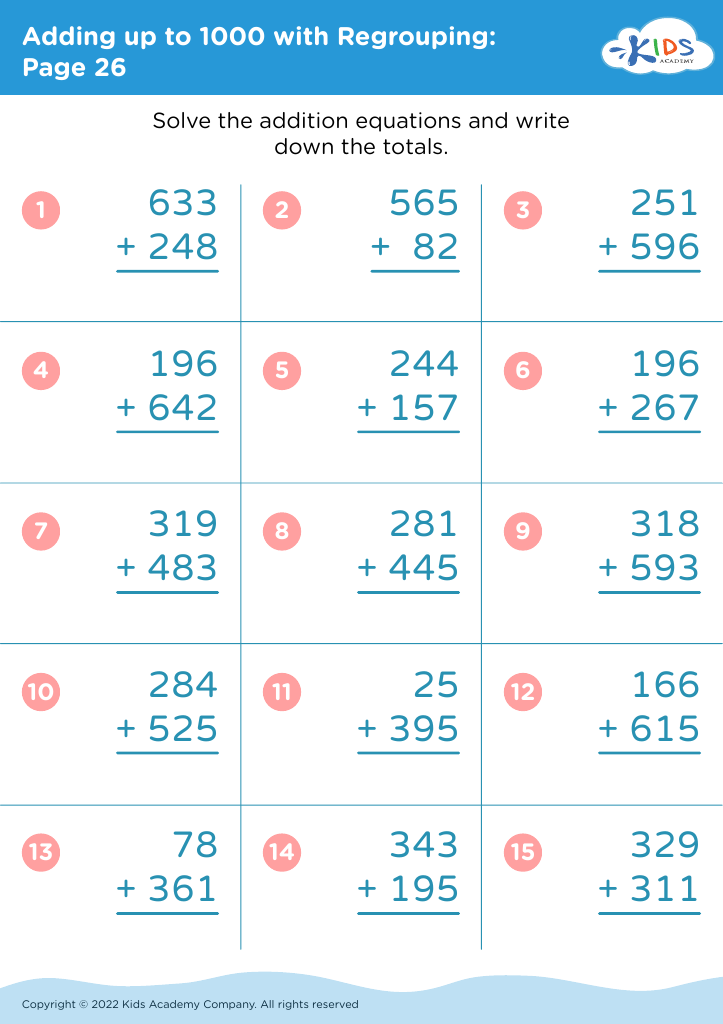
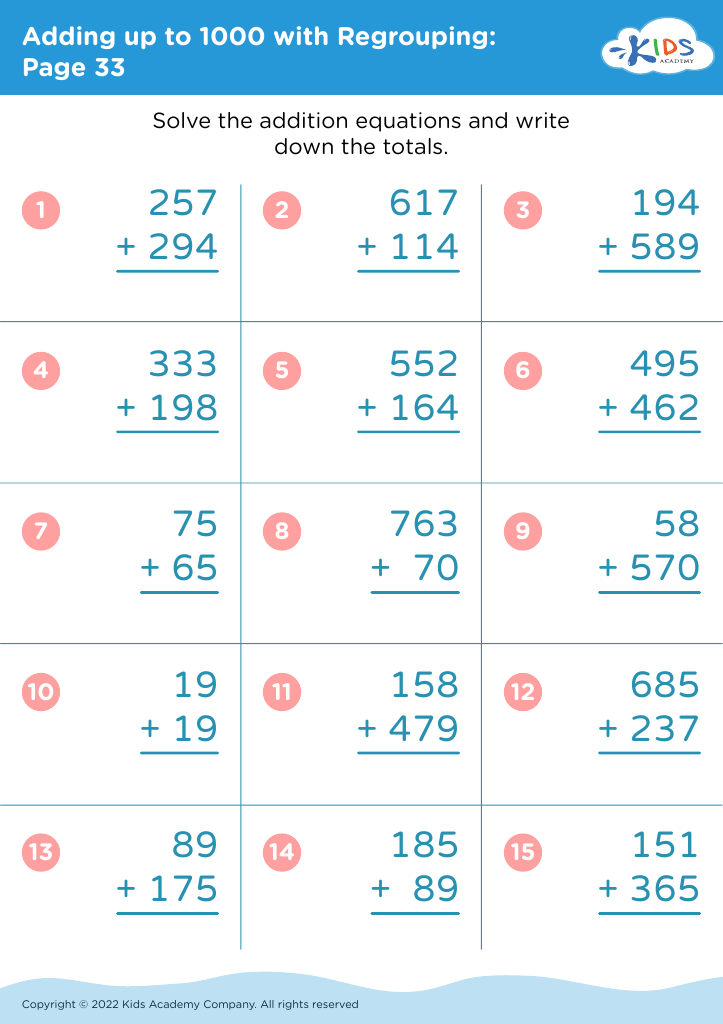


Mathematical reasoning, especially at the grade 3 level, is crucial for developing a strong foundation in mathematics. The concept of adding up to 1000 with regrouping introduces students to foundational skills such as place value, number relationships, and critical problem-solving. Understanding how to regroup facilitates their ability to handle more complex mathematical operations in the future, laying the groundwork for topics like addition of larger numbers, multiplication, and even algebra.
For parents and teachers, nurturing mathematical reasoning ensures that children gain confidence in their abilities. As students learn to break down numbers and manipulate them thoughtfully (e.g., regrouping from tens to hundreds), they develop resilience in facing challenges and finding solutions. This skill extends beyond math—enhancing logical thinking, agility in reasoning, and the ability to navigate real-world problems.
Moreover, proficient math reasoning contributes positively to academic success across subjects, supports standardized testing preparations, and encourages a positive attitude toward learning. By prioritizing these skills early on, parents and teachers help children cultivate a robust mathematical mindset that serves them well throughout their education and everyday life. Investing time in mathematical reasoning is an investment in a child's cognitive development and lifelong learning potential.