Comparing Fractions Grade 3 Adding up to 1000 Without Regrouping Worksheets
3 filtered results
-
From - To
Discover engaging Third Grade multiplication worksheets designed for mastering comparing fractions and adding up to 1000 without regrouping. These carefully crafted worksheets support your child's learning by making complex concepts simple and fun. Your child will confidently compare fractions with ease and skillfully perform addition, building a strong mathematical foundation. Each worksheet is designed to enhance proficiency and foster a love for math through engaging exercises and practice problems. Perfect for at-home learning, these resources ensure your child stays ahead and fully understands essential math concepts. Unlock your child’s potential today with our comprehensive worksheets!
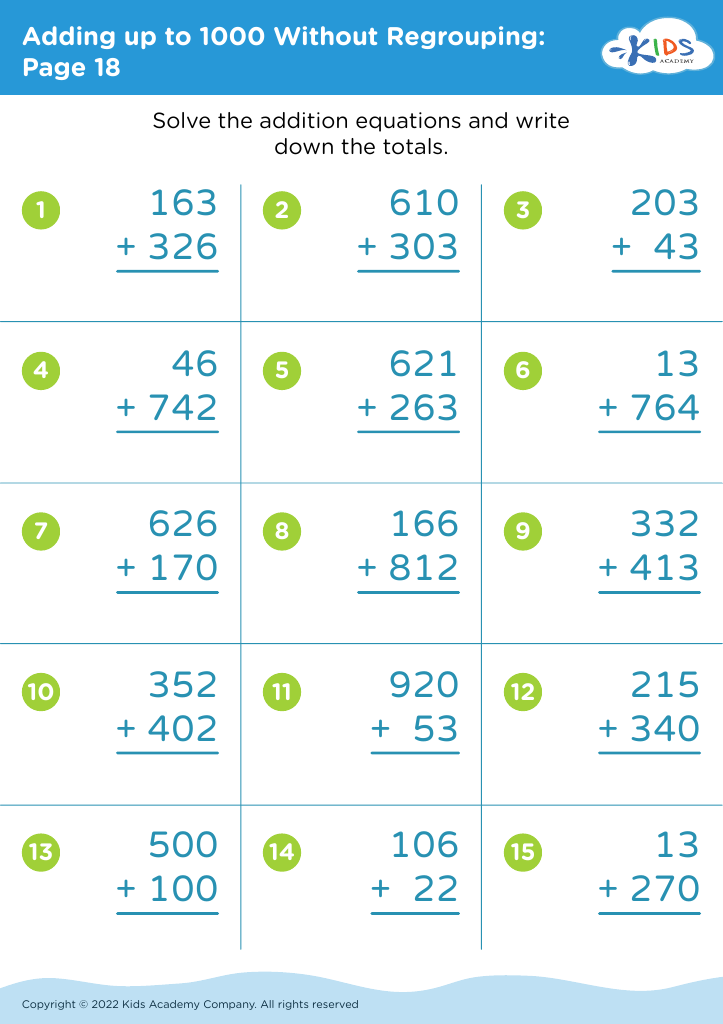
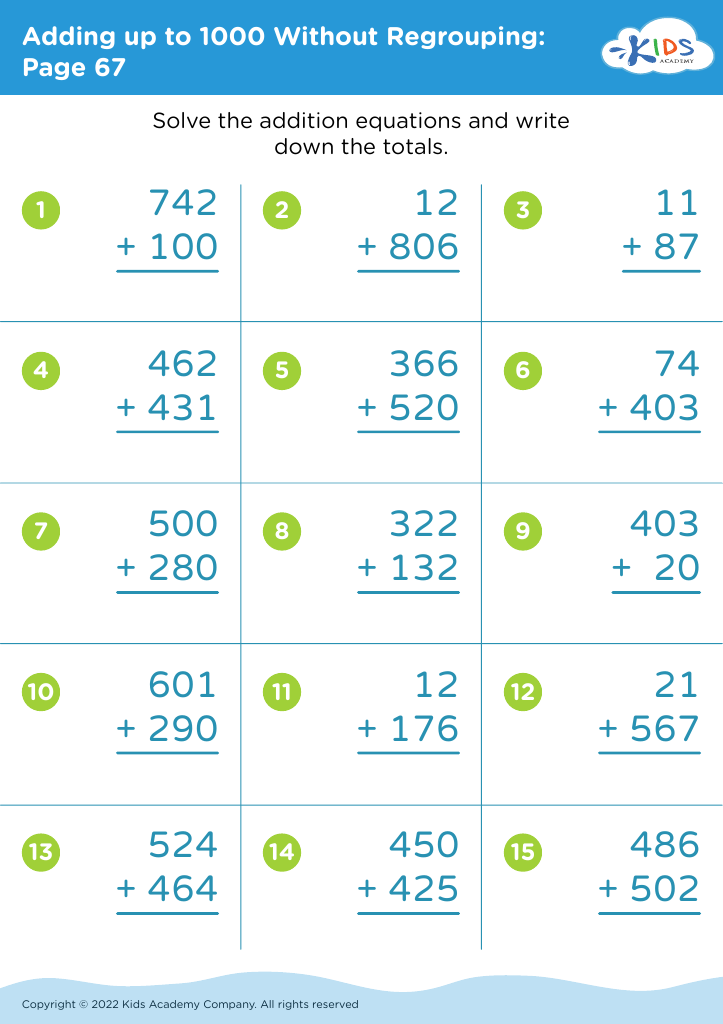
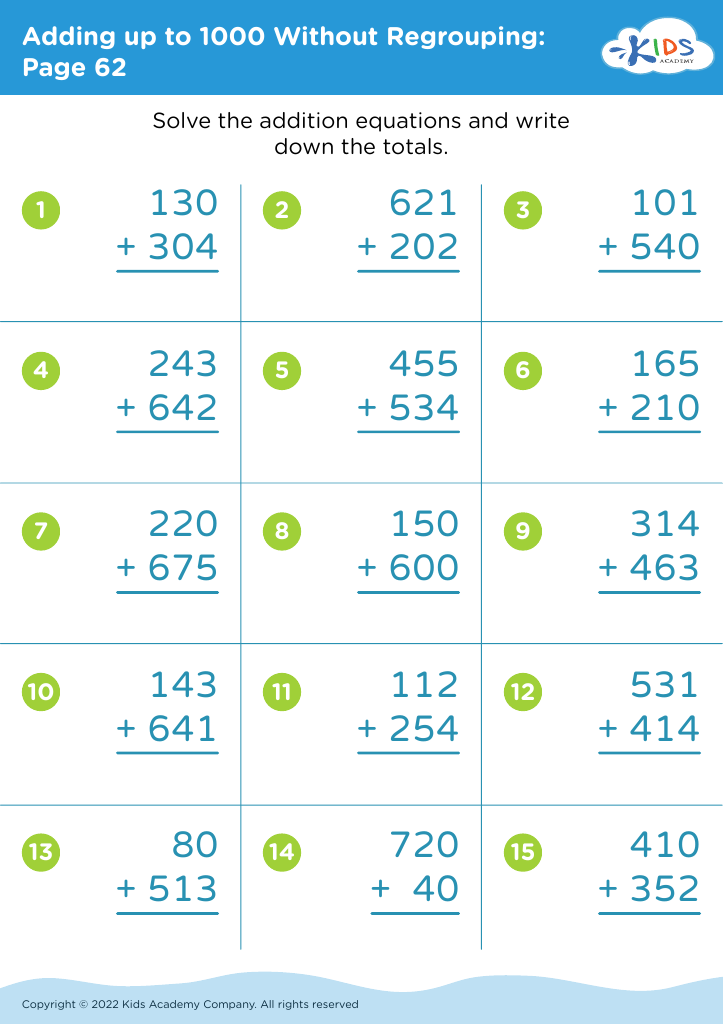


Parents and teachers caring about comparing fractions and adding up to 1000 without regrouping in Grade 3 is crucial for several reasons.
Firstly, learning to compare fractions helps children develop a deeper understanding of numerical relationships and proportional reasoning. This forms a foundational mathematical skill that paves the way for more advanced topics like ratios, percentages, and algebra. Comparing fractions also strengthens their conceptual understanding of fractions as parts of a whole, which is critical for solving real-life problems.
Secondly, adding numbers up to 1000 without regrouping is an essential arithmetic skill that reinforces place value understanding. This practice develops children's ability to perform basic calculations quickly and accurately, which boosts their confidence and sets the stage for more complex operations. Being proficient in such calculations helps students grasp the bigger picture in math, making it easier for them to tackle word problems and perform mental math.
Together, these skills enhance critical thinking and problem-solving abilities. By mastering comparing fractions and adding large numbers early, children build a solid mathematical foundation necessary for future learning. Therefore, parents and teachers should prioritize these skills to ensure students' long-term academic success and confidence in tackling more complex mathematical concepts.